
Power Module Heatsinks · Comparison
Natural-Convection vs Forced-Air Heatsinks for Power Modules
Natural-Convection vs Forced-Air Heatsinks for Power Modules starts with the system question: When does the thermal design require airflow rather than passive cooling? A useful selection brief connects the equipment duty, installation and receiving system to a specific orderable product. The article below separates project inputs from product evidence so that a familiar product name does not quietly become a technical approval.
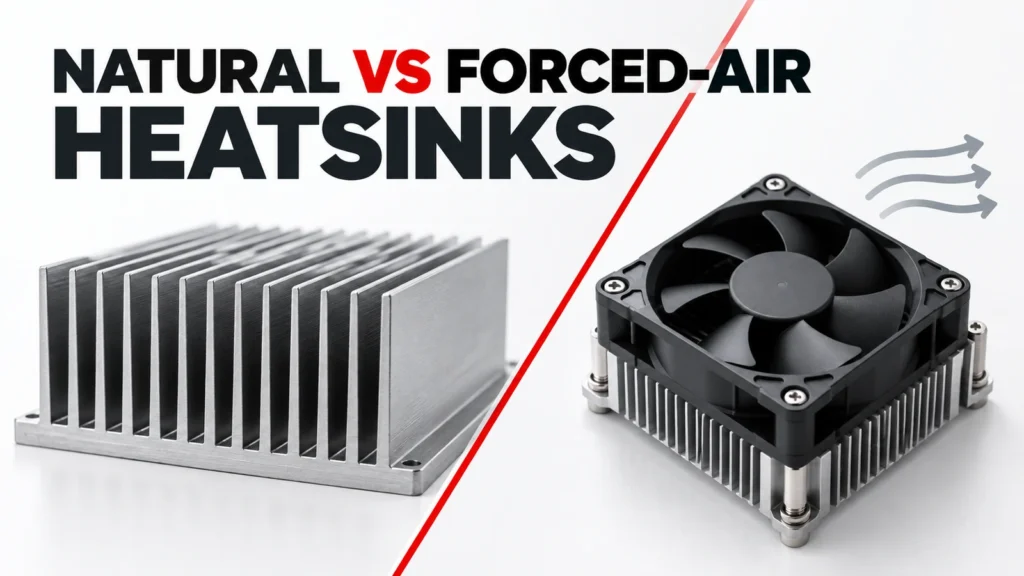
This comparison explains the thermal design evidence required to choose passive or forced-air heatsinking. It gives no universal heat dissipation rating, airflow value, thermal resistance or fan lifetime for a product without exact test conditions.
Короткий огляд даних, що враховуються при прийнятті рішень
| Область огляду | Вхідні дані проекту | Докази, які слід вимагати |
|---|---|---|
| DEVICE LOSS | Визначити фактичний робочий стан та межі системи | Затверджений креслення системи або журнал експлуатації |
| INTERFACE | Вкажіть інтерфейс, геометрію або очікувані параметри керування | Точна документація щодо обладнання або продукції |
| HEATSINK | Стан навколишнього середовища та умови встановлення | Креслення об’єкта або панелі |
| AMBIENT | Опишіть вимоги до обслуговування та приймання | Чіткі інструкції та план тестування |
Two cooling methods, one thermal obligation
A natural-convection heatsink transfers heat to surrounding air without a dedicated fan moving air through its fins. A forced-air heatsink uses directed airflow to change that transfer condition. The practical choice is not determined by appearance or the word “power” in a module description. It depends on verified semiconductor loss, allowable temperatures, ambient conditions, mounting and the entire thermal path.
Both approaches can be appropriate in industrial equipment. Passive cooling avoids dependence on a fan, but often requires a compatible installation orientation, space and ambient. Forced air can support a different heat-transfer condition, but introduces airflow, power, acoustic, filtration, service and failure-state questions. The exact device data decides whether either approach has sufficient margin.
Calculate losses before comparing fin shapes
The starting input is the power module’s heat dissipation under representative operating states. Obtain loss information for the exact semiconductor order code and the intended electrical duty. A nameplate current or visually large package does not equal the heat that must leave the assembly. Include continuous and relevant transient conditions in the project brief.
Document whether the module is an SCR, rectifier, diode or another device, because conduction and switching behavior may differ. If the loss model is uncertain, do not backfill a generic wattage. Identify the missing curve or supplier calculation and treat the heatsink selection as provisional until it is supplied.
Trace the complete thermal path
Heat moves from junction through the device package, mounting interface and heatsink into the surrounding air. Each boundary needs evidence. The mechanical contact, approved interface material, mounting pressure and surface condition affect the result, as does the airflow or convection environment at the fins. A quoted heatsink value without its test conditions is not transferable to every assembly.
Ask for the exact thermal data, mounting instructions and a drawing that shows contact area and clearances. Compare the semiconductor’s allowable temperature with the proposed operating states using the supplier’s method. Reserve a prototype temperature check for conditions that are difficult to model, such as a densely populated enclosure or uncertain local air recirculation.
Natural convection needs a real installation context
Passive performance depends on how air can enter, warm and leave the fin channels. Orientation, vertical clearance, adjacent equipment and enclosure temperature may change the result materially. A bench test in open air may not describe a crowded cabinet with nearby heat sources. Define the actual mounting plane and free space before accepting a catalog thermal curve.
The system should also account for warm-start and high-ambient conditions. The passive option may be attractive where fan maintenance is difficult, but simplicity does not waive a thermal check. If the only available data describes a different orientation or ambient, request an applicable test or engineering review.
Forced air is an operating system, not an accessory
A fan rating quoted in free air does not reveal the flow through a heatsink inside a cabinet. Filters, grilles, duct turns, neighboring components and air recirculation can restrict the actual path. Request the fan curve and heatsink performance under documented airflow conditions, then evaluate the assembled path rather than adding nominal component values.
Decide who monitors fan operation and what the equipment does when airflow is lost. A forced-air design can be valid only if its power supply, wiring, maintenance access, replacement plan and alarm behavior are accepted by the project. Include these controls in the quotation and assembly test plan.
Compare reliability and service honestly
A passive design can reduce moving parts but may use more volume and still require clean air passages. A forced-air design can fit a different thermal envelope but needs fan and filter inspection. Dust accumulation affects both fin exposure and the airflow system. State the intended service interval as a project decision, not as an invented universal product property.
Procurement should compare delivered scope: heatsink extrusion, machining, mounting hardware, interface material, fan, guard, filter and cables. Two quotes for “the same heatsink” may include different work. Normalize those inclusions before comparing lead time or price.
Confirm with an assembly-level temperature test
A calculation screens candidates; a representative assembly test closes uncertainty. Measure the relevant points under the operating states and ambient conditions specified by the project engineer, and record how the result maps to the exact device limit. Do not substitute an enclosure air reading for a junction calculation without a supported method.
The test record should identify the exact semiconductor, heatsink, fan configuration if used, mounting material, orientation and enclosure state. A later change to any of these inputs can invalidate the result. Keep the approved thermal configuration with the product build documentation.
Створити файл доказів на основі точної моделі
For the proposed Power Module Heatsink, create one approval record with the complete order code, the exact datasheet, the relevant drawing, installation instructions and any curve or test report used for the decision. Date each file or record its revision. A product-family page is useful for discovery, but it does not prove that a particular configuration includes an optional feature or meets a system condition.
Порівнюйте кожну вимогу з даними щодо того самого товару, який можна замовити. Не поєднуйте максимальне значення для серії, вказане для одного варіанту, зі схемою, переліком аксесуарів або тепловою кривою іншого варіанту. Поля, щодо яких не отримано відповіді, вкажіть у видимій колонці для уточнення. Якщо постачальник пропонує замінник, повторіть відповідну перевірку перед затвердженням його технічної еквівалентності.
Розділяйте вхідні дані проєкту та рахунки-фактури постачальників
Команда проекту відповідає за документацію щодо застосування: джерело та завантаження, робочі стани, середовище, монтаж, засоби керування, критерії обслуговування та приймання. Постачальник відповідає за запропонований код замовлення та підтверджуючу документацію щодо пристрою. Жодна зі сторін не повинна заповнювати прогалини, роблячи висновки на основі зовнішнього вигляду або знайомого сімейного імені. Корисною відповіддю може бути “дані ще не доступні”, за умови, що відсутній елемент має відповідального та дату завершення.
Зафіксуйте ці дані на час порівняння пропозицій. Якщо відбудуться зміни в режимі експлуатації, шафі, джерелі живлення, лічильнику, двигуні або схемі захисту, видайте оновлений специфікаційний лист і попросіть кожного постачальника ще раз підтвердити свою пропозицію. Це запобігає тому, щоб попередня пропозиція розглядалася як затвердження для подальшого проектування.
Як порівняти пропозиції постачальників
| Товар у пропозиції | Що порівнювати | Докази затвердження |
|---|---|---|
| Область дії, що підлягає упорядкуванню | Повний комплект та аксесуари, що входять до комплекту | Точна кошторис та специфікація матеріалів |
| Електромонтаж | Усі можливі режими роботи | Документ із точними номінальними значеннями, схемою або характеристикою |
| Механічне прилягання | Кріплення, клеми та доступ | Інструкції з монтажу та установки |
| План обслуговування | Метод перевірки та заміни | Інструкції з технічного обслуговування |
| Незавершені питання | Припущення, виключення та винятки | Реєстр письмових роз’яснень |
Normalize each Power Module Heatsink offer to the same application record. A shorter lead time or lower price is meaningful only after the technical scope is comparable. Record whether each supplier included the required accessories, documents and support for commissioning. Keep exceptions explicit, especially when the candidate needs a change to the panel or control design.
Етапи закупівлі та введення в експлуатацію
- Підтвердьте межі системи, робочі стани та критерії прийнятності.
- Порівняти код одного повного замовлення з документацією щодо конкретної моделі.
- Усувайте несправності електричного, механічного, екологічного характеру та пов’язані з обслуговуванням.
- Порівняйте обсяг робіт, що надаються, та зміни в документації у різних пропозиціях.
- Порівняйте отриманий товар із затвердженим записом.
- Проведіть випробування готового вузла відповідно до затвердженої процедури проекту.
Під час вхідного контролю слід перевірити, чи відповідають поставлені етикетки, клеми, комплектуючі та документація затвердженому замовленню. Заміна на виріб того самого сімейства не є автоматично прийнятною. Під час введення в експлуатацію слід перевірити функції, що залежать від конкретного застосування, які неможливо встановити лише на основі технічної документації до компонентів. У плані випробувань слід вказати типові стани та критерії прийнятності, не встановлюючи універсальних обмежень.
Перелік питань для підготовки запиту на пропозицію
A useful request for quotation on natural convection vs forced air heatsink is concise but complete. Ask for the exact orderable configuration and list unknown values as questions. Do not let the sales description silently answer a technical question that belongs to a calculation, a drawing or a test.
- DEVICE LOSS
- INTERFACE
- HEATSINK
- AMBIENT
- FAN CURVE
- RESTRICTION
- FAILURE MODE
- TEST
- Діючі редакції документів
- Кількість, місце призначення та обсяг поставки
Попросіть постачальника окремо вказати винятки, припущення та необов’язкові позиції. Зберігайте протокол технічних уточнень разом із комерційною пропозицією, щоб відділи закупівель та інженерії розглядали один і той самий обсяг робіт. Якщо все ще бракує важливої інформації, кандидат може залишатися комерційно привабливим, але питання його технічного затвердження залишається відкритим.
Поширені запитання
Can a Power Module Heatsink be chosen from one headline rating?
Ні. Заявку, точну конфігурацію та відповідні електричні, механічні, теплові та екологічні умови необхідно розглядати в комплексі. Назва в каталозі є лише відправною точкою для вивчення, а не повним документом про затвердження.
Чи є сімейна сторінка доказом безпосереднього зв’язку чи причетності?
Ні. Слід використовувати запропонований код замовлення, а також актуальний креслення, технічні характеристики та інструкцію з монтажу. Додаткові функції або альтернативні варіанти розташування клем можуть відрізнятися в межах однієї серії.
А що, якщо постачальник не зможе надати одне з необхідних значень?
Позначте це значення як «невизначене», визначте, хто його отримає, та призупиніть прийняття відповідного рішення. Не перетворюйте припущення на підтверджене твердження лише тому, що наближається дата придбання.
Де продовжити огляд
Переглянути Power Module Heatsink category для наявної серії продуктів, а потім перегляньте сторінка з подібними товарами як орієнтовну відправну точку. На цих сторінках вказано комерційне призначення; точні зразки документів визначають придатність застосування. Для порівняння конкретного проєкту надішліть вихідні дані системи та відкриті питання через Сторінка запитів RITOKS.
Якщо після аналізу даних виявиться, що інший пристрій або метод є більш підходящим, внесіть зміни до технічного завдання, перш ніж звертатися з проханням про заміну. Забезпечте відповідність документації остаточній схемі та монтажу, а не лише серії виробів, яка спочатку привернула увагу.