
Power Module Heatsinks · Comparison
Natural-Convection vs Forced-Air Heatsinks for Power Modules
Natural-Convection vs Forced-Air Heatsinks for Power Modules starts with the system question: When does the thermal design require airflow rather than passive cooling? A useful selection brief connects the equipment duty, installation and receiving system to a specific orderable product. The article below separates project inputs from product evidence so that a familiar product name does not quietly become a technical approval.
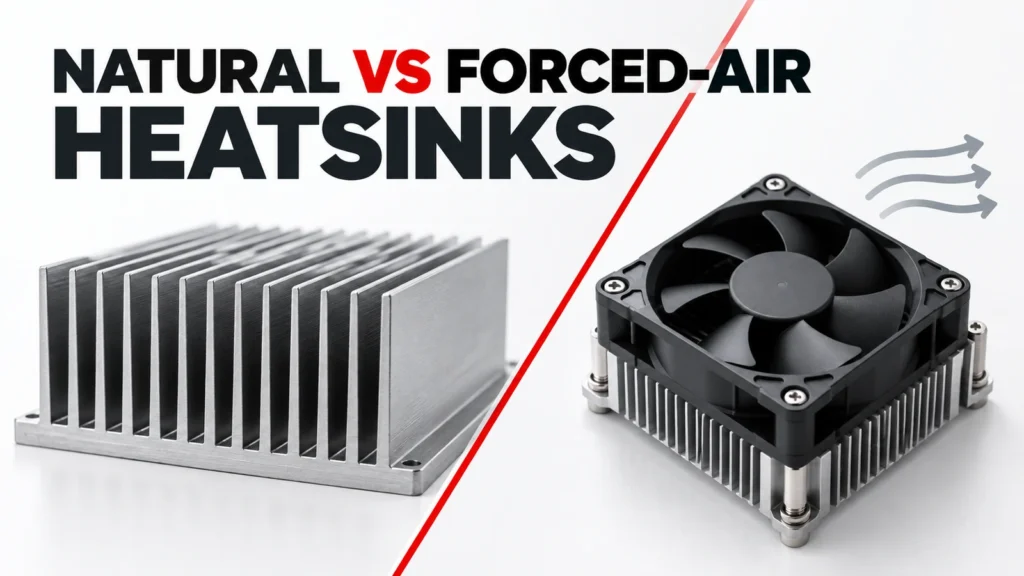
This comparison explains the thermal design evidence required to choose passive or forced-air heatsinking. It gives no universal heat dissipation rating, airflow value, thermal resistance or fan lifetime for a product without exact test conditions.
Sekilas tentang Masukan Pengambilan Keputusan
| Area ulasan | Masukan proyek | Bukti yang perlu diminta |
|---|---|---|
| DEVICE LOSS | Tentukan kondisi operasi aktual dan batas sistem | Gambar sistem yang telah disetujui atau catatan tugas |
| INTERFACE | Sebutkan antarmuka, geometri, atau ekspektasi kontrol | Dokumen peralatan atau produk yang tepat |
| HEATSINK | Kondisi lingkungan dan kondisi pemasangan | Gambar lokasi atau panel |
| AMBIENT | Jelaskan persyaratan layanan dan penerimaan | Petunjuk terperinci dan rencana pengujian |
Two cooling methods, one thermal obligation
A natural-convection heatsink transfers heat to surrounding air without a dedicated fan moving air through its fins. A forced-air heatsink uses directed airflow to change that transfer condition. The practical choice is not determined by appearance or the word “power” in a module description. It depends on verified semiconductor loss, allowable temperatures, ambient conditions, mounting and the entire thermal path.
Both approaches can be appropriate in industrial equipment. Passive cooling avoids dependence on a fan, but often requires a compatible installation orientation, space and ambient. Forced air can support a different heat-transfer condition, but introduces airflow, power, acoustic, filtration, service and failure-state questions. The exact device data decides whether either approach has sufficient margin.
Calculate losses before comparing fin shapes
The starting input is the power module’s heat dissipation under representative operating states. Obtain loss information for the exact semiconductor order code and the intended electrical duty. A nameplate current or visually large package does not equal the heat that must leave the assembly. Include continuous and relevant transient conditions in the project brief.
Document whether the module is an SCR, rectifier, diode or another device, because conduction and switching behavior may differ. If the loss model is uncertain, do not backfill a generic wattage. Identify the missing curve or supplier calculation and treat the heatsink selection as provisional until it is supplied.
Trace the complete thermal path
Heat moves from junction through the device package, mounting interface and heatsink into the surrounding air. Each boundary needs evidence. The mechanical contact, approved interface material, mounting pressure and surface condition affect the result, as does the airflow or convection environment at the fins. A quoted heatsink value without its test conditions is not transferable to every assembly.
Ask for the exact thermal data, mounting instructions and a drawing that shows contact area and clearances. Compare the semiconductor’s allowable temperature with the proposed operating states using the supplier’s method. Reserve a prototype temperature check for conditions that are difficult to model, such as a densely populated enclosure or uncertain local air recirculation.
Natural convection needs a real installation context
Passive performance depends on how air can enter, warm and leave the fin channels. Orientation, vertical clearance, adjacent equipment and enclosure temperature may change the result materially. A bench test in open air may not describe a crowded cabinet with nearby heat sources. Define the actual mounting plane and free space before accepting a catalog thermal curve.
The system should also account for warm-start and high-ambient conditions. The passive option may be attractive where fan maintenance is difficult, but simplicity does not waive a thermal check. If the only available data describes a different orientation or ambient, request an applicable test or engineering review.
Forced air is an operating system, not an accessory
A fan rating quoted in free air does not reveal the flow through a heatsink inside a cabinet. Filters, grilles, duct turns, neighboring components and air recirculation can restrict the actual path. Request the fan curve and heatsink performance under documented airflow conditions, then evaluate the assembled path rather than adding nominal component values.
Decide who monitors fan operation and what the equipment does when airflow is lost. A forced-air design can be valid only if its power supply, wiring, maintenance access, replacement plan and alarm behavior are accepted by the project. Include these controls in the quotation and assembly test plan.
Compare reliability and service honestly
A passive design can reduce moving parts but may use more volume and still require clean air passages. A forced-air design can fit a different thermal envelope but needs fan and filter inspection. Dust accumulation affects both fin exposure and the airflow system. State the intended service interval as a project decision, not as an invented universal product property.
Procurement should compare delivered scope: heatsink extrusion, machining, mounting hardware, interface material, fan, guard, filter and cables. Two quotes for “the same heatsink” may include different work. Normalize those inclusions before comparing lead time or price.
Confirm with an assembly-level temperature test
A calculation screens candidates; a representative assembly test closes uncertainty. Measure the relevant points under the operating states and ambient conditions specified by the project engineer, and record how the result maps to the exact device limit. Do not substitute an enclosure air reading for a junction calculation without a supported method.
The test record should identify the exact semiconductor, heatsink, fan configuration if used, mounting material, orientation and enclosure state. A later change to any of these inputs can invalidate the result. Keep the approved thermal configuration with the product build documentation.
Membuat Berkas Bukti Model yang Tepat
For the proposed Power Module Heatsink, create one approval record with the complete order code, the exact datasheet, the relevant drawing, installation instructions and any curve or test report used for the decision. Date each file or record its revision. A product-family page is useful for discovery, but it does not prove that a particular configuration includes an optional feature or meets a system condition.
Bandingkan setiap persyaratan dengan bukti yang tersedia untuk barang yang sama yang dapat dipesan. Jangan menggabungkan nilai maksimum per keluarga dari satu varian dengan diagram rangkaian, daftar aksesori, atau kurva termal dari varian lain. Tempatkan kolom yang belum terselesaikan dalam kolom klarifikasi yang terlihat. Jika pemasok mengusulkan pengganti, ulangi proses peninjauan yang bersangkutan sebelum menyetujui kesetaraan teknisnya.
Pisahkan Data Masukan Proyek dari Tagihan Pemasok
Tim proyek bertanggung jawab atas catatan aplikasi: sumber dan pemuatan, status operasional, lingkungan, pemasangan, kontrol, layanan, serta kriteria penerimaan. Pemasok bertanggung jawab atas kode pesanan yang diusulkan dan bukti perangkat pendukungnya. Kedua belah pihak tidak boleh mengisi kekosongan informasi dengan berspekulasi berdasarkan penampilan atau nama keluarga yang dikenal. Jawaban yang berguna dapat berupa “data belum tersedia,” asalkan item yang hilang tersebut memiliki penanggung jawab dan tanggal penyelesaian.
Bekukan data tersebut sementara penawaran sedang dibandingkan. Jika tugas operasional, kabinet, sumber daya, meteran, motor, atau arsitektur proteksi mengalami perubahan, terbitkan lembar input yang telah direvisi dan mintalah setiap pemasok untuk mengonfirmasi kembali kandidatnya. Hal ini mencegah agar penawaran awal tidak dianggap sebagai persetujuan untuk desain yang muncul kemudian.
Cara Membandingkan Penawaran Pemasok
| Produk yang ditawarkan | Apa yang perlu dibandingkan | Bukti persetujuan |
|---|---|---|
| Cakupan yang dapat dipesan | Kode lengkap dan aksesori yang disertakan | Penawaran harga yang tepat dan daftar bahan |
| Pemasangan kelistrikan | Semua kondisi operasi yang berlaku | Dokumen spesifikasi, rangkaian, atau kurva yang tepat |
| Kesesuaian mekanis | Pemasangan, terminal, dan akses | Petunjuk penggambaran dan pemasangan |
| Paket layanan | Metode pemeriksaan dan penggantian | Petunjuk perawatan |
| Pos-pos yang belum diselesaikan | Asumsi, pengecualian, dan pengecualian khusus | Daftar klarifikasi tertulis |
Normalize each Power Module Heatsink offer to the same application record. A shorter lead time or lower price is meaningful only after the technical scope is comparable. Record whether each supplier included the required accessories, documents and support for commissioning. Keep exceptions explicit, especially when the candidate needs a change to the panel or control design.
Titik Pemeriksaan Pengadaan dan Pengoperasian Awal
- Pastikan batasan sistem, kondisi operasi, dan kriteria penerimaan.
- Periksa satu kode pesanan lengkap berdasarkan dokumen spesifikasi model yang tepat.
- Menangani masalah-masalah terkait kelistrikan, mekanik, lingkungan, dan layanan.
- Bandingkan cakupan yang disepakati dan revisi dokumen di antara berbagai penawaran.
- Periksa barang yang diterima dengan membandingkannya dengan catatan yang telah disetujui.
- Uji rakitan yang telah selesai sesuai dengan prosedur yang disahkan dalam proyek tersebut.
Pemeriksaan penerimaan harus mencakup pengecekan label, terminal, aksesori yang disertakan, dan dokumen yang dikirimkan sesuai dengan pesanan yang telah disetujui. Penggantian dengan produk dari keluarga yang sama tidak secara otomatis dapat diterima. Pada saat pengoperasian awal, pastikan fungsi-fungsi yang bergantung pada aplikasi—yang tidak dapat ditentukan hanya berdasarkan dokumentasi komponen saja. Rencana pengujian harus mencantumkan kondisi representatif dan kriteria penerimaan tanpa menetapkan batas-batas universal.
Daftar Periksa Persiapan RFQ
A useful request for quotation on natural convection vs forced air heatsink is concise but complete. Ask for the exact orderable configuration and list unknown values as questions. Do not let the sales description silently answer a technical question that belongs to a calculation, a drawing or a test.
- DEVICE LOSS
- INTERFACE
- HEATSINK
- AMBIENT
- FAN CURVE
- RESTRICTION
- FAILURE MODE
- TEST
- Revisi dokumen yang berlaku
- Jumlah, tujuan, dan cakupan pengiriman
Minta pemasok untuk mencantumkan pengecualian, asumsi, dan item opsional secara terpisah. Simpan catatan klarifikasi teknis bersama penawaran agar bagian pengadaan dan teknik meninjau ruang lingkup yang sama. Jika input penting masih belum terpenuhi, calon pemasok tersebut mungkin tetap menarik secara komersial, namun persetujuan teknisnya masih belum pasti.
Pertanyaan yang Sering Diajukan
Can a Power Module Heatsink be chosen from one headline rating?
Tidak. Aplikasi, konfigurasi yang tepat, serta kondisi kelistrikan, mekanik, termal, dan lingkungan yang relevan harus ditinjau secara bersamaan. Judul katalog hanyalah titik awal untuk melakukan penelusuran, bukan catatan persetujuan yang lengkap.
Apakah halaman keluarga membuktikan adanya hubungan yang pasti atau keterkaitan?
Tidak. Gunakan kode pesanan yang diusulkan beserta gambar teknis, lembar data, dan petunjuk pemasangannya yang terbaru. Fitur opsional atau susunan terminal alternatif mungkin berbeda-beda di dalam satu seri produk.
Bagaimana jika pemasok tidak dapat menyediakan salah satu nilai yang diminta?
Tandai nilai tersebut sebagai belum terselesaikan, tentukan siapa yang akan memperolehnya, dan tunda keputusan yang terkait. Jangan mengubah suatu asumsi menjadi pernyataan yang telah diverifikasi hanya karena tanggal pembelian semakin dekat.
Di Mana Harus Melanjutkan Ulasan Ini
Telusuri Power Module Heatsink category untuk rangkaian produk yang tersedia, kemudian tinjau halaman produk terkait sebagai titik awal yang dapat dipertimbangkan. Halaman-halaman ini mengidentifikasi tujuan komersialnya; dokumen model yang tepatlah yang menentukan kesesuaian penerapannya. Untuk perbandingan yang disesuaikan dengan proyek tertentu, kirimkan data masukan sistem dan pertanyaan yang masih belum terjawab melalui Halaman Pertanyaan RITOKS.
Jika, setelah meninjau bukti-bukti yang ada, perangkat atau metode lain tampak lebih sesuai, revisi spesifikasi desain sebelum mengajukan permintaan penggantian. Pastikan dokumentasi tersebut terkait dengan rangkaian dan pemasangan akhir, bukan hanya dengan kelompok produk yang semula menarik perhatian.