
Power Module Heatsinks · Comparison
Natural-Convection vs Forced-Air Heatsinks for Power Modules
Natural-Convection vs Forced-Air Heatsinks for Power Modules starts with the system question: When does the thermal design require airflow rather than passive cooling? A useful selection brief connects the equipment duty, installation and receiving system to a specific orderable product. The article below separates project inputs from product evidence so that a familiar product name does not quietly become a technical approval.
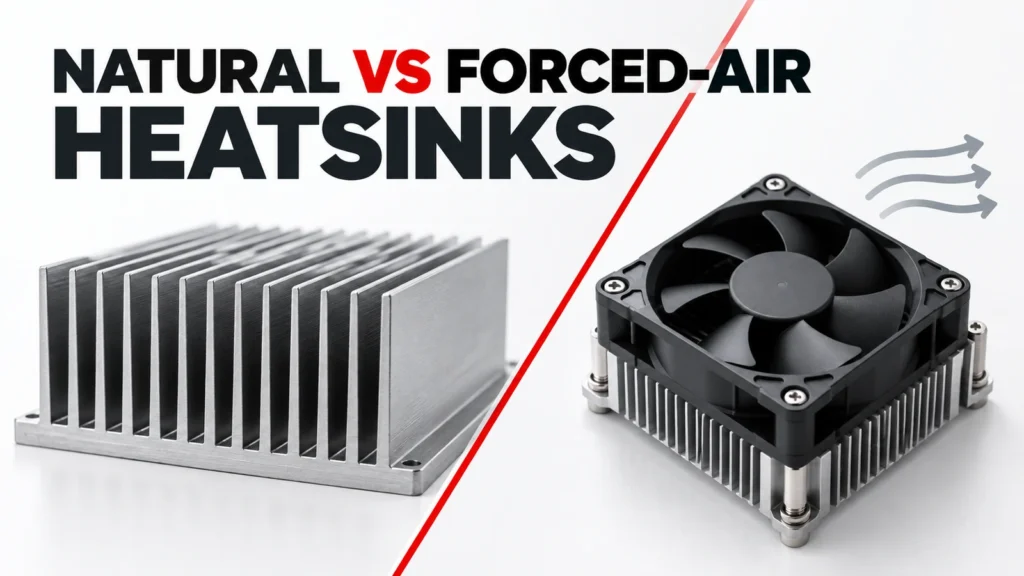
This comparison explains the thermal design evidence required to choose passive or forced-air heatsinking. It gives no universal heat dissipation rating, airflow value, thermal resistance or fan lifetime for a product without exact test conditions.
Podsumowanie danych wejściowych do decyzji
| Obszar przeglądu | Dane wejściowe projektu | Dokumenty, o których udostępnienie należy wystąpić |
|---|---|---|
| DEVICE LOSS | Określ rzeczywisty stan pracy i granice systemu | Zatwierdzony rysunek techniczny lub rejestr pracy |
| INTERFACE | Nazwa interfejsu, geometrii lub oczekiwań dotyczących sterowania | Dokładna dokumentacja dotycząca sprzętu lub produktu |
| HEATSINK | Stan środowiska i warunki instalacji | Rysunek obiektu lub panelu |
| AMBIENT | Opisz wymagania dotyczące usługi i odbioru | Szczegółowe instrukcje i plan testów |
Two cooling methods, one thermal obligation
A natural-convection heatsink transfers heat to surrounding air without a dedicated fan moving air through its fins. A forced-air heatsink uses directed airflow to change that transfer condition. The practical choice is not determined by appearance or the word “power” in a module description. It depends on verified semiconductor loss, allowable temperatures, ambient conditions, mounting and the entire thermal path.
Both approaches can be appropriate in industrial equipment. Passive cooling avoids dependence on a fan, but often requires a compatible installation orientation, space and ambient. Forced air can support a different heat-transfer condition, but introduces airflow, power, acoustic, filtration, service and failure-state questions. The exact device data decides whether either approach has sufficient margin.
Calculate losses before comparing fin shapes
The starting input is the power module’s heat dissipation under representative operating states. Obtain loss information for the exact semiconductor order code and the intended electrical duty. A nameplate current or visually large package does not equal the heat that must leave the assembly. Include continuous and relevant transient conditions in the project brief.
Document whether the module is an SCR, rectifier, diode or another device, because conduction and switching behavior may differ. If the loss model is uncertain, do not backfill a generic wattage. Identify the missing curve or supplier calculation and treat the heatsink selection as provisional until it is supplied.
Trace the complete thermal path
Heat moves from junction through the device package, mounting interface and heatsink into the surrounding air. Each boundary needs evidence. The mechanical contact, approved interface material, mounting pressure and surface condition affect the result, as does the airflow or convection environment at the fins. A quoted heatsink value without its test conditions is not transferable to every assembly.
Ask for the exact thermal data, mounting instructions and a drawing that shows contact area and clearances. Compare the semiconductor’s allowable temperature with the proposed operating states using the supplier’s method. Reserve a prototype temperature check for conditions that are difficult to model, such as a densely populated enclosure or uncertain local air recirculation.
Natural convection needs a real installation context
Passive performance depends on how air can enter, warm and leave the fin channels. Orientation, vertical clearance, adjacent equipment and enclosure temperature may change the result materially. A bench test in open air may not describe a crowded cabinet with nearby heat sources. Define the actual mounting plane and free space before accepting a catalog thermal curve.
The system should also account for warm-start and high-ambient conditions. The passive option may be attractive where fan maintenance is difficult, but simplicity does not waive a thermal check. If the only available data describes a different orientation or ambient, request an applicable test or engineering review.
Forced air is an operating system, not an accessory
A fan rating quoted in free air does not reveal the flow through a heatsink inside a cabinet. Filters, grilles, duct turns, neighboring components and air recirculation can restrict the actual path. Request the fan curve and heatsink performance under documented airflow conditions, then evaluate the assembled path rather than adding nominal component values.
Decide who monitors fan operation and what the equipment does when airflow is lost. A forced-air design can be valid only if its power supply, wiring, maintenance access, replacement plan and alarm behavior are accepted by the project. Include these controls in the quotation and assembly test plan.
Compare reliability and service honestly
A passive design can reduce moving parts but may use more volume and still require clean air passages. A forced-air design can fit a different thermal envelope but needs fan and filter inspection. Dust accumulation affects both fin exposure and the airflow system. State the intended service interval as a project decision, not as an invented universal product property.
Procurement should compare delivered scope: heatsink extrusion, machining, mounting hardware, interface material, fan, guard, filter and cables. Two quotes for “the same heatsink” may include different work. Normalize those inclusions before comparing lead time or price.
Confirm with an assembly-level temperature test
A calculation screens candidates; a representative assembly test closes uncertainty. Measure the relevant points under the operating states and ambient conditions specified by the project engineer, and record how the result maps to the exact device limit. Do not substitute an enclosure air reading for a junction calculation without a supported method.
The test record should identify the exact semiconductor, heatsink, fan configuration if used, mounting material, orientation and enclosure state. A later change to any of these inputs can invalidate the result. Keep the approved thermal configuration with the product build documentation.
Stwórz plik dowodów oparty na modelu dokładnym
For the proposed Power Module Heatsink, create one approval record with the complete order code, the exact datasheet, the relevant drawing, installation instructions and any curve or test report used for the decision. Date each file or record its revision. A product-family page is useful for discovery, but it does not prove that a particular configuration includes an optional feature or meets a system condition.
Porównaj wszystkie wymagania z danymi technicznymi dotyczącymi tego samego produktu dostępnego w ofercie. Nie łącz maksymalnej wartości dla całej rodziny z jednego wariantu ze schematem obwodu, listą akcesoriów lub krzywą termiczną z innego wariantu. Pola, w których nie ustalono wartości, umieść w widocznej kolumnie przeznaczonej na wyjaśnienia. Jeśli dostawca zaproponuje produkt zastępczy, przed zatwierdzeniem jego równoważności technicznej należy powtórzyć odpowiednią weryfikację.
Należy oddzielać dane wejściowe projektu od rozliczeń dostawców
Zespół projektowy odpowiada za dokumentację aplikacji: dane źródłowe i ładunek, stany pracy, środowisko, montaż, elementy sterujące, konserwację oraz kryteria odbioru. Dostawca odpowiada za proponowany kod zamówienia oraz dokumentację potwierdzającą zgodność urządzenia. Żadna ze stron nie powinna wypełniać luk, opierając się na domysłach wynikających z wyglądu lub znanego nazwiska. Przydatną odpowiedzią może być sformułowanie “dane jeszcze niedostępne”, pod warunkiem że brakująca pozycja ma wyznaczonego właściciela oraz termin uzupełnienia.
Należy wstrzymać ten zapis na czas porównywania ofert. W przypadku zmiany warunków eksploatacji, szafy sterowniczej, źródła zasilania, licznika, silnika lub schematu zabezpieczeń należy sporządzić zaktualizowany arkusz danych wejściowych i poprosić każdego dostawcę o ponowne potwierdzenie proponowanego rozwiązania. Zapobiega to traktowaniu wcześniejszej oferty jako zatwierdzenia późniejszego projektu.
Jak porównać oferty dostawców
| Produkt w promocji | Co porównać | Dowód zatwierdzenia |
|---|---|---|
| Zakres zamawiania | Kompletny zestaw wraz z akcesoriami | Dokładna wycena i zestawienie materiałów |
| Instalacja elektryczna | Wszystkie możliwe stany pracy | Dokument zawierający dokładne parametry znamionowe, schemat obwodu lub krzywą charakterystyki |
| Pasowanie mechaniczne | Mocowanie, zaciski i dostęp | Instrukcja rysowania i montażu |
| Plan serwisowy | Metoda kontroli i wymiany | Instrukcja konserwacji |
| Otwarte pozycje | Założenia, wyłączenia i wyjątki | Rejestr pisemnych wyjaśnień |
Normalize each Power Module Heatsink offer to the same application record. A shorter lead time or lower price is meaningful only after the technical scope is comparable. Record whether each supplier included the required accessories, documents and support for commissioning. Keep exceptions explicit, especially when the candidate needs a change to the panel or control design.
Etapy kontroli w procesie zamówień i oddania do użytku
- Należy potwierdzić granice systemu, stany pracy oraz kryteria akceptacji.
- Należy sprawdzić jeden kompletny kod zamówienia pod kątem zgodności z dokumentacją dotyczącą konkretnego modelu.
- Rozwiązywanie problemów związanych z układami elektrycznymi, mechanicznymi, warunkami otoczenia oraz obsługą serwisową.
- Porównaj zakres dostawy i zmiany w dokumentacji w poszczególnych ofertach.
- Należy sprawdzić otrzymany towar pod kątem zgodności z zatwierdzonym dokumentem.
- Przeprowadź test gotowego zespołu zgodnie z zatwierdzoną procedurą projektu.
Podczas kontroli przychodzącej należy sprawdzić dostarczoną etykietę, zaciski, dołączone akcesoria i dokumenty pod kątem zgodności z zatwierdzonym zamówieniem. Wymiana na produkt z tej samej rodziny nie jest automatycznie dopuszczalna. Podczas uruchamiania należy zweryfikować funkcje zależne od zastosowania, których nie da się ustalić wyłącznie na podstawie dokumentacji technicznej komponentu. Plan testów powinien określać reprezentatywne stany i kryteria akceptacji, bez ustalania uniwersalnych limitów.
Lista kontrolna dotycząca przygotowania zapytania ofertowego
A useful request for quotation on natural convection vs forced air heatsink is concise but complete. Ask for the exact orderable configuration and list unknown values as questions. Do not let the sales description silently answer a technical question that belongs to a calculation, a drawing or a test.
- DEVICE LOSS
- INTERFACE
- HEATSINK
- AMBIENT
- FAN CURVE
- RESTRICTION
- FAILURE MODE
- TEST
- Obowiązujące wersje dokumentów
- Ilość, miejsce przeznaczenia i zakres dostawy
Należy poprosić dostawcę o oddzielne wskazanie wyłączeń, założeń i pozycji opcjonalnych. Dokumentację wyjaśnień technicznych należy dołączyć do oferty, aby działy zaopatrzenia i inżynierii mogły dokonać przeglądu tego samego zakresu. Jeśli nadal brakuje kluczowego elementu, kandydat może nadal być interesujący pod względem handlowym, ale jego zatwierdzenie techniczne pozostaje w toku.
Najczęściej zadawane pytania
Can a Power Module Heatsink be chosen from one headline rating?
Nie. Należy wspólnie przeanalizować zastosowanie, dokładną konfigurację oraz odpowiednie warunki elektryczne, mechaniczne, termiczne i środowiskowe. Nazwa katalogowa stanowi jedynie punkt wyjścia do dalszej analizy, a nie kompletną dokumentację zatwierdzającą.
Czy strona rodzinna potwierdza dokładny związek czy tylko powiązanie?
Nie. Należy korzystać z proponowanego kodu zamówieniowego oraz aktualnego rysunku technicznego, karty katalogowej i instrukcji montażu. Funkcje opcjonalne lub alternatywne rozmieszczenie zacisków mogą się różnić w obrębie tej samej rodziny produktów.
Co się stanie, jeśli dostawca nie będzie w stanie podać jednej z wymaganych wartości?
Oznacz tę wartość jako nierozstrzygniętą, określ, kto ją uzyska, i wstrzymaj realizację decyzji, której to dotyczy. Nie przekształcaj założenia w zweryfikowane stwierdzenie tylko dlatego, że zbliża się termin zakupu.
Gdzie kontynuować przegląd
Przejrzyj Power Module Heatsink category dla dostępnej rodziny produktów, a następnie zapoznaj się z strona z powiązanymi produktami jako wstępny punkt odniesienia. Na tych stronach podano przeznaczenie komercyjne; o przydatności danego zastosowania decydują konkretne wzory dokumentów. Aby uzyskać porównanie dostosowane do konkretnego projektu, prosimy o przesłanie danych wejściowych systemu oraz pytań, na które nie ma jeszcze odpowiedzi, za pośrednictwem Strona z zapytaniami dotyczącymi RITOKS.
Jeśli po przeanalizowaniu dostępnych danych okaże się, że inne urządzenie lub metoda jest bardziej odpowiednia, należy zaktualizować specyfikację projektową przed złożeniem wniosku o zmianę. Dokumentacja powinna odnosić się do ostatecznego schematu obwodu i instalacji, a nie tylko do rodziny produktów, która jako pierwsza wzbudziła zainteresowanie.