
Power Module Heatsinks · Comparison
Natural-Convection vs Forced-Air Heatsinks for Power Modules
Natural-Convection vs Forced-Air Heatsinks for Power Modules starts with the system question: When does the thermal design require airflow rather than passive cooling? A useful selection brief connects the equipment duty, installation and receiving system to a specific orderable product. The article below separates project inputs from product evidence so that a familiar product name does not quietly become a technical approval.
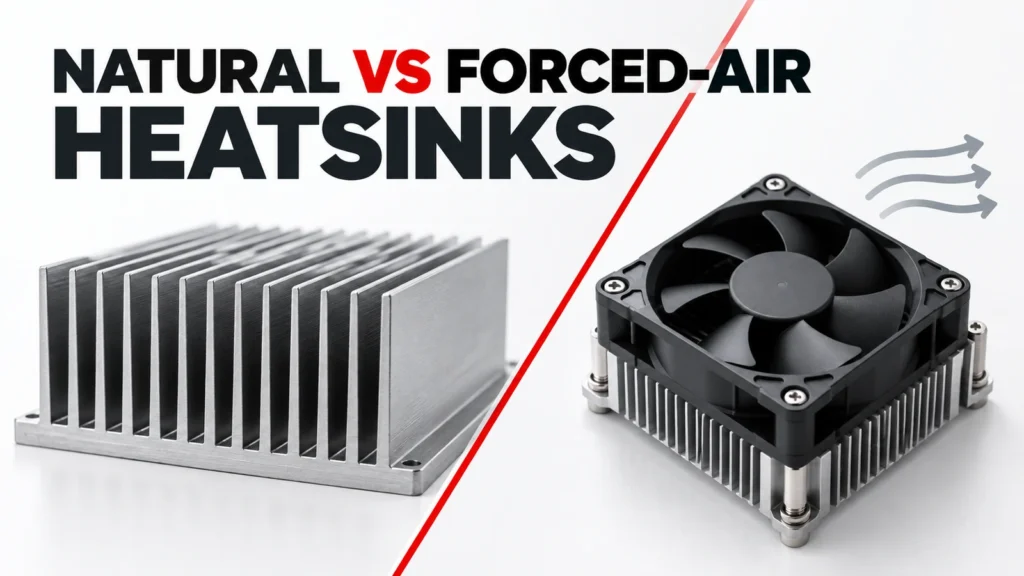
This comparison explains the thermal design evidence required to choose passive or forced-air heatsinking. It gives no universal heat dissipation rating, airflow value, thermal resistance or fan lifetime for a product without exact test conditions.
決策輸入要素一覽
| 評論區 | 專案輸入 | 應索取的證據 |
|---|---|---|
| 裝置損耗 | 定義實際運作狀態與系統邊界 | 經核准的系統圖或運作紀錄 |
| 介面 | 為介面、幾何形狀或控制項的預期行為命名 | 確切的設備或產品文件 |
| 散熱器 | 狀態與安裝條件 | 現場圖或面板圖 |
| AMBIENT | 說明服務與驗收要求 | 詳細操作說明與測試計畫 |
Two cooling methods, one thermal obligation
A natural-convection heatsink transfers heat to surrounding air without a dedicated fan moving air through its fins. A forced-air heatsink uses directed airflow to change that transfer condition. The practical choice is not determined by appearance or the word “power” in a module description. It depends on verified semiconductor loss, allowable temperatures, ambient conditions, mounting and the entire thermal path.
Both approaches can be appropriate in industrial equipment. Passive cooling avoids dependence on a fan, but often requires a compatible installation orientation, space and ambient. Forced air can support a different heat-transfer condition, but introduces airflow, power, acoustic, filtration, service and failure-state questions. The exact device data decides whether either approach has sufficient margin.
Calculate losses before comparing fin shapes
The starting input is the power module’s heat dissipation under representative operating states. Obtain loss information for the exact semiconductor order code and the intended electrical duty. A nameplate current or visually large package does not equal the heat that must leave the assembly. Include continuous and relevant transient conditions in the project brief.
Document whether the module is an SCR, rectifier, diode or another device, because conduction and switching behavior may differ. If the loss model is uncertain, do not backfill a generic wattage. Identify the missing curve or supplier calculation and treat the heatsink selection as provisional until it is supplied.
Trace the complete thermal path
Heat moves from junction through the device package, mounting interface and heatsink into the surrounding air. Each boundary needs evidence. The mechanical contact, approved interface material, mounting pressure and surface condition affect the result, as does the airflow or convection environment at the fins. A quoted heatsink value without its test conditions is not transferable to every assembly.
Ask for the exact thermal data, mounting instructions and a drawing that shows contact area and clearances. Compare the semiconductor’s allowable temperature with the proposed operating states using the supplier’s method. Reserve a prototype temperature check for conditions that are difficult to model, such as a densely populated enclosure or uncertain local air recirculation.
Natural convection needs a real installation context
Passive performance depends on how air can enter, warm and leave the fin channels. Orientation, vertical clearance, adjacent equipment and enclosure temperature may change the result materially. A bench test in open air may not describe a crowded cabinet with nearby heat sources. Define the actual mounting plane and free space before accepting a catalog thermal curve.
The system should also account for warm-start and high-ambient conditions. The passive option may be attractive where fan maintenance is difficult, but simplicity does not waive a thermal check. If the only available data describes a different orientation or ambient, request an applicable test or engineering review.
Forced air is an operating system, not an accessory
A fan rating quoted in free air does not reveal the flow through a heatsink inside a cabinet. Filters, grilles, duct turns, neighboring components and air recirculation can restrict the actual path. Request the fan curve and heatsink performance under documented airflow conditions, then evaluate the assembled path rather than adding nominal component values.
Decide who monitors fan operation and what the equipment does when airflow is lost. A forced-air design can be valid only if its power supply, wiring, maintenance access, replacement plan and alarm behavior are accepted by the project. Include these controls in the quotation and assembly test plan.
Compare reliability and service honestly
A passive design can reduce moving parts but may use more volume and still require clean air passages. A forced-air design can fit a different thermal envelope but needs fan and filter inspection. Dust accumulation affects both fin exposure and the airflow system. State the intended service interval as a project decision, not as an invented universal product property.
Procurement should compare delivered scope: heatsink extrusion, machining, mounting hardware, interface material, fan, guard, filter and cables. Two quotes for “the same heatsink” may include different work. Normalize those inclusions before comparing lead time or price.
Confirm with an assembly-level temperature test
A calculation screens candidates; a representative assembly test closes uncertainty. Measure the relevant points under the operating states and ambient conditions specified by the project engineer, and record how the result maps to the exact device limit. Do not substitute an enclosure air reading for a junction calculation without a supported method.
The test record should identify the exact semiconductor, heatsink, fan configuration if used, mounting material, orientation and enclosure state. A later change to any of these inputs can invalidate the result. Keep the approved thermal configuration with the product build documentation.
建立精確模型證據檔案
For the proposed Power Module Heatsink, create one approval record with the complete order code, the exact datasheet, the relevant drawing, installation instructions and any curve or test report used for the decision. Date each file or record its revision. A product-family page is useful for discovery, but it does not prove that a particular configuration includes an optional feature or meets a system condition.
請將每項要求與同一可訂購項目的相關證據進行比對。切勿將某個變體的系列最大值,與另一個變體的電路圖、配件清單或熱曲線混為一談。將尚未釐清的欄位填入醒目的「待澄清」欄位中。若供應商提出替代方案,請在核准其技術等效性之前,重新進行相關審查。.
將專案投入與供應商請款分開處理
專案團隊負責管理應用紀錄:包括來源與載入、運作狀態、環境、安裝、控制、服務及驗收標準。供應商則負責管理擬議的訂單代碼及相關設備證明文件。雙方均不應僅憑外觀或熟悉的家族名稱來推斷填補缺漏。 若缺失的項目已指定負責人且設有完成期限,則「資料尚未提供」可視為有效的答覆。.
在比對各家報價期間,請暫停該紀錄。若運作職責、控制櫃、電源、電表、馬達或保護架構有所變更,請發布修訂後的輸入表,並要求各供應商重新確認其候選方案。此舉可避免將早期的報價視為對後期設計的核准。.
如何比較供應商的報價
| 促銷商品 | 該比較什麼 | 核准證明 |
|---|---|---|
| 可排序範圍 | 完整套件及隨附配件 | 精確報價單與物料清單 |
| 電氣安裝 | 所有適用的運作狀態 | 精確的額定值、電路或特性曲線文件 |
| 機械配合 | 安裝、端子與接線口 | 繪圖與安裝說明 |
| 服務方案 | 檢查與更換方法 | 保養說明 |
| 未結項目 | 假設、排除事項及例外情況 | 書面說明登記冊 |
Normalize each Power Module Heatsink offer to the same application record. A shorter lead time or lower price is meaningful only after the technical scope is comparable. Record whether each supplier included the required accessories, documents and support for commissioning. Keep exceptions explicit, especially when the candidate needs a change to the panel or control design.
採購與調試檢查要點
- 確認系統邊界、運作狀態及驗收準則。.
- 根據精確型號文件,審核一份完整的訂單編號。.
- 解決電氣、機械、環境及服務方面的異常狀況。.
- 比較各份報價單中已交付的範圍及文件修訂內容。.
- 請根據核准紀錄,對收到的物品進行檢查。.
- 依照專案的授權程序,對完成的組件進行測試。.
收貨檢驗應根據核准訂單,核對所交付的標籤、端子、隨附配件及文件。同系列產品作為替換品並不自動被接受。在調試階段,應驗證那些僅憑元件手冊無法確認的、與應用相關的功能。測試計畫應列出具代表性的狀態及驗收標準,而不應自行制定通用的限值。.
詢價單(RFQ)準備檢查清單
A useful request for quotation on natural convection vs forced air heatsink is concise but complete. Ask for the exact orderable configuration and list unknown values as questions. Do not let the sales description silently answer a technical question that belongs to a calculation, a drawing or a test.
- 裝置損耗
- 介面
- 散熱器
- AMBIENT
- FAN CURVE
- RESTRICTION
- FAILURE MODE
- TEST
- 適用的文件修訂版本
- 數量、目的地及交貨範圍
請要求供應商分別列出排除事項、假設條件及可選項目。將技術澄清紀錄與報價單一併保存,以便採購與工程部門能針對相同範圍進行審查。若仍有關鍵輸入項目缺失,該候選供應商雖在商業上仍具吸引力,但其技術核准仍屬待定狀態。.
常見問題
Can a Power Module Heatsink be chosen from one headline rating?
不。必須綜合審查該應用、確切的配置以及相關的電氣、機械、熱學與環境條件。型錄標題僅是查閱的起點,並非完整的核准紀錄。.
家族頁面能否證明確切的親屬關係或關聯性?
不。請使用建議的訂購代碼及其最新的圖面、資料表和安裝說明。同一產品系列中的可選功能或替代端子配置可能有所不同。.
如果供應商無法提供其中一項所需的數值,該怎麼辦?
將該數值標記為「未解決」,明確指出由誰負責取得該數值,並暫停受影響的決策。切勿僅因採購日期將至,便將假設轉為經證實的論點。.
該從哪裡繼續閱讀這篇書評?
瀏覽 Power Module Heatsink category 針對現有的產品系列,請檢視 相關產品頁面 作為初步參考點。這些頁面列出了商業應用目標;具體的範本文件則決定了其適用性。若需針對特定專案進行比較,請透過以下方式提供系統輸入資料及待釐清的問題: RITOKS 查詢頁面.
若在審閱證據後,發現另有更合適的裝置或方法,請先修訂設計簡報,再提出更換要求。請確保記錄與最終的電路及安裝相關聯,而不僅僅是與最初引起關注的產品系列相關。.