
Enclosure Air Conditioners for Control Cabinets · Technical Explainer
Closed-Loop Enclosure Cooling: What It Means
Understand closed-loop enclosure cooling, its separation from ambient air exchange and the evidence needed before selection. A useful buyer review connects the project requirement to one exact orderable product and preserves the evidence used for approval.
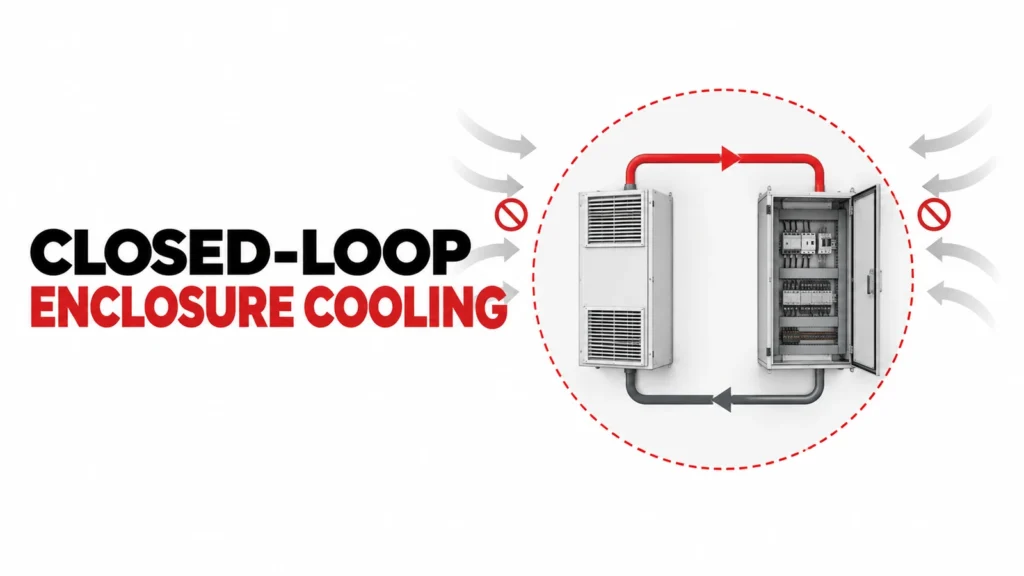
This explainer defines closed-loop enclosure cooling at an architectural level. It does not calculate cooling capacity, promise a sealing or ingress result, or claim that every enclosure air conditioner isolates internal and ambient air in the same way.
Entscheidungsgrundlagen auf einen Blick
| Bewertungsfeld | Der Käufer muss festlegen | Anzufordernde Nachweise |
|---|---|---|
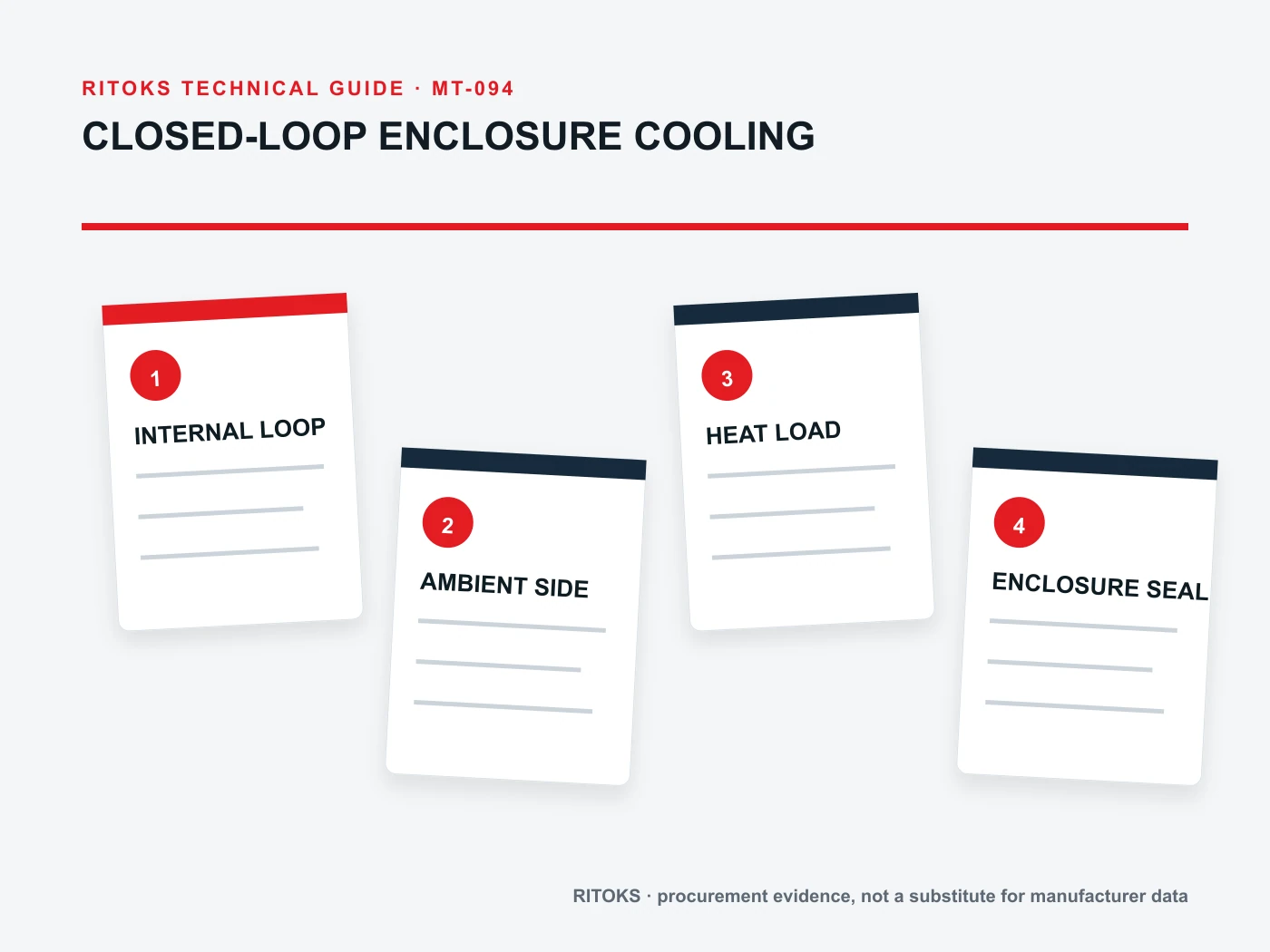
| Internal circuit | Cabinet air recirculation and component temperature objective | System design and equipment documentation |
| External circuit | Ambient-side heat rejection and installation clearance | Exact installation manual |
| Thermal load | Component losses and other heat inputs | Project heat-loss schedule |
| Grenze | Openings, door condition, cable entries and enclosure construction | Enclosure inspection record |
| Umwelt | Ambient temperature, contamination, humidity and service access | Site conditions and maintenance plan |
The Loop Refers to Air Separation
Closed-loop enclosure cooling generally describes an architecture in which cabinet air is recirculated through a cooling device while heat is rejected through a separate ambient-side path. The intent is different from bringing outside air directly through the enclosure. The exact construction and separation still depend on the selected equipment.
The phrase does not mean that the entire cabinet is automatically sealed, contamination-proof or moisture-proof. Cable entries, doors, gaskets, drains and installation workmanship remain part of the boundary. Ask what the exact product does and what the complete enclosure achieves.
Why Ambient-Air Ventilation Is Different
A filter fan or open ventilation path exchanges cabinet air with the surrounding environment. That can be effective when ambient air is suitable and the target cabinet temperature can remain above ambient. Closed-loop cooling instead uses a heat-transfer system intended to avoid direct process-air exchange through the cooling circuit.
These architectures should not be compared from airflow and cooling-capacity headlines as if they were equivalent units. Start from the environmental boundary, allowable temperature and heat load, then evaluate the suitable method.
Map the Internal and External Thermal Paths
Inside the cabinet, heat leaves components, mixes into the internal air and reaches the cooling device. On the ambient side, the device rejects that heat to its surroundings. Obstructed internal circulation or inadequate external clearance can undermine the intended performance even when the equipment is correctly rated.
Record equipment placement, hot spots, internal obstructions and the route available for recirculated air. Separately record wall spacing, ambient-air access and rejected-heat effects. The two paths need different installation evidence.
Calculate From Heat Load and Conditions
Cooling selection begins with component losses and other heat inputs, the required internal temperature, ambient conditions and enclosure surface behavior. A cabinet size alone is not a heat-load calculation. Use a documented engineering method and exact product performance data at the relevant conditions.
Do not treat a nominal capacity in a product title as a universal delivered result. Capacity can depend on temperature conditions and installation details. The quotation should show the selection basis and keep all assumptions visible.
Protect the Enclosure Boundary During Installation
A closed-loop concept can be defeated by unmanaged openings, damaged seals or installation details that create unwanted air exchange. Review door gaskets, cable entries, mounting cutouts, drainage and service penetrations as part of the enclosure system.
The cooling-unit drawing should define its mounting interface and required clearances. Any sealing, condensate or drainage provisions must come from the exact installation instructions. Avoid generic field modifications that are not supported by those documents.
Plan Maintenance on Both Sides of the Boundary
Closed-loop equipment still needs inspection and service. Ambient-side surfaces can collect dirt, and internal circulation paths can become obstructed. The maintenance plan should define access, cleaning, alarm response and the conditions that trigger further investigation.
Keep maintenance claims precise. The absence of a direct ventilation filter does not mean maintenance-free operation. Ask the supplier for the exact schedule and preserve it with the cabinet documentation.
Erstellen Sie eine Beweisdatei nach dem Exaktmodell
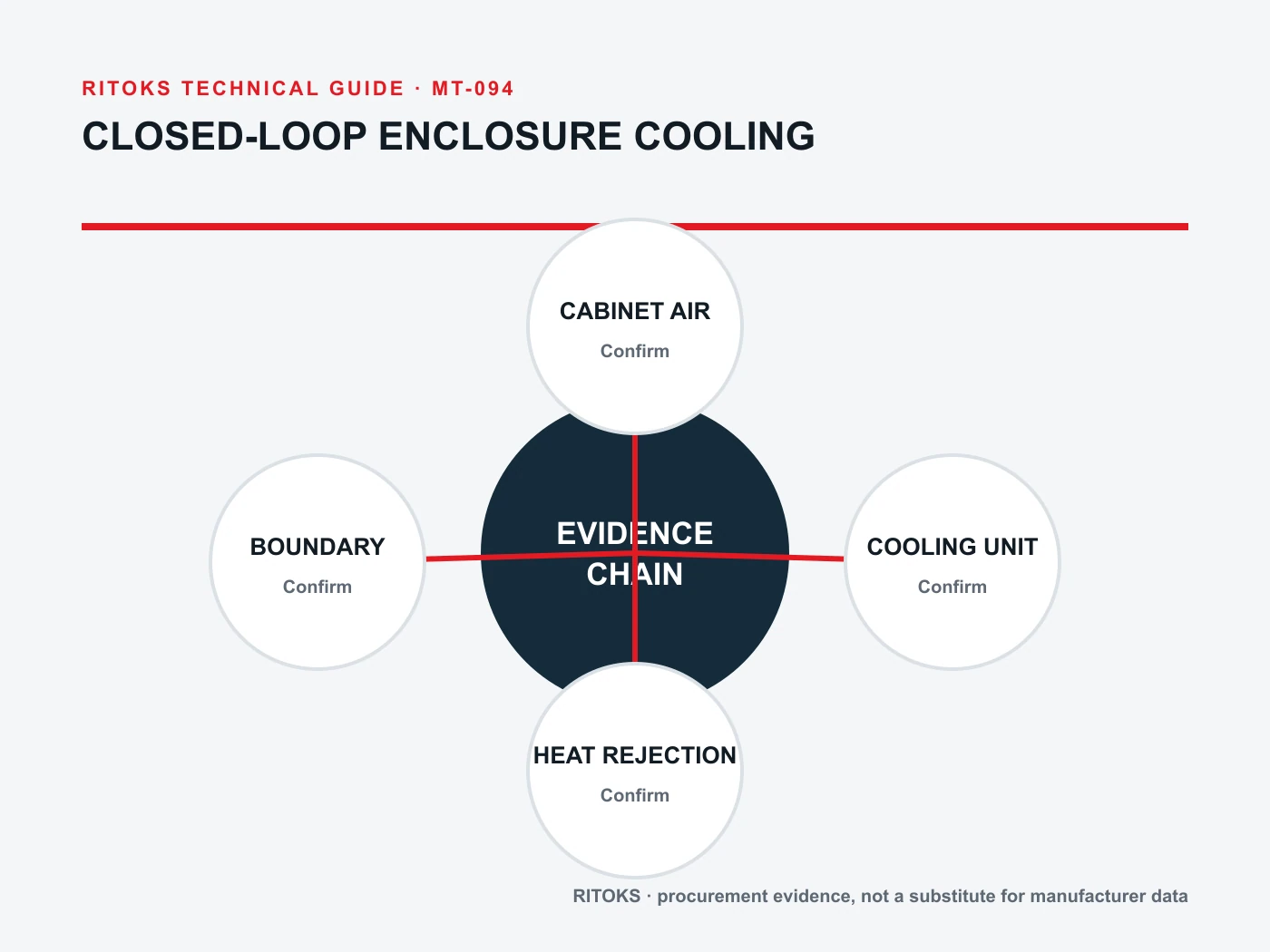
Create one approval record for the proposed Enclosure Air Conditioner order code. Put each project requirement beside the supplier document that answers it. Preserve the exact datasheet, drawing, table, instruction or selection output used, including its revision or retrieval date. A category page can establish family context, but it cannot prove an exact rating, terminal arrangement or system combination.
Stellen Sie sicher, dass jede akzeptierte Angabe denselben bestellbaren Artikel beschreibt. Ähnliche Gehäuse können unterschiedliche Schaltungen, Stromversorgungen, Anschlüsse, Zubehörteile oder Funktionen enthalten. Kombinieren Sie nicht das maximale Familienkontingent einer Variante, ein Schaltbild einer anderen und eine optionale Ausstattung einer dritten. Markieren Sie ungeklärte Felder ausdrücklich, damit sie bei der kaufmännischen Prüfung sichtbar bleiben.
Projektdaten von Produktnachweisen trennen
Das Projektteam definiert die Anwendung: Quelle, Last, Betriebsbedingungen, Umgebung, Steuerungen, mechanische Grenzen und erforderliche Funktionen. Der Lieferant benennt ein konkretes Gehäusekühlgerät und untermauert dies mit genauen Unterlagen. Keine der beiden Seiten sollte Lücken durch Schlussfolgerungen aufgrund des äußeren Erscheinungsbilds, eines gemeinsamen Produktnamens oder eines übereinstimmenden Nennwerts füllen.
Sperren Sie den Angebotsdatensatz, während die Angebote verglichen werden. Sollten sich die Topologie, die Quelle, die Last, die Umgebung, das Gehäuse oder die erforderliche Leistung ändern, erstellen Sie einen überarbeiteten Datensatz und bitten Sie jeden Anbieter, das Angebot erneut zu bestätigen. Andernfalls könnten scheinbar vergleichbare Angebote unterschiedliche technische Anforderungen erfüllen.
Häufige Fehler bei der Beschaffung
Avoid selecting a Enclosure Air Conditioner from one headline value while the application context remains incomplete. Do not use a circuit, curve, terminal drawing or performance claim from a neighboring model. A product photograph and a family page can support discovery, but neither is exact technical evidence.
Gehen Sie außerdem nicht davon aus, dass ein Zubehörteil, eine Kommunikationsfunktion, eine Schutzfunktion oder ein koordiniertes Ergebnis enthalten ist, es sei denn, dies geht aus dem Angebot und den Unterlagen zum genauen Modell hervor. Ein Ersatzteil erfordert dieselbe Topologie, Nennleistung, Montageart und Überprüfung der Nachweise wie das ursprünglich vorgeschlagene Produkt.
So vergleichen Sie Angebote von Lieferanten
Normalize every Enclosure Air Conditioner offer to the same application record. Keep document revisions, stated conditions, included accessories and open questions beside each value. This makes differences in delivered scope visible and prevents a lower-cost but narrower offer from appearing equivalent to a complete solution.
Unterlassen Sie den Vergleich, wenn eine entscheidende Anwendungsvorgabe unbekannt ist, das angeführte Modell mehrdeutig ist, eine erforderliche Angabe nur durch einen anderen Hersteller oder eine andere Bestellnummer gestützt wird oder die Installation außerhalb der verfügbaren Nachweise liegt. Hierbei handelt es sich um technische Lücken und nicht um redaktionelle Details.
Änderungen und Ersetzungen kontrollieren
Give the approved Enclosure Air Conditioner record a revision identifier and keep it with the project file. If the supplier changes the order code, accessory, firmware, drawing or stated operating condition, identify the change before accepting it. A substitution is a new technical proposal even when its price, housing or product-family name looks familiar.
Wiederholen Sie nur die betroffenen Prüfungen, verzichten Sie jedoch nicht auf diese. Vergewissern Sie sich, dass der überarbeitete Kandidat weiterhin der festgelegten Anwendung entspricht, dass alle referenzierten Dokumente dazu gehören und dass alle offenen Ausnahmen einem Verantwortlichen zugeordnet sind. Dieser kleine Schritt der Änderungskontrolle verhindert, dass eine technisch geprüfte Auswahl durch ein ungeprüftes kommerzielles Äquivalent ersetzt wird.
Entscheidungsablauf
- Sichern Sie die Anwendungs- und Systemdaten, bevor Sie einen Katalogcode auswählen.
- Ermitteln Sie die genaue Funktion und jede Schnittstelle, für die Nachweise erforderlich sind.
- Bitte senden Sie mir einen vollständigen Bestellcode mit dem aktuellen Datenblatt und den Zeichnungen zu.
- Ordnen Sie jede Projektanforderung einer bestimmten Herstellerangabe zu.
- Halten Sie Abweichungen, Zubehör, Dokumentenänderungen und offene Fragen fest.
- Wiederholen Sie die Überprüfung, sobald sich die Anwendung oder das vorgeschlagene Produkt ändert.
Use this workflow as a procurement and evidence discipline. It does not replace qualified design, installation instructions or the responsible engineer's approval for the Enclosure Air Conditioner application.
Checkliste zur Vorbereitung einer Angebotsanfrage
A practical closed loop enclosure cooling should be concise enough for a supplier to answer and complete enough to prevent silent assumptions. Identify unknown values as questions rather than allowing them to become undocumented selections.
- Internal circuit: Cabinet air recirculation and component temperature objective.
- External circuit: Ambient-side heat rejection and installation clearance.
- Thermal load: Component losses and other heat inputs.
- Boundary: Openings, door condition, cable entries and enclosure construction.
- Environment: Ambient temperature, contamination, humidity and service access.
- Genaue Artikelnummer, mitgeliefertes Zubehör und Version der Dokumentation
- Menge, Bestimmungsort, erforderliche Genehmigungen und geschäftlicher Umfang
Erfragen Sie den genauen Umfang aller Angaben zu Klassifizierung, Kompatibilität, Koordination oder Leistung. Halten Sie Menge und Bestimmungsort im Anschluss an die technischen Angaben fest, damit geschäftliche Aspekte noch offene technische Fragen nicht verschleiern.
Häufig gestellte Fragen
Does closed-loop cooling make an enclosure airtight?
No. The complete enclosure boundary and installation details must be evaluated separately.
Can closed-loop cooling reduce temperature below ambient?
Some architectures may, but the exact capability must be verified from product data at the stated conditions.
Is a filter fan a closed-loop device?
No. A filter-fan system normally exchanges enclosure air with ambient air.
Zugehörige RITOKS-Produkte und Anleitungen
Diese Links dienen lediglich der Einordnung in die Produktfamilie. Ein kontextbezogener Link stellt keine Aussage über Austauschbarkeit, Kompatibilität oder eine zugelassene Systemkombination dar.
Produktkategorie „Klimageräte für Gehäuse“
EP-A-Klimaanlagen für den Innenbereich
Technische Hinweise
Diese Herstellerangaben beziehen sich ausschließlich auf die im Folgenden beschriebenen allgemeinen technischen Konzepte. Die Produktangaben, Schaltpläne, Zulassungen und Abstimmungsergebnisse der Hersteller gelten nicht für RITOKS-Produkte.
Rittal, Technischer Systemkatalog: Kühlung mit Umgebungsluft
Supports enclosure heat-load, temperature-difference and air-exchange concepts. Rittal formulas and product values apply only under their stated conditions.
Rittal, RiTherm – Planung von Klimatisierungsanlagen
Supports treating enclosure climate control as a documented heat-load and environmental calculation. It does not size a RITOKS product.
Eine Überprüfung des genauen Modells anfordern
Senden Sie die Anwendungsanforderungen, Fragen zu den genauen Dokumenten, die Menge und den Bestimmungsort über das RITOKS-Kontaktformular. Eine Angebotsanfrage erfordert eine Prüfung des genauen Modells; dieser Leitfaden genehmigt keine Schaltkreise, Installationen oder automatischen Ersatzprodukte.