
Enclosure Air Conditioners for Control Cabinets · Technical Explainer
Closed-Loop Enclosure Cooling: What It Means
Understand closed-loop enclosure cooling, its separation from ambient air exchange and the evidence needed before selection. A useful buyer review connects the project requirement to one exact orderable product and preserves the evidence used for approval.
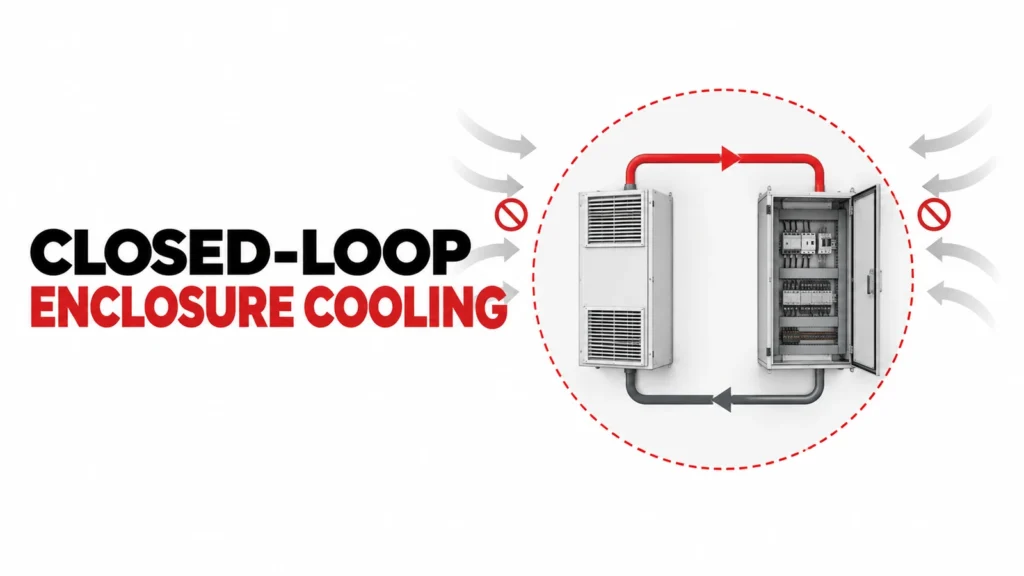
This explainer defines closed-loop enclosure cooling at an architectural level. It does not calculate cooling capacity, promise a sealing or ingress result, or claim that every enclosure air conditioner isolates internal and ambient air in the same way.
Podsumowanie danych wejściowych do decyzji
| Pole recenzji | Kupujący musi określić | Dokumenty, o których udostępnienie należy wystąpić |
|---|---|---|
| Internal circuit | Cabinet air recirculation and component temperature objective | System design and equipment documentation |
| External circuit | Ambient-side heat rejection and installation clearance | Exact installation manual |
| Thermal load | Component losses and other heat inputs | Project heat-loss schedule |
| Granica | Openings, door condition, cable entries and enclosure construction | Enclosure inspection record |
| Środowisko | Ambient temperature, contamination, humidity and service access | Site conditions and maintenance plan |
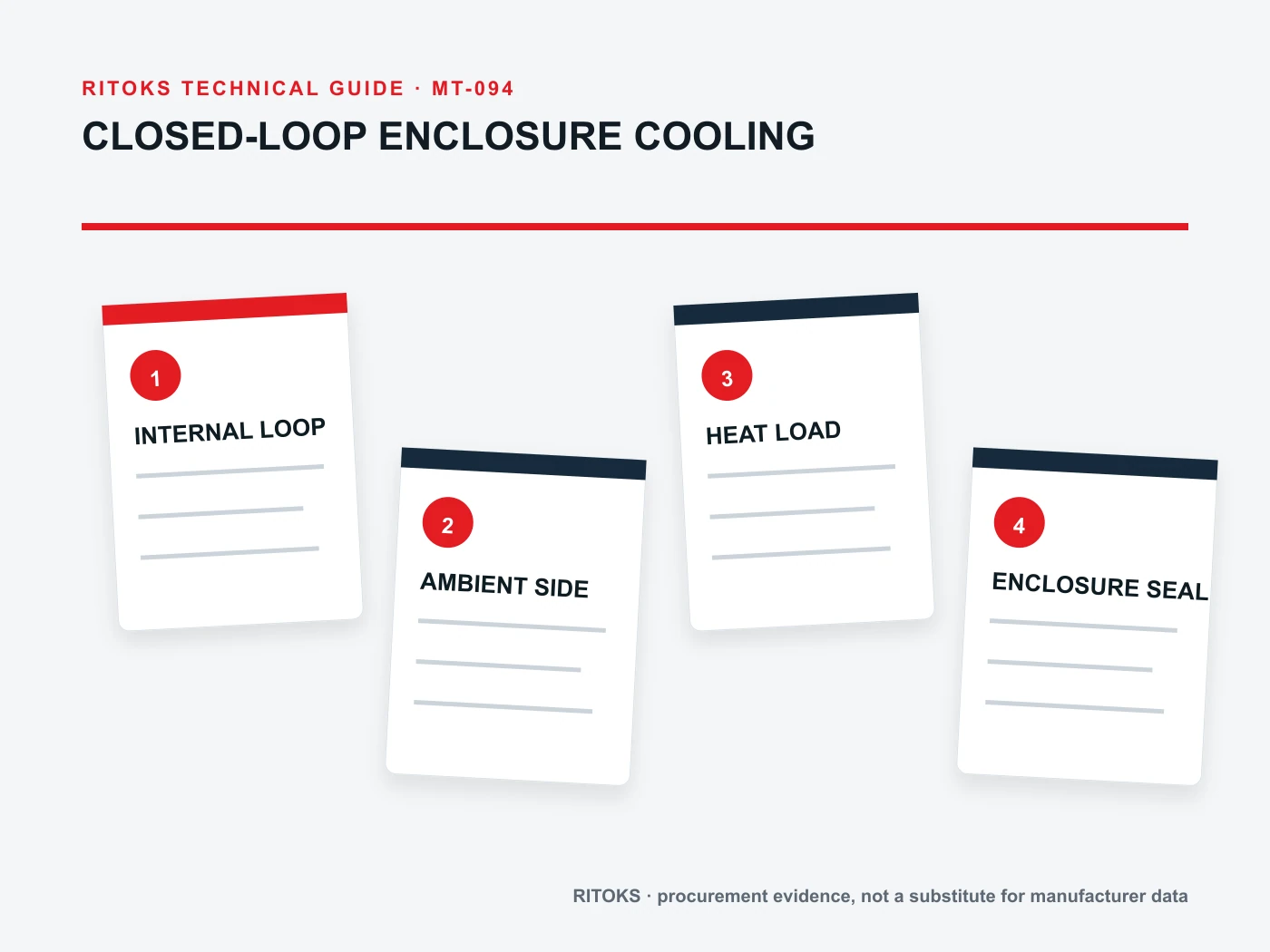
The Loop Refers to Air Separation
Closed-loop enclosure cooling generally describes an architecture in which cabinet air is recirculated through a cooling device while heat is rejected through a separate ambient-side path. The intent is different from bringing outside air directly through the enclosure. The exact construction and separation still depend on the selected equipment.
The phrase does not mean that the entire cabinet is automatically sealed, contamination-proof or moisture-proof. Cable entries, doors, gaskets, drains and installation workmanship remain part of the boundary. Ask what the exact product does and what the complete enclosure achieves.
Why Ambient-Air Ventilation Is Different
A filter fan or open ventilation path exchanges cabinet air with the surrounding environment. That can be effective when ambient air is suitable and the target cabinet temperature can remain above ambient. Closed-loop cooling instead uses a heat-transfer system intended to avoid direct process-air exchange through the cooling circuit.
These architectures should not be compared from airflow and cooling-capacity headlines as if they were equivalent units. Start from the environmental boundary, allowable temperature and heat load, then evaluate the suitable method.
Map the Internal and External Thermal Paths
Inside the cabinet, heat leaves components, mixes into the internal air and reaches the cooling device. On the ambient side, the device rejects that heat to its surroundings. Obstructed internal circulation or inadequate external clearance can undermine the intended performance even when the equipment is correctly rated.
Record equipment placement, hot spots, internal obstructions and the route available for recirculated air. Separately record wall spacing, ambient-air access and rejected-heat effects. The two paths need different installation evidence.
Calculate From Heat Load and Conditions
Cooling selection begins with component losses and other heat inputs, the required internal temperature, ambient conditions and enclosure surface behavior. A cabinet size alone is not a heat-load calculation. Use a documented engineering method and exact product performance data at the relevant conditions.
Do not treat a nominal capacity in a product title as a universal delivered result. Capacity can depend on temperature conditions and installation details. The quotation should show the selection basis and keep all assumptions visible.
Protect the Enclosure Boundary During Installation
A closed-loop concept can be defeated by unmanaged openings, damaged seals or installation details that create unwanted air exchange. Review door gaskets, cable entries, mounting cutouts, drainage and service penetrations as part of the enclosure system.
The cooling-unit drawing should define its mounting interface and required clearances. Any sealing, condensate or drainage provisions must come from the exact installation instructions. Avoid generic field modifications that are not supported by those documents.
Plan Maintenance on Both Sides of the Boundary
Closed-loop equipment still needs inspection and service. Ambient-side surfaces can collect dirt, and internal circulation paths can become obstructed. The maintenance plan should define access, cleaning, alarm response and the conditions that trigger further investigation.
Keep maintenance claims precise. The absence of a direct ventilation filter does not mean maintenance-free operation. Ask the supplier for the exact schedule and preserve it with the cabinet documentation.
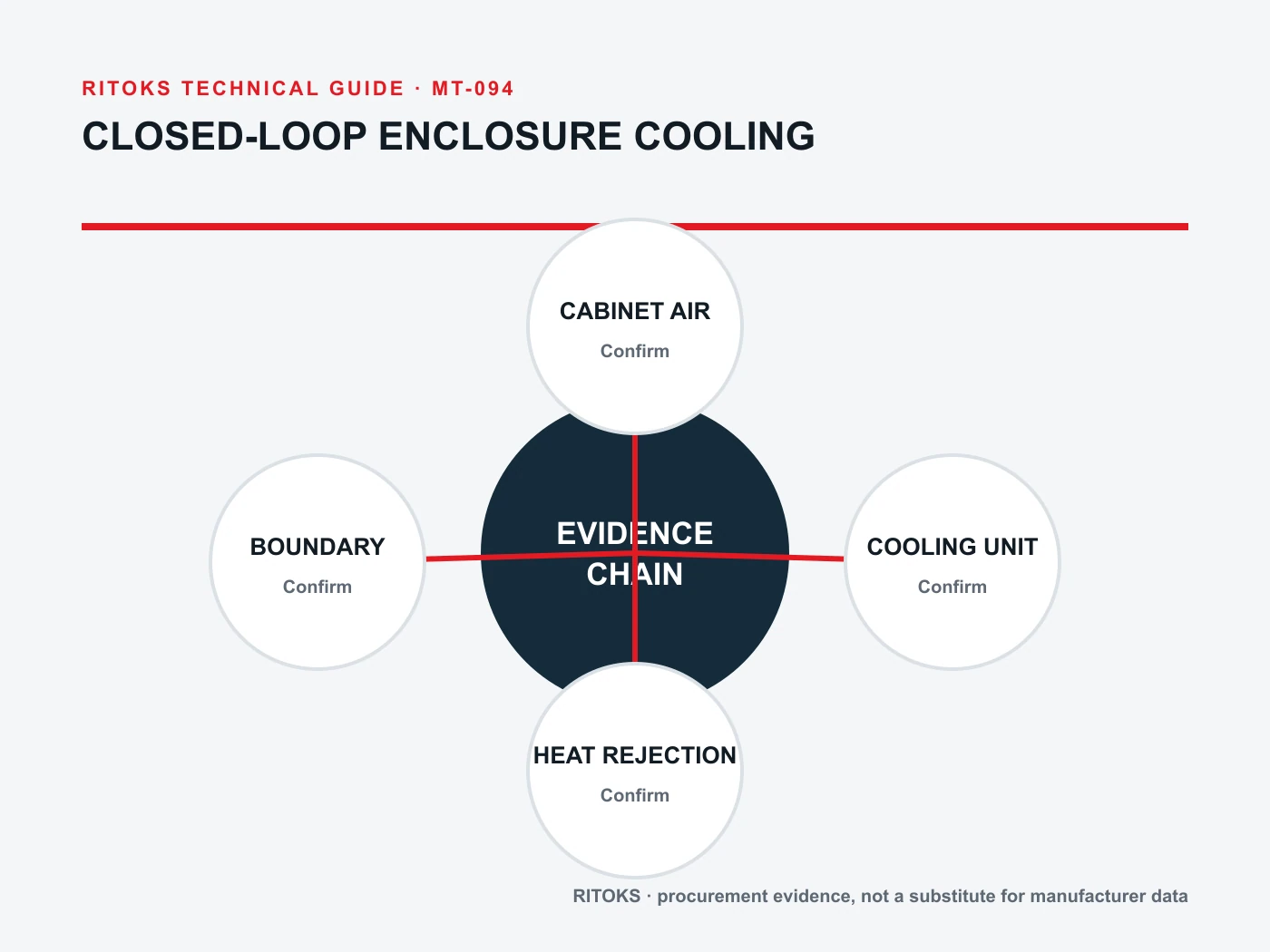
Stwórz plik dowodów oparty na modelu dokładnym
Create one approval record for the proposed Enclosure Air Conditioner order code. Put each project requirement beside the supplier document that answers it. Preserve the exact datasheet, drawing, table, instruction or selection output used, including its revision or retrieval date. A category page can establish family context, but it cannot prove an exact rating, terminal arrangement or system combination.
Należy sprawdzić, czy każda zaakceptowana specyfikacja dotyczy tej samej pozycji dostępnej w ofercie. Podobne obudowy mogą zawierać różne układy elektroniczne, zasilacze, zaciski, akcesoria lub funkcje. Nie należy łączyć maksymalnej liczby sztuk z jednej rodziny z wariantem, schematem z innego wariantu oraz opcjonalną funkcją z trzeciego. Należy wyraźnie oznaczyć pola, które nie zostały jeszcze wypełnione, tak aby pozostały widoczne podczas przeglądu handlowego.
Należy oddzielać dane wejściowe projektu od dowodów dotyczących produktu
Zespół projektowy określa wymagania dotyczące urządzenia: źródło zasilania, obciążenie, tryb pracy, warunki otoczenia, elementy sterujące, ograniczenia mechaniczne oraz wymagane funkcje. Dostawca wskazuje konkretny model klimatyzatora obudowowego i popiera swój wybór odpowiednią dokumentacją. Żadna ze stron nie powinna wypełniać luk, opierając się na domysłach wynikających z wyglądu, wspólnej nazwy serii lub zbieżnej wartości podanej w nagłówku.
Należy wstrzymać proces rozpatrywania wniosku na czas porównywania ofert. Jeśli zmienią się topologia, źródło, obciążenie, środowisko, obudowa lub wymagana moc wyjściowa, należy sporządzić zaktualizowany dokument i poprosić każdego dostawcę o ponowne potwierdzenie wybranego rozwiązania. W przeciwnym razie oferty, które na pierwszy rzut oka wydają się porównywalne, mogą odpowiadać na różne wymagania techniczne.
Typowe błędy związane z zamówieniami publicznymi
Avoid selecting a Enclosure Air Conditioner from one headline value while the application context remains incomplete. Do not use a circuit, curve, terminal drawing or performance claim from a neighboring model. A product photograph and a family page can support discovery, but neither is exact technical evidence.
Należy również unikać zakładania, że dany element wyposażenia, funkcja komunikacyjna, rola ochronna lub skoordynowany wynik są uwzględnione, o ile nie zostały one wymienione w ofercie cenowej i dokumentacji dotyczącej konkretnego modelu. Produkt zastępczy musi spełniać te same wymagania dotyczące topologii, parametrów znamionowych, sposobu montażu oraz weryfikacji dokumentacji, co pierwotnie rozważany produkt.
Jak porównać oferty dostawców
Normalize every Enclosure Air Conditioner offer to the same application record. Keep document revisions, stated conditions, included accessories and open questions beside each value. This makes differences in delivered scope visible and prevents a lower-cost but narrower offer from appearing equivalent to a complete solution.
Należy zaprzestać porównywania, gdy nieznane są kluczowe parametry aplikacji, podany model jest niejednoznaczny, wymagana specyfikacja jest poparta jedynie danymi innego producenta lub kodem zamówienia, albo gdy instalacja wykracza poza zakres dostępnych danych. Są to luki techniczne, a nie szczegóły redakcyjne.
Kontrola zmian i zamian
Give the approved Enclosure Air Conditioner record a revision identifier and keep it with the project file. If the supplier changes the order code, accessory, firmware, drawing or stated operating condition, identify the change before accepting it. A substitution is a new technical proposal even when its price, housing or product-family name looks familiar.
Powtórz tylko te kontrole, których dotyczy problem, ale nie rezygnuj z nich. Upewnij się, że zaktualizowana wersja wniosku nadal odpowiada zamrożonemu wnioskowi, że wszystkie dokumenty, do których się odwołuje, należą do niego oraz że wszystkie otwarte wyjątki mają wyznaczonego odpowiedzialnego. Ten niewielki etap kontroli zmian zapobiega zastąpieniu selekcji, która przeszła weryfikację techniczną, przez jej niepoddaną weryfikacji komercyjną wersję.
Proces podejmowania decyzji
- Przed wybraniem kodu katalogowego należy zablokować aplikację i zapis systemowy.
- Należy określić dokładną funkcję oraz każdy interfejs, który wymaga potwierdzenia.
- Proszę o przesłanie jednego kompletnego kodu zamówienia wraz z aktualną kartą katalogową i rysunkami technicznymi.
- Należy przyporządkować każde wymaganie projektowe do konkretnego oświadczenia producenta.
- Należy odnotować odchylenia, elementy dodatkowe, zmiany w dokumentacji oraz nierozstrzygnięte kwestie.
- Należy powtórzyć przegląd za każdym razem, gdy nastąpią zmiany w zastosowaniu lub w proponowanym produkcie.
Use this workflow as a procurement and evidence discipline. It does not replace qualified design, installation instructions or the responsible engineer's approval for the Enclosure Air Conditioner application.
Lista kontrolna dotycząca przygotowania zapytania ofertowego
A practical closed loop enclosure cooling should be concise enough for a supplier to answer and complete enough to prevent silent assumptions. Identify unknown values as questions rather than allowing them to become undocumented selections.
- Internal circuit: Cabinet air recirculation and component temperature objective.
- External circuit: Ambient-side heat rejection and installation clearance.
- Thermal load: Component losses and other heat inputs.
- Boundary: Openings, door condition, cable entries and enclosure construction.
- Environment: Ambient temperature, contamination, humidity and service access.
- Dokładny kod produktu, zawarte w zestawie akcesoria oraz wersja dokumentacji
- Ilość, miejsce przeznaczenia, wymagane zezwolenia oraz zakres handlowy
Należy poprosić o dokładny zakres wszelkich oświadczeń dotyczących klasyfikacji, zgodności, koordynacji lub wydajności. Należy odnotować ilość i miejsce przeznaczenia po danych technicznych, aby warunki handlowe nie przesłaniały nierozstrzygniętych kwestii technicznych.
Najczęściej zadawane pytania
Does closed-loop cooling make an enclosure airtight?
No. The complete enclosure boundary and installation details must be evaluated separately.
Can closed-loop cooling reduce temperature below ambient?
Some architectures may, but the exact capability must be verified from product data at the stated conditions.
Is a filter fan a closed-loop device?
No. A filter-fan system normally exchanges enclosure air with ambient air.
Powiązane produkty i wytyczne firmy RITOKS
Linki te służą wyłącznie do przedstawienia kontekstu rodziny produktów. Link kontekstowy nie oznacza zamienności, kompatybilności ani zatwierdzonej kombinacji systemów.
Kategoria produktów: Klimatyzatory typu szafowego
Klimatyzatory typu EP-A do pomieszczeń zamkniętych
Materiały techniczne
Powyższe źródła producenta służą wyłącznie do zilustrowania ogólnych zasad technicznych opisanych poniżej. Dane techniczne produktów, schematy obwodów, certyfikaty oraz wyniki koordynacji z tych źródeł nie mają zastosowania do produktów RITOKS.
Rittal, Katalog systemów technicznych: Chłodzenie powietrzem otoczenia
Supports enclosure heat-load, temperature-difference and air-exchange concepts. Rittal formulas and product values apply only under their stated conditions.
Rittal, projektowanie systemów klimatyzacji RiTherm
Supports treating enclosure climate control as a documented heat-load and environmental calculation. It does not size a RITOKS product.
Poproś o przegląd konkretnego modelu
Prosimy o przesłanie wymagań dotyczących zamówienia, szczegółowych pytań dotyczących dokumentacji, ilości i miejsca dostawy za pośrednictwem formularza kontaktowego RITOKS. Zapytanie ofertowe wymaga weryfikacji konkretnego modelu; niniejszy przewodnik nie zatwierdza obwodów, instalacji ani automatycznych zamienników.