
Кондиционеры для шкафов управления · Техническое руководство
Closed-Loop Enclosure Cooling: What It Means
Understand closed-loop enclosure cooling, its separation from ambient air exchange and the evidence needed before selection. A useful buyer review connects the project requirement to one exact orderable product and preserves the evidence used for approval.
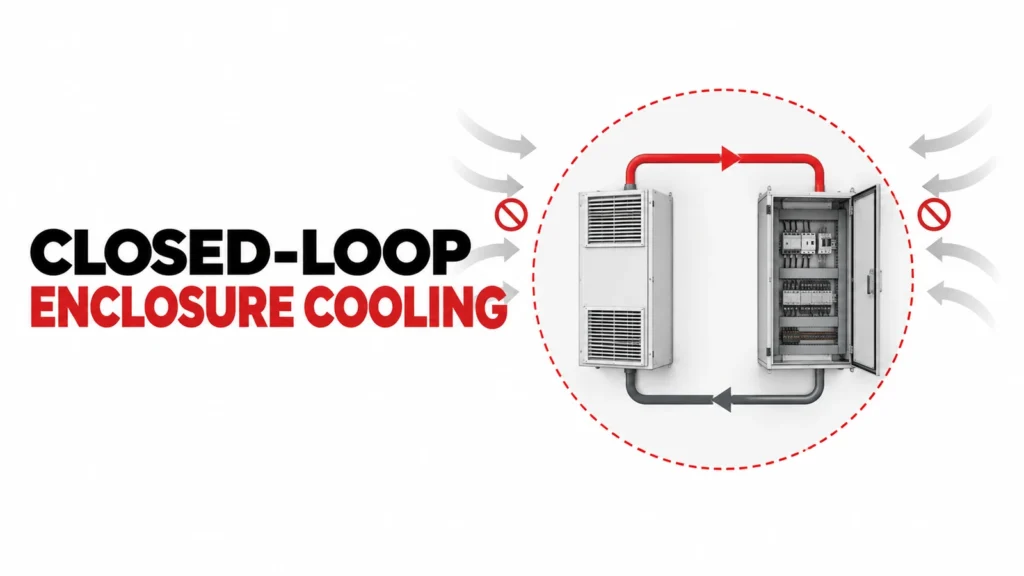
This explainer defines closed-loop enclosure cooling at an architectural level. It does not calculate cooling capacity, promise a sealing or ingress result, or claim that every enclosure air conditioner isolates internal and ambient air in the same way.
Краткий обзор исходных данных для принятия решений
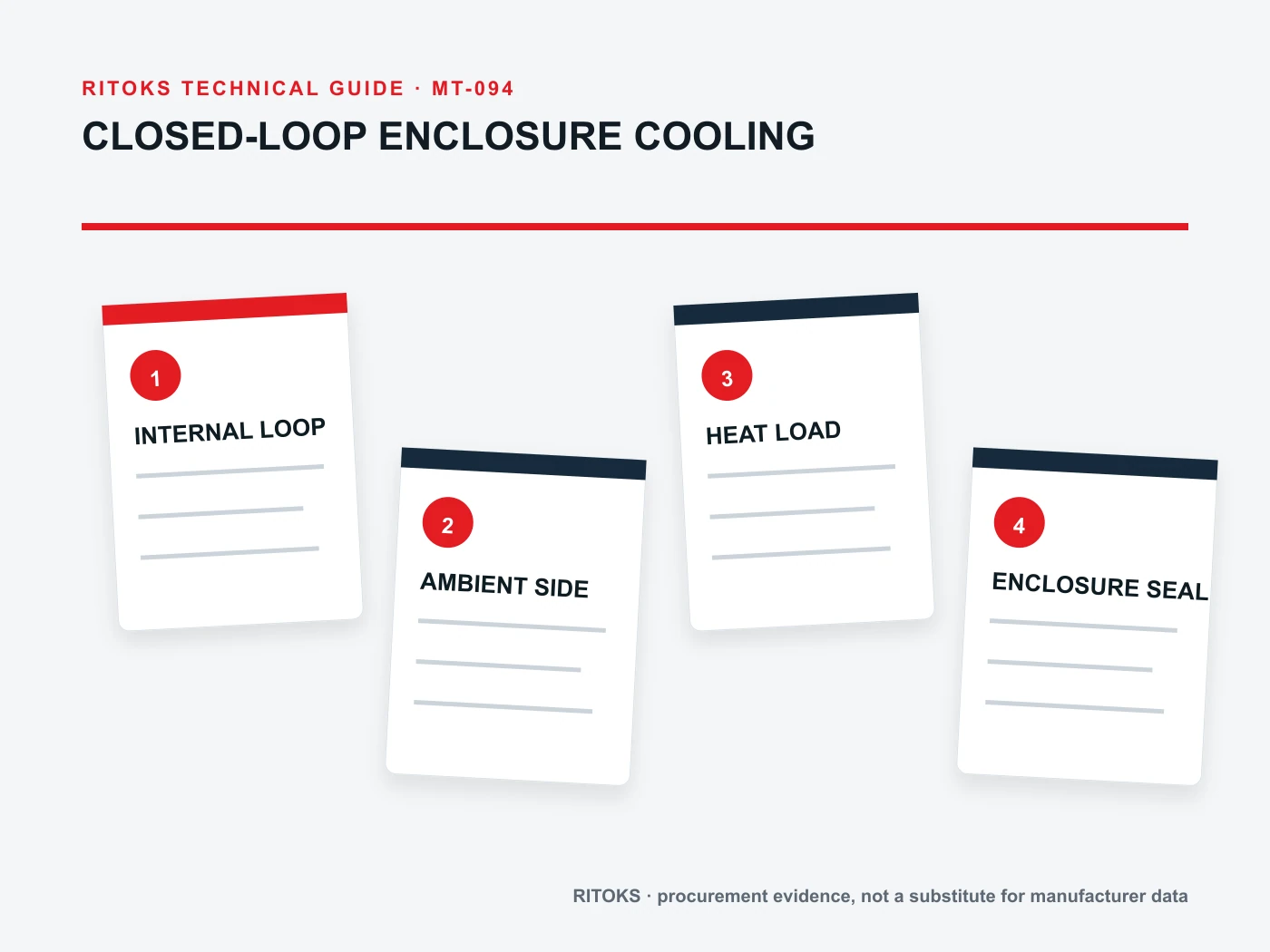
| Поле для отзыва | Покупатель должен определить | Доказательства, которые необходимо запросить |
|---|---|---|
| Internal circuit | Cabinet air recirculation and component temperature objective | System design and equipment documentation |
| External circuit | Ambient-side heat rejection and installation clearance | Exact installation manual |
| Thermal load | Component losses and other heat inputs | Project heat-loss schedule |
| Граница | Openings, door condition, cable entries and enclosure construction | Enclosure inspection record |
| Окружающая среда | Ambient temperature, contamination, humidity and service access | Site conditions and maintenance plan |
The Loop Refers to Air Separation
Closed-loop enclosure cooling generally describes an architecture in which cabinet air is recirculated through a cooling device while heat is rejected through a separate ambient-side path. The intent is different from bringing outside air directly through the enclosure. The exact construction and separation still depend on the selected equipment.
The phrase does not mean that the entire cabinet is automatically sealed, contamination-proof or moisture-proof. Cable entries, doors, gaskets, drains and installation workmanship remain part of the boundary. Ask what the exact product does and what the complete enclosure achieves.
Why Ambient-Air Ventilation Is Different
A filter fan or open ventilation path exchanges cabinet air with the surrounding environment. That can be effective when ambient air is suitable and the target cabinet temperature can remain above ambient. Closed-loop cooling instead uses a heat-transfer system intended to avoid direct process-air exchange through the cooling circuit.
These architectures should not be compared from airflow and cooling-capacity headlines as if they were equivalent units. Start from the environmental boundary, allowable temperature and heat load, then evaluate the suitable method.
Map the Internal and External Thermal Paths
Inside the cabinet, heat leaves components, mixes into the internal air and reaches the cooling device. On the ambient side, the device rejects that heat to its surroundings. Obstructed internal circulation or inadequate external clearance can undermine the intended performance even when the equipment is correctly rated.
Record equipment placement, hot spots, internal obstructions and the route available for recirculated air. Separately record wall spacing, ambient-air access and rejected-heat effects. The two paths need different installation evidence.
Calculate From Heat Load and Conditions
Cooling selection begins with component losses and other heat inputs, the required internal temperature, ambient conditions and enclosure surface behavior. A cabinet size alone is not a heat-load calculation. Use a documented engineering method and exact product performance data at the relevant conditions.
Do not treat a nominal capacity in a product title as a universal delivered result. Capacity can depend on temperature conditions and installation details. The quotation should show the selection basis and keep all assumptions visible.
Protect the Enclosure Boundary During Installation
A closed-loop concept can be defeated by unmanaged openings, damaged seals or installation details that create unwanted air exchange. Review door gaskets, cable entries, mounting cutouts, drainage and service penetrations as part of the enclosure system.
The cooling-unit drawing should define its mounting interface and required clearances. Any sealing, condensate or drainage provisions must come from the exact installation instructions. Avoid generic field modifications that are not supported by those documents.
Plan Maintenance on Both Sides of the Boundary
Closed-loop equipment still needs inspection and service. Ambient-side surfaces can collect dirt, and internal circulation paths can become obstructed. The maintenance plan should define access, cleaning, alarm response and the conditions that trigger further investigation.
Keep maintenance claims precise. The absence of a direct ventilation filter does not mean maintenance-free operation. Ask the supplier for the exact schedule and preserve it with the cabinet documentation.
Создать файл доказательств на основе точной модели
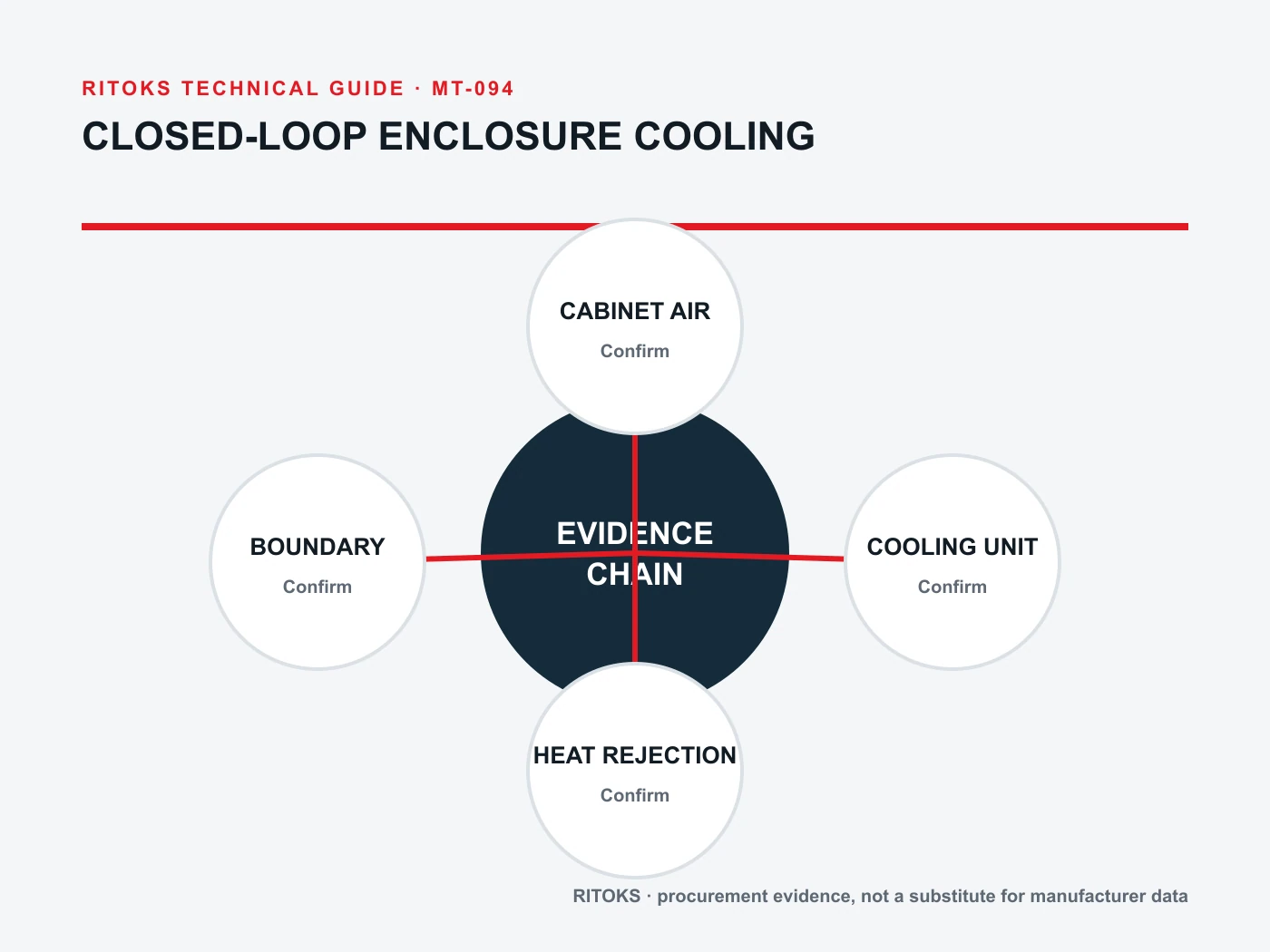
Create one approval record for the proposed Enclosure Air Conditioner order code. Put each project requirement beside the supplier document that answers it. Preserve the exact datasheet, drawing, table, instruction or selection output used, including its revision or retrieval date. A category page can establish family context, but it cannot prove an exact rating, terminal arrangement or system combination.
Убедитесь, что каждое утвержденное описание относится к одному и тому же заказываемому изделию. Похожие корпуса могут содержать разные схемы, источники питания, клеммы, принадлежности или функции. Не следует комбинировать максимальное количество изделий в семействе из одного варианта, схему из другого и дополнительную функцию из третьего. Четко обозначьте не заполненные поля, чтобы они оставались видимыми при коммерческой проверке.
Разделяйте исходные данные проекта и доказательства эффективности продукта
Проектная группа определяет технические характеристики оборудования: источник питания, нагрузку, режим работы, условия эксплуатации, средства управления, механические ограничения и требуемые функции. Поставщик указывает конкретную модель кондиционера в корпусе и подтверждает свой выбор точной документацией. Ни одна из сторон не должна восполнять пробелы в информации, основываясь на внешнем виде, совпадении названия серии или одном совпадающем номинальном значении.
Заморозьте запись заявки на время сравнения предложений. Если изменятся топология, источник, нагрузка, условия эксплуатации, корпус или требуемая выходная мощность, выпустите обновленную запись и попросите каждого поставщика вновь подтвердить свою кандидатуру. В противном случае, казалось бы, сопоставимые предложения могут соответствовать разным техническим требованиям.
Распространенные ошибки при проведении закупок
Avoid selecting a Enclosure Air Conditioner from one headline value while the application context remains incomplete. Do not use a circuit, curve, terminal drawing or performance claim from a neighboring model. A product photograph and a family page can support discovery, but neither is exact technical evidence.
Кроме того, не следует предполагать, что тот или иной аксессуар, функция связи, защитная роль или согласованный результат включены в поставку, если это не указано в коммерческом предложении и документации по конкретной модели. Замена требует такой же топологии, технических характеристик, способа монтажа и проверки документации, что и исходный вариант.
Как сравнивать предложения поставщиков
Normalize every Enclosure Air Conditioner offer to the same application record. Keep document revisions, stated conditions, included accessories and open questions beside each value. This makes differences in delivered scope visible and prevents a lower-cost but narrower offer from appearing equivalent to a complete solution.
Прекратите сравнение, если неизвестны ключевые входные данные приложения, указанная модель является неоднозначной, требуемое заявление подтверждается только другим производителем или кодом заказа, либо условия установки выходят за рамки имеющихся данных. Речь идет о пробелах в технической информации, а не о редакторских деталях.
Контроль изменений и замен
Give the approved Enclosure Air Conditioner record a revision identifier and keep it with the project file. If the supplier changes the order code, accessory, firmware, drawing or stated operating condition, identify the change before accepting it. A substitution is a new technical proposal even when its price, housing or product-family name looks familiar.
Повторите только те проверки, которые затронуты изменениями, но не отказывайтесь от них. Убедитесь, что пересмотренный кандидат по-прежнему соответствует «замороженной» заявке, что все указанные документы относятся к ней и что у всех открытых исключений есть ответственное лицо. Этот небольшой этап контроля изменений предотвращает замену технически проверенного кандидата на непроверенный коммерческий аналог.
Рабочий процесс принятия решений
- Перед выбором кода каталога необходимо зафиксировать состояние приложения и системных записей.
- Определите точную функцию и каждый интерфейс, для которых требуются подтверждающие данные.
- Пожалуйста, предоставьте один полный код заказа с актуальным техническим паспортом и чертежами.
- Соотнесите каждое требование проекта с конкретным заявлением производителя.
- Фиксируйте отклонения, дополнительные сведения, изменения в документации и нерешенные вопросы.
- Повторяйте проверку при каждом изменении приложения или предлагаемого продукта.
Use this workflow as a procurement and evidence discipline. It does not replace qualified design, installation instructions or the responsible engineer's approval for the Enclosure Air Conditioner application.
Контрольный список по подготовке запроса предложений
A practical closed loop enclosure cooling should be concise enough for a supplier to answer and complete enough to prevent silent assumptions. Identify unknown values as questions rather than allowing them to become undocumented selections.
- Internal circuit: Cabinet air recirculation and component temperature objective.
- External circuit: Ambient-side heat rejection and installation clearance.
- Thermal load: Component losses and other heat inputs.
- Boundary: Openings, door condition, cable entries and enclosure construction.
- Environment: Ambient temperature, contamination, humidity and service access.
- Точный код товара, входящие в комплект аксессуары и версия документации
- Количество, пункт назначения, необходимые разрешения и коммерческие условия
Запрашивайте точные сведения о сфере применения любых заявлений, касающихся классификации, совместимости, согласования или эксплуатационных характеристик. Указывайте количество и пункт назначения после технических данных, чтобы коммерческие условия не затмевали нерешенные технические вопросы.
Часто задаваемые вопросы
Does closed-loop cooling make an enclosure airtight?
No. The complete enclosure boundary and installation details must be evaluated separately.
Can closed-loop cooling reduce temperature below ambient?
Some architectures may, but the exact capability must be verified from product data at the stated conditions.
Is a filter fan a closed-loop device?
No. A filter-fan system normally exchanges enclosure air with ambient air.
Сопутствующие продукты и рекомендации RITOKS
Эти ссылки приводятся исключительно для ознакомления с семейством продуктов. Контекстная ссылка не подразумевает взаимозаменяемости, совместимости или утвержденной системной комбинации.
Категория товаров «Кондиционеры для закрытых помещений»
Кондиционеры EP-A для установки в помещениях
Технические справочные материалы
Указанные источники от производителей служат лишь для иллюстрации общих технических концепций, описанных ниже. Технические характеристики их продукции, схемы, сертификаты и результаты согласования не распространяются на продукцию RITOKS.
Rittal, Каталог технических систем: Охлаждение с использованием воздуха из окружающей среды
Supports enclosure heat-load, temperature-difference and air-exchange concepts. Rittal formulas and product values apply only under their stated conditions.
Rittal, проектирование систем климат-контроля RiTherm
Supports treating enclosure climate control as a documented heat-load and environmental calculation. It does not size a RITOKS product.
Запросить обзор конкретной модели
Отправьте требования к заявке, вопросы по конкретным документам, количество и пункт назначения через контактную форму RITOKS. Запрос предложения (RFQ) предполагает рассмотрение именно данной модели; настоящее руководство не предусматривает утверждение схемы, монтажа или автоматической замены.