
Enclosure Air Conditioners for Control Cabinets · Technical Explainer
Closed-Loop Enclosure Cooling: What It Means
Understand closed-loop enclosure cooling, its separation from ambient air exchange and the evidence needed before selection. A useful buyer review connects the project requirement to one exact orderable product and preserves the evidence used for approval.
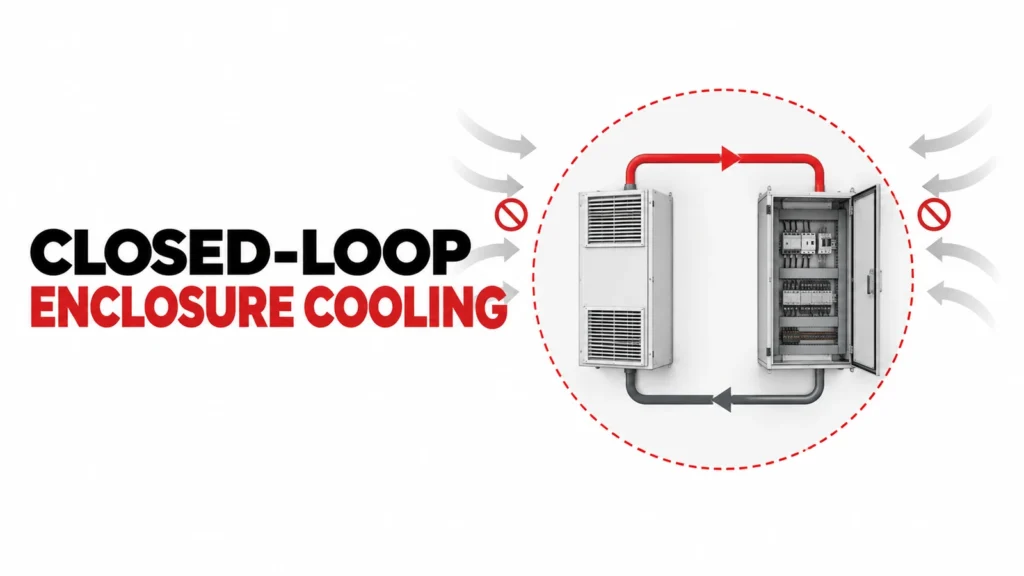
This explainer defines closed-loop enclosure cooling at an architectural level. It does not calculate cooling capacity, promise a sealing or ingress result, or claim that every enclosure air conditioner isolates internal and ambient air in the same way.
Aperçu des éléments d'aide à la décision
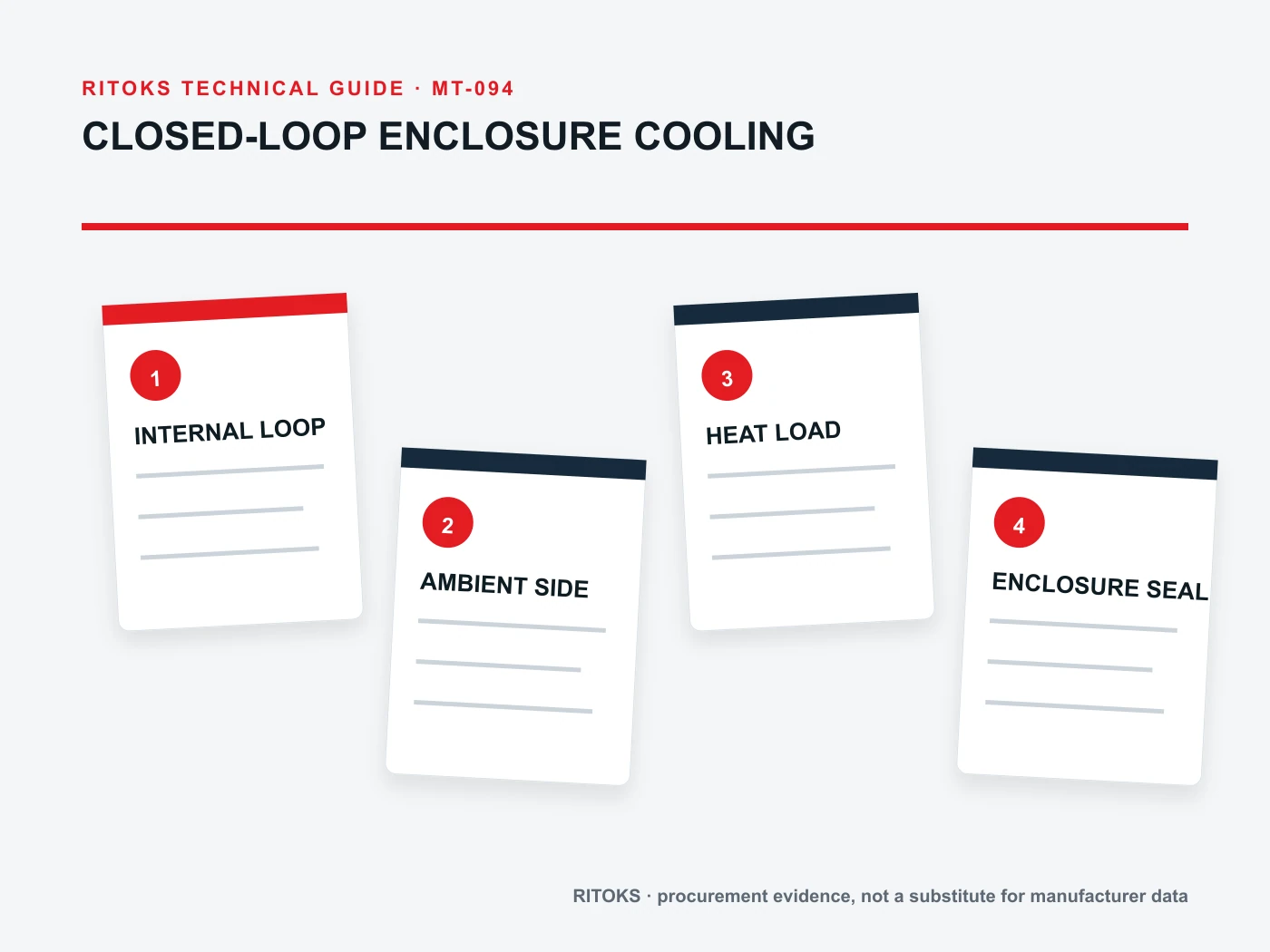
| Champ « Avis » | L'acheteur doit préciser | Pièces à demander |
|---|---|---|
| Internal circuit | Cabinet air recirculation and component temperature objective | System design and equipment documentation |
| External circuit | Ambient-side heat rejection and installation clearance | Exact installation manual |
| Thermal load | Component losses and other heat inputs | Project heat-loss schedule |
| Limite | Openings, door condition, cable entries and enclosure construction | Enclosure inspection record |
| Environnement | Ambient temperature, contamination, humidity and service access | Site conditions and maintenance plan |
The Loop Refers to Air Separation
Closed-loop enclosure cooling generally describes an architecture in which cabinet air is recirculated through a cooling device while heat is rejected through a separate ambient-side path. The intent is different from bringing outside air directly through the enclosure. The exact construction and separation still depend on the selected equipment.
The phrase does not mean that the entire cabinet is automatically sealed, contamination-proof or moisture-proof. Cable entries, doors, gaskets, drains and installation workmanship remain part of the boundary. Ask what the exact product does and what the complete enclosure achieves.
Why Ambient-Air Ventilation Is Different
A filter fan or open ventilation path exchanges cabinet air with the surrounding environment. That can be effective when ambient air is suitable and the target cabinet temperature can remain above ambient. Closed-loop cooling instead uses a heat-transfer system intended to avoid direct process-air exchange through the cooling circuit.
These architectures should not be compared from airflow and cooling-capacity headlines as if they were equivalent units. Start from the environmental boundary, allowable temperature and heat load, then evaluate the suitable method.
Map the Internal and External Thermal Paths
Inside the cabinet, heat leaves components, mixes into the internal air and reaches the cooling device. On the ambient side, the device rejects that heat to its surroundings. Obstructed internal circulation or inadequate external clearance can undermine the intended performance even when the equipment is correctly rated.
Record equipment placement, hot spots, internal obstructions and the route available for recirculated air. Separately record wall spacing, ambient-air access and rejected-heat effects. The two paths need different installation evidence.
Calculate From Heat Load and Conditions
Cooling selection begins with component losses and other heat inputs, the required internal temperature, ambient conditions and enclosure surface behavior. A cabinet size alone is not a heat-load calculation. Use a documented engineering method and exact product performance data at the relevant conditions.
Do not treat a nominal capacity in a product title as a universal delivered result. Capacity can depend on temperature conditions and installation details. The quotation should show the selection basis and keep all assumptions visible.
Protect the Enclosure Boundary During Installation
A closed-loop concept can be defeated by unmanaged openings, damaged seals or installation details that create unwanted air exchange. Review door gaskets, cable entries, mounting cutouts, drainage and service penetrations as part of the enclosure system.
The cooling-unit drawing should define its mounting interface and required clearances. Any sealing, condensate or drainage provisions must come from the exact installation instructions. Avoid generic field modifications that are not supported by those documents.
Plan Maintenance on Both Sides of the Boundary
Closed-loop equipment still needs inspection and service. Ambient-side surfaces can collect dirt, and internal circulation paths can become obstructed. The maintenance plan should define access, cleaning, alarm response and the conditions that trigger further investigation.
Keep maintenance claims precise. The absence of a direct ventilation filter does not mean maintenance-free operation. Ask the supplier for the exact schedule and preserve it with the cabinet documentation.
Créer un dossier de preuves basé sur un modèle exact
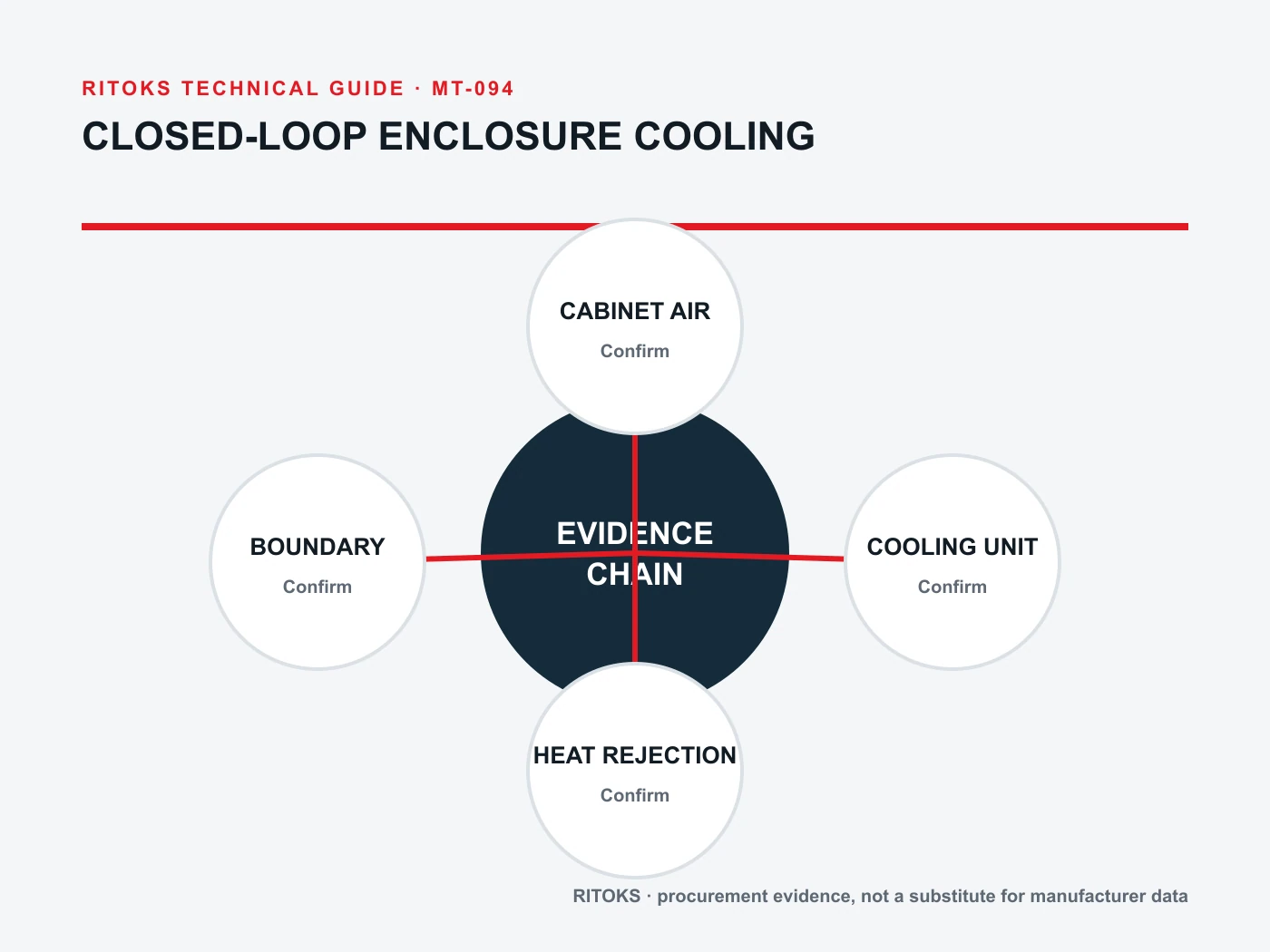
Create one approval record for the proposed Enclosure Air Conditioner order code. Put each project requirement beside the supplier document that answers it. Preserve the exact datasheet, drawing, table, instruction or selection output used, including its revision or retrieval date. A category page can establish family context, but it cannot prove an exact rating, terminal arrangement or system combination.
Vérifiez que chaque description acceptée correspond bien au même article commandable. Des boîtiers d'apparence similaire peuvent contenir des circuits, des alimentations, des bornes, des accessoires ou des fonctions différents. Ne combinez pas le nombre maximal autorisé pour une famille provenant d'une variante, un schéma provenant d'une autre et une option provenant d'une troisième. Indiquez clairement les champs non renseignés afin qu'ils restent visibles lors de la révision commerciale.
Séparer les données d'entrée du projet des éléments probants relatifs au produit
L'équipe chargée du projet définit le cahier des charges de l'application : source, charge, régime de fonctionnement, environnement, commandes, limites mécaniques et fonctions requises. Le fournisseur identifie un climatiseur d'armoire précis et étaye son choix à l'aide de documents précis. Aucune des deux parties ne doit combler une lacune en se basant sur des suppositions liées à l'apparence, à un nom de famille commun ou à une valeur nominale correspondante.
Geler le dossier de demande pendant la comparaison des devis. Si la topologie, la source, la charge, l'environnement, le boîtier ou les performances requises changent, émettre un dossier révisé et demander à chaque fournisseur de reconfirmer son offre. Sinon, des devis apparemment comparables pourraient en réalité répondre à des exigences techniques différentes.
Erreurs courantes en matière de passation de marchés
Avoid selecting a Enclosure Air Conditioner from one headline value while the application context remains incomplete. Do not use a circuit, curve, terminal drawing or performance claim from a neighboring model. A product photograph and a family page can support discovery, but neither is exact technical evidence.
Évitez également de supposer qu'un accessoire, une fonction de communication, un rôle de protection ou un résultat coordonné est inclus, à moins que cela ne figure dans le devis et dans la documentation relative au modèle exact. Tout produit de remplacement doit présenter la même topologie, les mêmes caractéristiques techniques, les mêmes modalités de montage et faire l'objet d'une même évaluation des preuves que le produit initialement retenu.
Comment comparer les offres des fournisseurs
Normalize every Enclosure Air Conditioner offer to the same application record. Keep document revisions, stated conditions, included accessories and open questions beside each value. This makes differences in delivered scope visible and prevents a lower-cost but narrower offer from appearing equivalent to a complete solution.
Cessez toute comparaison lorsqu'une donnée d'entrée essentielle à l'application est inconnue, que le modèle cité est ambigu, qu'une spécification requise n'est étayée que par un autre fabricant ou un autre code de commande, ou que l'installation ne correspond à aucun des cas documentés. Il s'agit là de lacunes techniques, et non de détails rédactionnels.
Contrôle des révisions et des remplacements
Give the approved Enclosure Air Conditioner record a revision identifier and keep it with the project file. If the supplier changes the order code, accessory, firmware, drawing or stated operating condition, identify the change before accepting it. A substitution is a new technical proposal even when its price, housing or product-family name looks familiar.
Ne refaites que les vérifications concernées, mais ne les ignorez pas. Vérifiez que le candidat révisé correspond toujours à la demande « gelée », que tous les documents référencés y sont bien rattachés et que toutes les exceptions en suspens ont un responsable. Cette petite étape de contrôle des modifications empêche qu’une sélection ayant fait l’objet d’une validation technique ne soit remplacée par un équivalent commercial non validé.
Processus décisionnel
- Verrouillez l'application et le fichier système avant de choisir un code de catalogue.
- Identifiez la fonction exacte et chaque interface pour laquelle des justificatifs sont nécessaires.
- Veuillez nous fournir un code de commande complet, accompagné de la fiche technique et des plans actuels.
- Mettre en correspondance chaque exigence du projet avec une déclaration spécifique du fabricant.
- Consignez les écarts, les éléments complémentaires, les révisions de documents et les questions en suspens.
- Répétez cet examen chaque fois que l'application ou le produit proposé fait l'objet de modifications.
Use this workflow as a procurement and evidence discipline. It does not replace qualified design, installation instructions or the responsible engineer's approval for the Enclosure Air Conditioner application.
Liste de contrôle pour la préparation d'un appel d'offres
A practical closed loop enclosure cooling should be concise enough for a supplier to answer and complete enough to prevent silent assumptions. Identify unknown values as questions rather than allowing them to become undocumented selections.
- Internal circuit: Cabinet air recirculation and component temperature objective.
- External circuit: Ambient-side heat rejection and installation clearance.
- Thermal load: Component losses and other heat inputs.
- Boundary: Openings, door condition, cable entries and enclosure construction.
- Environment: Ambient temperature, contamination, humidity and service access.
- Code produit exact, accessoires fournis et version de la documentation
- Quantité, destination, autorisations requises et portée commerciale
Demandez à connaître le champ d'application précis de toute spécification relative à la classification, à la compatibilité, à la coordination ou aux performances. Indiquez la quantité et la destination après les données techniques afin que les conditions commerciales ne masquent pas les questions techniques non résolues.
Foire aux questions
Does closed-loop cooling make an enclosure airtight?
No. The complete enclosure boundary and installation details must be evaluated separately.
Can closed-loop cooling reduce temperature below ambient?
Some architectures may, but the exact capability must be verified from product data at the stated conditions.
Is a filter fan a closed-loop device?
No. A filter-fan system normally exchanges enclosure air with ambient air.
Produits RITOKS associés et conseils d'utilisation
Ces liens fournissent uniquement des informations contextuelles sur les familles de produits. Un lien contextuel ne sous-entend en aucun cas une interchangeabilité, une compatibilité ou une combinaison de systèmes homologuée.
Catégorie de produits « Climatiseurs d'enceinte »
Références techniques
Ces sources provenant des fabricants ne servent qu'à étayer les principes généraux d'ingénierie décrits ci-dessous. Les caractéristiques techniques, schémas électriques, homologations et résultats de coordination de leurs produits ne s'appliquent pas aux produits RITOKS.
Rittal, Catalogue des systèmes techniques : Refroidissement par air ambiant
Supports enclosure heat-load, temperature-difference and air-exchange concepts. Rittal formulas and product values apply only under their stated conditions.
Rittal, conception des systèmes de climatisation RiTherm
Supports treating enclosure climate control as a documented heat-load and environmental calculation. It does not size a RITOKS product.
Demander une analyse du modèle exact
Veuillez envoyer les exigences relatives à la demande, les questions précises concernant les documents, la quantité et la destination via le formulaire de contact RITOKS. Une demande de devis (RFQ) nécessite l'examen d'un modèle précis ; ce guide n'autorise pas le remplacement d'un circuit, d'une installation ou d'un dispositif automatique.