
Enclosure Air Conditioners for Control Cabinets · Technical Explainer
Closed-Loop Enclosure Cooling: What It Means
Understand closed-loop enclosure cooling, its separation from ambient air exchange and the evidence needed before selection. A useful buyer review connects the project requirement to one exact orderable product and preserves the evidence used for approval.
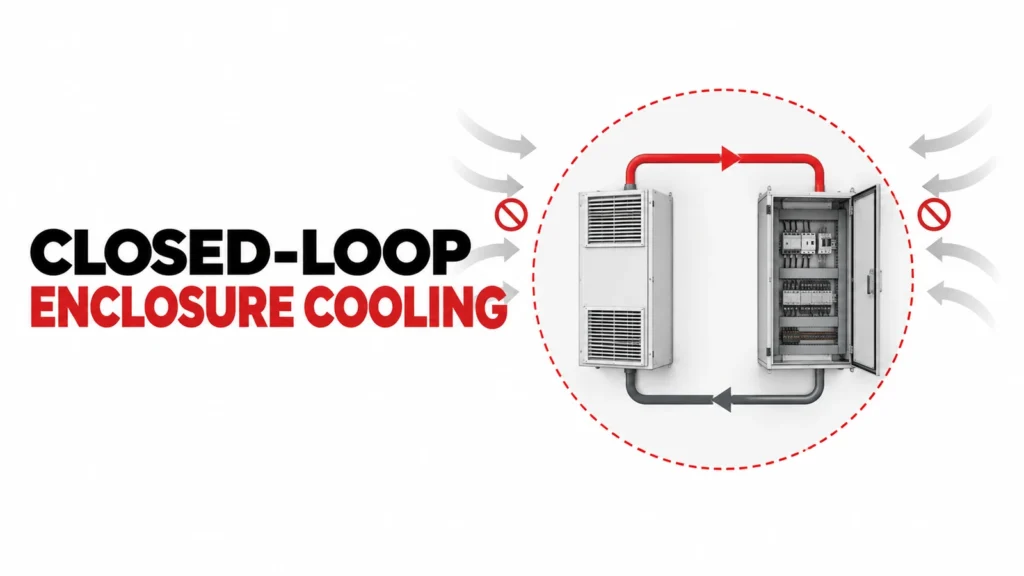
This explainer defines closed-loop enclosure cooling at an architectural level. It does not calculate cooling capacity, promise a sealing or ingress result, or claim that every enclosure air conditioner isolates internal and ambient air in the same way.
De beslissingsfactoren in één oogopslag
| Beoordelingsveld | De koper moet het volgende vaststellen: | Te vragen bewijsstukken |
|---|---|---|
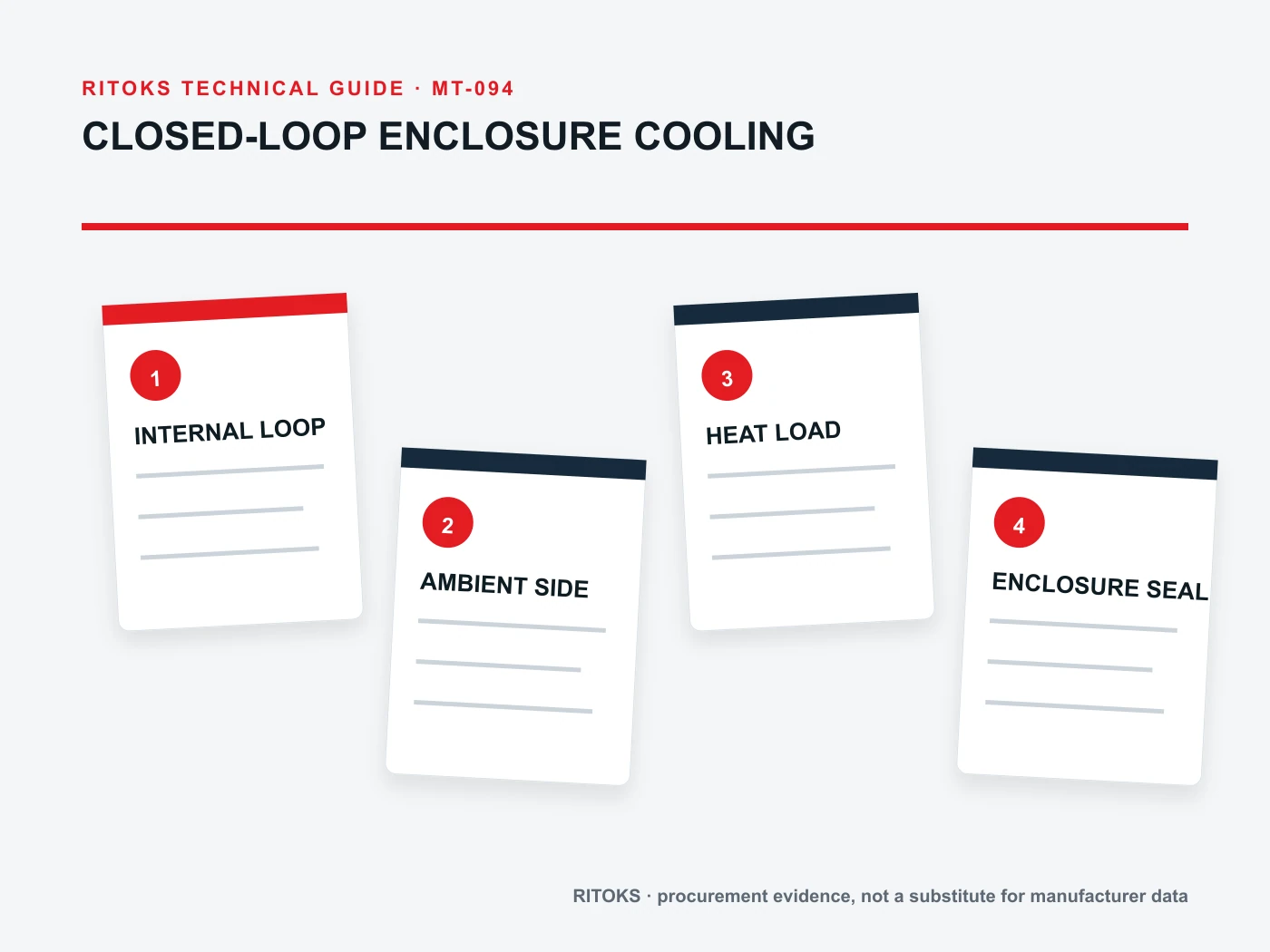
| Internal circuit | Cabinet air recirculation and component temperature objective | System design and equipment documentation |
| External circuit | Ambient-side heat rejection and installation clearance | Exact installation manual |
| Thermal load | Component losses and other heat inputs | Project heat-loss schedule |
| Grens | Openings, door condition, cable entries and enclosure construction | Enclosure inspection record |
| Milieu | Ambient temperature, contamination, humidity and service access | Site conditions and maintenance plan |
The Loop Refers to Air Separation
Closed-loop enclosure cooling generally describes an architecture in which cabinet air is recirculated through a cooling device while heat is rejected through a separate ambient-side path. The intent is different from bringing outside air directly through the enclosure. The exact construction and separation still depend on the selected equipment.
The phrase does not mean that the entire cabinet is automatically sealed, contamination-proof or moisture-proof. Cable entries, doors, gaskets, drains and installation workmanship remain part of the boundary. Ask what the exact product does and what the complete enclosure achieves.
Why Ambient-Air Ventilation Is Different
A filter fan or open ventilation path exchanges cabinet air with the surrounding environment. That can be effective when ambient air is suitable and the target cabinet temperature can remain above ambient. Closed-loop cooling instead uses a heat-transfer system intended to avoid direct process-air exchange through the cooling circuit.
These architectures should not be compared from airflow and cooling-capacity headlines as if they were equivalent units. Start from the environmental boundary, allowable temperature and heat load, then evaluate the suitable method.
Map the Internal and External Thermal Paths
Inside the cabinet, heat leaves components, mixes into the internal air and reaches the cooling device. On the ambient side, the device rejects that heat to its surroundings. Obstructed internal circulation or inadequate external clearance can undermine the intended performance even when the equipment is correctly rated.
Record equipment placement, hot spots, internal obstructions and the route available for recirculated air. Separately record wall spacing, ambient-air access and rejected-heat effects. The two paths need different installation evidence.
Calculate From Heat Load and Conditions
Cooling selection begins with component losses and other heat inputs, the required internal temperature, ambient conditions and enclosure surface behavior. A cabinet size alone is not a heat-load calculation. Use a documented engineering method and exact product performance data at the relevant conditions.
Do not treat a nominal capacity in a product title as a universal delivered result. Capacity can depend on temperature conditions and installation details. The quotation should show the selection basis and keep all assumptions visible.
Protect the Enclosure Boundary During Installation
A closed-loop concept can be defeated by unmanaged openings, damaged seals or installation details that create unwanted air exchange. Review door gaskets, cable entries, mounting cutouts, drainage and service penetrations as part of the enclosure system.
The cooling-unit drawing should define its mounting interface and required clearances. Any sealing, condensate or drainage provisions must come from the exact installation instructions. Avoid generic field modifications that are not supported by those documents.
Plan Maintenance on Both Sides of the Boundary
Closed-loop equipment still needs inspection and service. Ambient-side surfaces can collect dirt, and internal circulation paths can become obstructed. The maintenance plan should define access, cleaning, alarm response and the conditions that trigger further investigation.
Keep maintenance claims precise. The absence of a direct ventilation filter does not mean maintenance-free operation. Ask the supplier for the exact schedule and preserve it with the cabinet documentation.
Een bewijsmap op basis van een exact model samenstellen
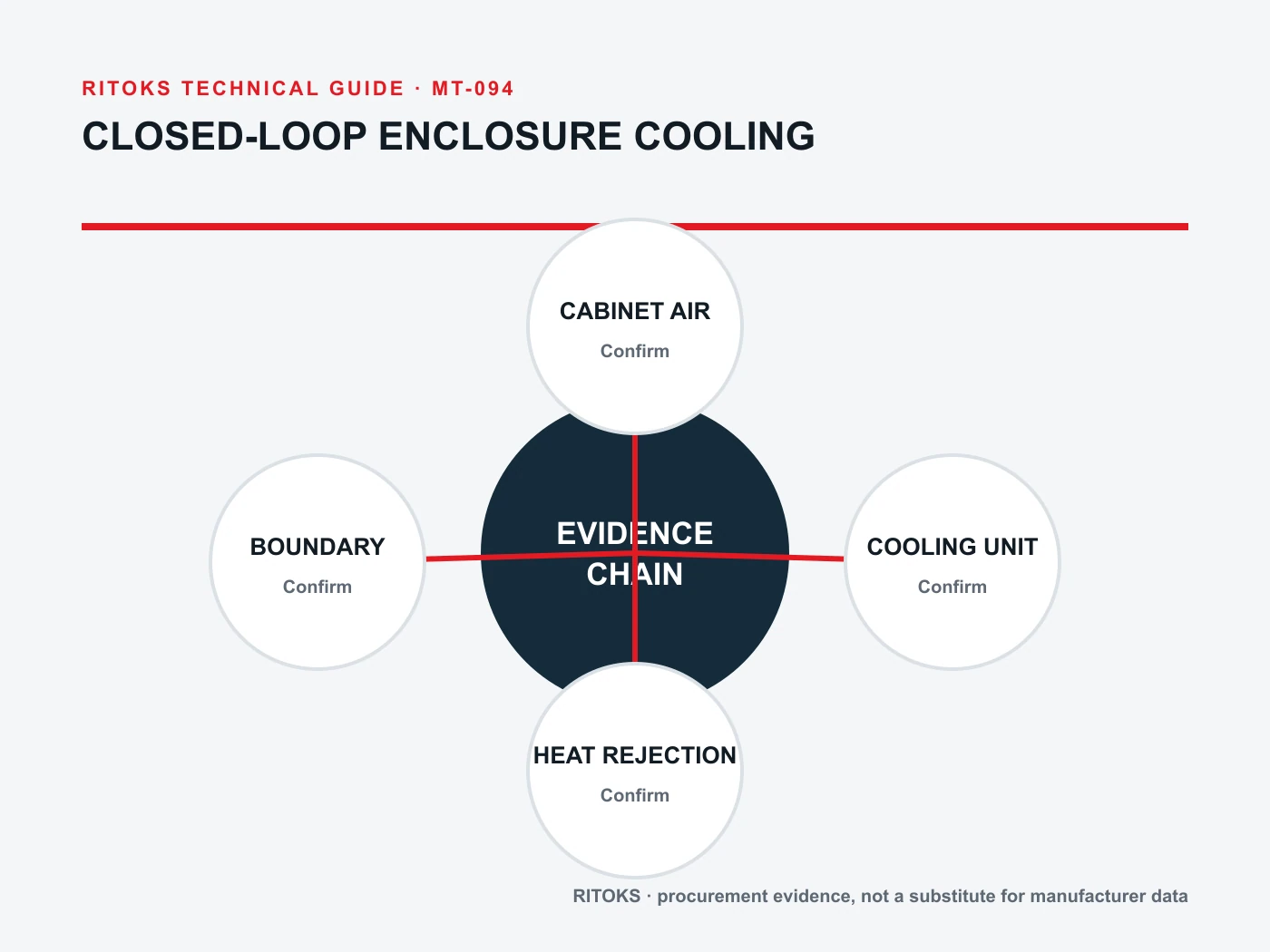
Create one approval record for the proposed Enclosure Air Conditioner order code. Put each project requirement beside the supplier document that answers it. Preserve the exact datasheet, drawing, table, instruction or selection output used, including its revision or retrieval date. A category page can establish family context, but it cannot prove an exact rating, terminal arrangement or system combination.
Controleer of elke geaccepteerde specificatie hetzelfde bestelbare artikel beschrijft. Vergelijkbare behuizingen kunnen verschillende schakelingen, voedingen, aansluitingen, accessoires of functies bevatten. Combineer niet het maximale aantal per productfamilie van de ene variant, een schema van een andere en een optionele functie van een derde. Markeer onvolledig ingevulde velden duidelijk, zodat ze zichtbaar blijven tijdens de commerciële beoordeling.
Houd projectgegevens gescheiden van productbewijs
Het projectteam definieert de toepassing: bron, belasting, bedrijfsduur, omgeving, besturing, mechanische beperkingen en vereiste functies. De leverancier selecteert een specifieke behuizing-airconditioner en onderbouwt deze keuze met gedetailleerde documentatie. Geen van beide partijen mag een leemte opvullen door conclusies te trekken op basis van het uiterlijk, een gemeenschappelijke productnaam of een overeenkomende nominale waarde.
Bevries het aanvraagdossier terwijl de offertes worden vergeleken. Als de topologie, de bron, de belasting, de omgeving, de behuizing of de vereiste output veranderen, stel dan een bijgewerkt dossier op en vraag elke leverancier om de kandidaat opnieuw te bevestigen. Anders kan het zijn dat ogenschijnlijk vergelijkbare offertes op verschillende technische vereisten betrekking hebben.
Veelvoorkomende fouten bij aanbestedingen
Avoid selecting a Enclosure Air Conditioner from one headline value while the application context remains incomplete. Do not use a circuit, curve, terminal drawing or performance claim from a neighboring model. A product photograph and a family page can support discovery, but neither is exact technical evidence.
Ga er ook niet zomaar vanuit dat een accessoire, communicatiefunctie, beschermingsfunctie of gecoördineerd resultaat is inbegrepen, tenzij dit in de offerte en de documentatie van het exacte model wordt vermeld. Een vervangend onderdeel moet voldoen aan dezelfde topologie, nominale waarden, montagevoorschriften en beoordeling van bewijsmateriaal als het oorspronkelijke onderdeel.
Hoe vergelijk je offertes van leveranciers?
Normalize every Enclosure Air Conditioner offer to the same application record. Keep document revisions, stated conditions, included accessories and open questions beside each value. This makes differences in delivered scope visible and prevents a lower-cost but narrower offer from appearing equivalent to a complete solution.
Stop met vergelijken wanneer een cruciale invoerwaarde voor de toepassing onbekend is, het genoemde model dubbelzinnig is, een vereiste specificatie alleen door een andere fabrikant of bestelcode wordt ondersteund, of wanneer de installatie buiten het beschikbare bewijsmateriaal valt. Dit zijn technische hiaten, geen redactionele details.
Wijzigingen en vervangingen beheren
Give the approved Enclosure Air Conditioner record a revision identifier and keep it with the project file. If the supplier changes the order code, accessory, firmware, drawing or stated operating condition, identify the change before accepting it. A substitution is a new technical proposal even when its price, housing or product-family name looks familiar.
Herhaal alleen de betreffende controles, maar zie er niet van af. Controleer of de herziene kandidaat nog steeds voldoet aan de vastgelegde specificaties, of alle documenten waarnaar wordt verwezen er deel van uitmaken en of alle openstaande uitzonderingen een verantwoordelijke hebben. Deze kleine stap in het wijzigingsbeheer voorkomt dat een technisch beoordeelde selectie wordt vervangen door een niet-beoordeeld commercieel equivalent.
Besluitvormingsproces
- Zet de applicatie en het systeemrecord op pauze voordat u een cataloguscode kiest.
- Geef aan wat de exacte functie is en welke interfaces bewijs vereisen.
- Gelieve één volledige bestelcode aan te vragen, inclusief het bijbehorende actuele gegevensblad en de tekeningen.
- Koppel elke projecteis aan een specifieke verklaring van de fabrikant.
- Noteer afwijkingen, accessoires, documentwijzigingen en onopgeloste vragen.
- Herhaal de beoordeling telkens wanneer de toepassing of het voorgestelde product verandert.
Use this workflow as a procurement and evidence discipline. It does not replace qualified design, installation instructions or the responsible engineer's approval for the Enclosure Air Conditioner application.
Checklist voor het opstellen van een offerteaanvraag
A practical closed loop enclosure cooling should be concise enough for a supplier to answer and complete enough to prevent silent assumptions. Identify unknown values as questions rather than allowing them to become undocumented selections.
- Internal circuit: Cabinet air recirculation and component temperature objective.
- External circuit: Ambient-side heat rejection and installation clearance.
- Thermal load: Component losses and other heat inputs.
- Boundary: Openings, door condition, cable entries and enclosure construction.
- Environment: Ambient temperature, contamination, humidity and service access.
- Exacte productcode, meegeleverde accessoires en revisienummer van de documentatie
- Hoeveelheid, bestemming, vereiste goedkeuringen en commerciële reikwijdte
Vraag naar de exacte reikwijdte van elke bewering met betrekking tot classificatie, compatibiliteit, coördinatie of prestaties. Noteer de hoeveelheid en de bestemming na de technische gegevens, zodat commerciële voorwaarden geen onopgeloste technische kwesties verhullen.
Veelgestelde vragen
Does closed-loop cooling make an enclosure airtight?
No. The complete enclosure boundary and installation details must be evaluated separately.
Can closed-loop cooling reduce temperature below ambient?
Some architectures may, but the exact capability must be verified from product data at the stated conditions.
Is a filter fan a closed-loop device?
No. A filter-fan system normally exchanges enclosure air with ambient air.
Gerelateerde RITOKS-producten en richtlijnen
Deze links geven uitsluitend informatie over de productfamilie. Een contextuele link impliceert geen uitwisselbaarheid, compatibiliteit of een goedgekeurde systeemcombinatie.
Productcategorie: Airconditioners voor binnenruimtes
EP-A-airconditioners voor binnenruimtes
Technische referenties
Deze bronnen van fabrikanten ondersteunen uitsluitend de hieronder beschreven algemene technische concepten. Hun productspecificaties, schakelschema’s, goedkeuringen en coördinatieresultaten zijn niet van toepassing op RITOKS-producten.
Rittal, Technische systeemcatalogus: Koeling met omgevingslucht
Supports enclosure heat-load, temperature-difference and air-exchange concepts. Rittal formulas and product values apply only under their stated conditions.
Rittal, RiTherm-klimaatbeheersingsplanning
Supports treating enclosure climate control as a documented heat-load and environmental calculation. It does not size a RITOKS product.
Vraag een beoordeling van het exacte model aan
Stuur de aanvraagvereisten, vragen over de exacte documenten, de hoeveelheid en de bestemming via het RITOKS-contactformulier. Een offerteaanvraag vereist een beoordeling van het exacte model; deze handleiding keurt geen schakeling, installatie of automatisch alternatief goed.