
Enclosure Air Conditioners for Control Cabinets · Technical Explainer
Closed-Loop Enclosure Cooling: What It Means
Understand closed-loop enclosure cooling, its separation from ambient air exchange and the evidence needed before selection. A useful buyer review connects the project requirement to one exact orderable product and preserves the evidence used for approval.
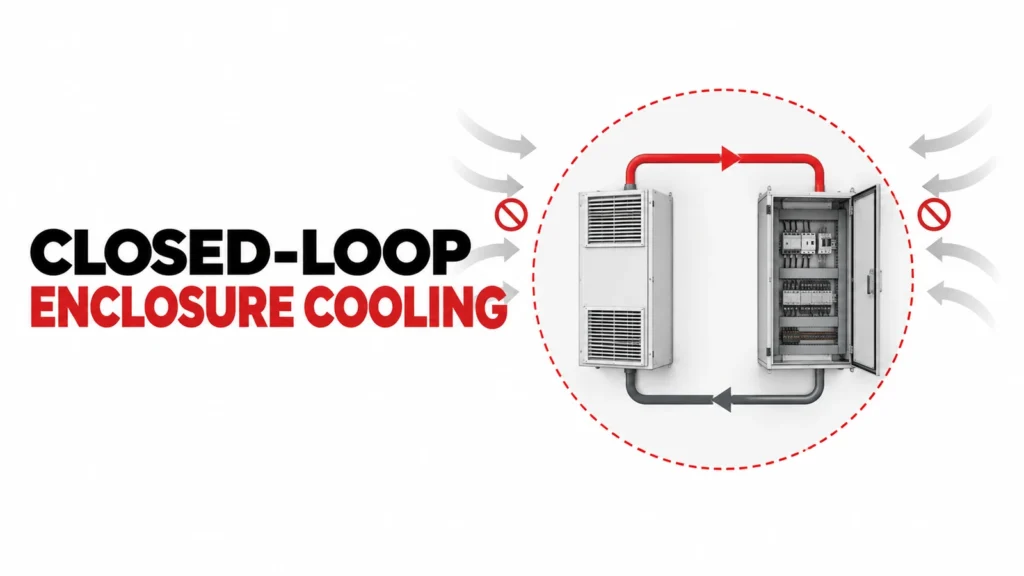
This explainer defines closed-loop enclosure cooling at an architectural level. It does not calculate cooling capacity, promise a sealing or ingress result, or claim that every enclosure air conditioner isolates internal and ambient air in the same way.
Короткий огляд даних, що враховуються при прийнятті рішень
| Поле для відгуку | Покупець повинен визначити | Докази, які слід вимагати |
|---|---|---|
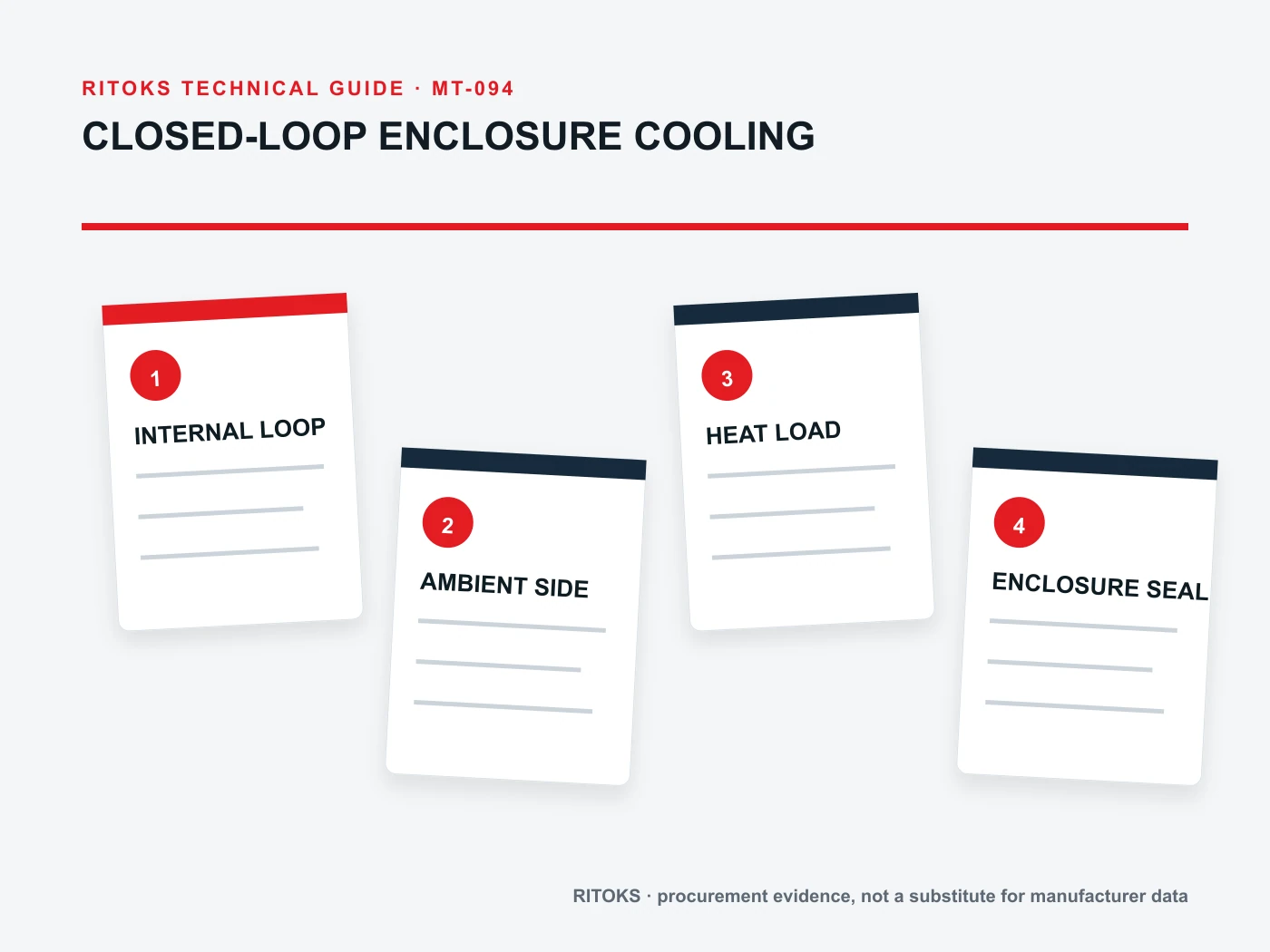
| Internal circuit | Cabinet air recirculation and component temperature objective | System design and equipment documentation |
| External circuit | Ambient-side heat rejection and installation clearance | Exact installation manual |
| Thermal load | Component losses and other heat inputs | Project heat-loss schedule |
| Межа | Openings, door condition, cable entries and enclosure construction | Enclosure inspection record |
| Навколишнє середовище | Ambient temperature, contamination, humidity and service access | Site conditions and maintenance plan |
The Loop Refers to Air Separation
Closed-loop enclosure cooling generally describes an architecture in which cabinet air is recirculated through a cooling device while heat is rejected through a separate ambient-side path. The intent is different from bringing outside air directly through the enclosure. The exact construction and separation still depend on the selected equipment.
The phrase does not mean that the entire cabinet is automatically sealed, contamination-proof or moisture-proof. Cable entries, doors, gaskets, drains and installation workmanship remain part of the boundary. Ask what the exact product does and what the complete enclosure achieves.
Why Ambient-Air Ventilation Is Different
A filter fan or open ventilation path exchanges cabinet air with the surrounding environment. That can be effective when ambient air is suitable and the target cabinet temperature can remain above ambient. Closed-loop cooling instead uses a heat-transfer system intended to avoid direct process-air exchange through the cooling circuit.
These architectures should not be compared from airflow and cooling-capacity headlines as if they were equivalent units. Start from the environmental boundary, allowable temperature and heat load, then evaluate the suitable method.
Map the Internal and External Thermal Paths
Inside the cabinet, heat leaves components, mixes into the internal air and reaches the cooling device. On the ambient side, the device rejects that heat to its surroundings. Obstructed internal circulation or inadequate external clearance can undermine the intended performance even when the equipment is correctly rated.
Record equipment placement, hot spots, internal obstructions and the route available for recirculated air. Separately record wall spacing, ambient-air access and rejected-heat effects. The two paths need different installation evidence.
Calculate From Heat Load and Conditions
Cooling selection begins with component losses and other heat inputs, the required internal temperature, ambient conditions and enclosure surface behavior. A cabinet size alone is not a heat-load calculation. Use a documented engineering method and exact product performance data at the relevant conditions.
Do not treat a nominal capacity in a product title as a universal delivered result. Capacity can depend on temperature conditions and installation details. The quotation should show the selection basis and keep all assumptions visible.
Protect the Enclosure Boundary During Installation
A closed-loop concept can be defeated by unmanaged openings, damaged seals or installation details that create unwanted air exchange. Review door gaskets, cable entries, mounting cutouts, drainage and service penetrations as part of the enclosure system.
The cooling-unit drawing should define its mounting interface and required clearances. Any sealing, condensate or drainage provisions must come from the exact installation instructions. Avoid generic field modifications that are not supported by those documents.
Plan Maintenance on Both Sides of the Boundary
Closed-loop equipment still needs inspection and service. Ambient-side surfaces can collect dirt, and internal circulation paths can become obstructed. The maintenance plan should define access, cleaning, alarm response and the conditions that trigger further investigation.
Keep maintenance claims precise. The absence of a direct ventilation filter does not mean maintenance-free operation. Ask the supplier for the exact schedule and preserve it with the cabinet documentation.
Створити файл доказів на основі точної моделі
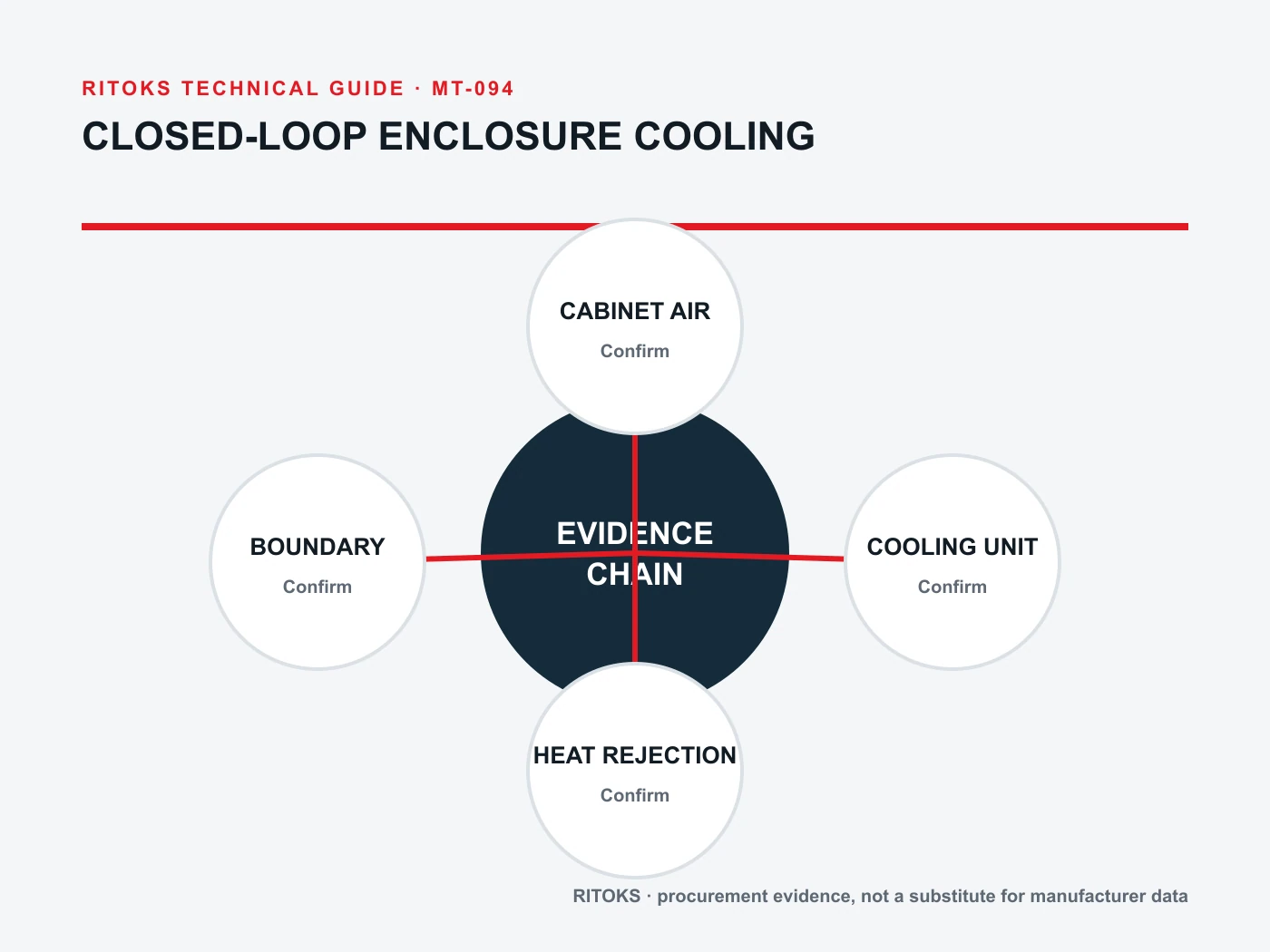
Create one approval record for the proposed Enclosure Air Conditioner order code. Put each project requirement beside the supplier document that answers it. Preserve the exact datasheet, drawing, table, instruction or selection output used, including its revision or retrieval date. A category page can establish family context, but it cannot prove an exact rating, terminal arrangement or system combination.
Переконайтеся, що кожне затверджене твердження описує один і той самий товар, який можна замовити. Схожі корпуси можуть містити різні схеми, джерела живлення, клеми, аксесуари або функції. Не поєднуйте максимальну кількість одиниць у серії з одного варіанту, схему з іншого та додаткову функцію з третього. Чітко позначте поля, щодо яких ще не прийнято рішення, щоб вони залишалися видимими під час комерційного огляду.
Розділяйте вхідні дані проєкту та докази щодо продукту
Проектна команда визначає технічні характеристики обладнання: джерело живлення, навантаження, режим роботи, умови експлуатації, засоби управління, механічні обмеження та необхідні функції. Постачальник визначає конкретну модель кондиціонера в корпусі та підтверджує свій вибір відповідною документацією. Жодна зі сторін не повинна заповнювати прогалини, спираючись на зовнішні ознаки, спільну назву серії або збіг одного номінального значення.
Зафіксуйте дані заявки на час порівняння комерційних пропозицій. Якщо зміняться топологія, джерело живлення, навантаження, умови експлуатації, корпус або необхідні вихідні параметри, опублікуйте оновлену версію заявки та попросіть кожного постачальника ще раз підтвердити відповідність його пропозиції вимогам. Інакше, на перший погляд, схожі комерційні пропозиції можуть відповідати різним технічним вимогам.
Поширені помилки при проведенні закупівель
Avoid selecting a Enclosure Air Conditioner from one headline value while the application context remains incomplete. Do not use a circuit, curve, terminal drawing or performance claim from a neighboring model. A product photograph and a family page can support discovery, but neither is exact technical evidence.
Також не слід припускати, що певний аксесуар, функція зв’язку, захисна роль або узгоджений результат включені до замовлення, якщо це не зазначено в комерційній пропозиції та документації щодо конкретної моделі. Замінник повинен відповідати оригінальному варіанту за топологією, технічними характеристиками, способом кріплення та результатами перевірки.
Як порівняти пропозиції постачальників
Normalize every Enclosure Air Conditioner offer to the same application record. Keep document revisions, stated conditions, included accessories and open questions beside each value. This makes differences in delivered scope visible and prevents a lower-cost but narrower offer from appearing equivalent to a complete solution.
Припиніть порівняння, якщо невідомі критично важливі вхідні дані застосування, зазначена модель є неоднозначною, необхідні технічні характеристики підтверджуються лише іншим виробником або кодом замовлення, або якщо умови монтажу виходять за межі наявних даних. Це — технічні прогалини, а не редакційні нюанси.
Контроль змін та замін
Give the approved Enclosure Air Conditioner record a revision identifier and keep it with the project file. If the supplier changes the order code, accessory, firmware, drawing or stated operating condition, identify the change before accepting it. A substitution is a new technical proposal even when its price, housing or product-family name looks familiar.
Повторіть лише ті перевірки, яких це стосується, але не відмовляйтеся від них. Переконайтеся, що переглянутий кандидат все ще відповідає замороженому запиту, що кожен документ, на який є посилання, належить до нього, і що всі відкриті винятки мають відповідального. Цей невеликий крок з контролю змін запобігає заміні технічно перевіреного кандидата на неперевірений комерційний еквівалент.
Процес прийняття рішень
- Перед тим, як вибрати код каталогу, зафіксуйте стан програми та системи.
- Визначте точну функцію та кожен інтерфейс, для якого потрібні докази.
- Надішліть один повний код замовлення разом із актуальним технічним описом та кресленнями.
- Зв’яжіть кожну вимогу до проекту з конкретною заявою виробника.
- Фіксуйте відхилення, додаткові елементи, зміни в документації та невирішені питання.
- Повторюйте перевірку щоразу, коли змінюється застосування або характеристики пропонованого продукту.
Use this workflow as a procurement and evidence discipline. It does not replace qualified design, installation instructions or the responsible engineer's approval for the Enclosure Air Conditioner application.
Перелік питань для підготовки запиту на пропозицію
A practical closed loop enclosure cooling should be concise enough for a supplier to answer and complete enough to prevent silent assumptions. Identify unknown values as questions rather than allowing them to become undocumented selections.
- Internal circuit: Cabinet air recirculation and component temperature objective.
- External circuit: Ambient-side heat rejection and installation clearance.
- Thermal load: Component losses and other heat inputs.
- Boundary: Openings, door condition, cable entries and enclosure construction.
- Environment: Ambient temperature, contamination, humidity and service access.
- Точний код товару, комплект поставки та версія документації
- Кількість, пункт призначення, необхідні дозволи та комерційні умови
Запитайте точний обсяг будь-яких вимог щодо класифікації, сумісності, координації або експлуатаційних характеристик. Зафіксуйте кількість та пункт призначення після технічних даних, щоб комерційні умови не затуляли невирішені технічні питання.
Поширені запитання
Does closed-loop cooling make an enclosure airtight?
No. The complete enclosure boundary and installation details must be evaluated separately.
Can closed-loop cooling reduce temperature below ambient?
Some architectures may, but the exact capability must be verified from product data at the stated conditions.
Is a filter fan a closed-loop device?
No. A filter-fan system normally exchanges enclosure air with ambient air.
Пов’язані продукти та рекомендації RITOKS
Ці посилання надають інформацію виключно щодо сімейства продуктів. Контекстне посилання не означає взаємозамінності, сумісності або затвердженої комбінації систем.
Категорія товарів «Кондиціонери для закритих приміщень»
Кондиціонери для приміщень серії EP-A
Технічні довідкові матеріали
Ці джерела від виробників підтверджують лише загальні технічні принципи, описані нижче. Характеристики їхньої продукції, схеми, сертифікати та результати узгодження не поширюються на продукцію компанії RITOKS.
Rittal, Каталог технічних систем: Охолодження за допомогою повітря навколишнього середовища
Supports enclosure heat-load, temperature-difference and air-exchange concepts. Rittal formulas and product values apply only under their stated conditions.
Rittal, Проектування систем клімат-контролю RiTherm
Supports treating enclosure climate control as a documented heat-load and environmental calculation. It does not size a RITOKS product.
Замовити перевірку конкретної моделі
Надішліть вимоги до заявки, конкретні запитання щодо документів, кількість та місце призначення через контактну форму RITOKS. Запит на пропозицію (RFQ) передбачає перевірку конкретної моделі; цей посібник не затверджує схеми, монтаж або автоматичну заміну.