
Enclosure Air Conditioners for Control Cabinets · Technical Explainer
Closed-Loop Enclosure Cooling: What It Means
Understand closed-loop enclosure cooling, its separation from ambient air exchange and the evidence needed before selection. A useful buyer review connects the project requirement to one exact orderable product and preserves the evidence used for approval.
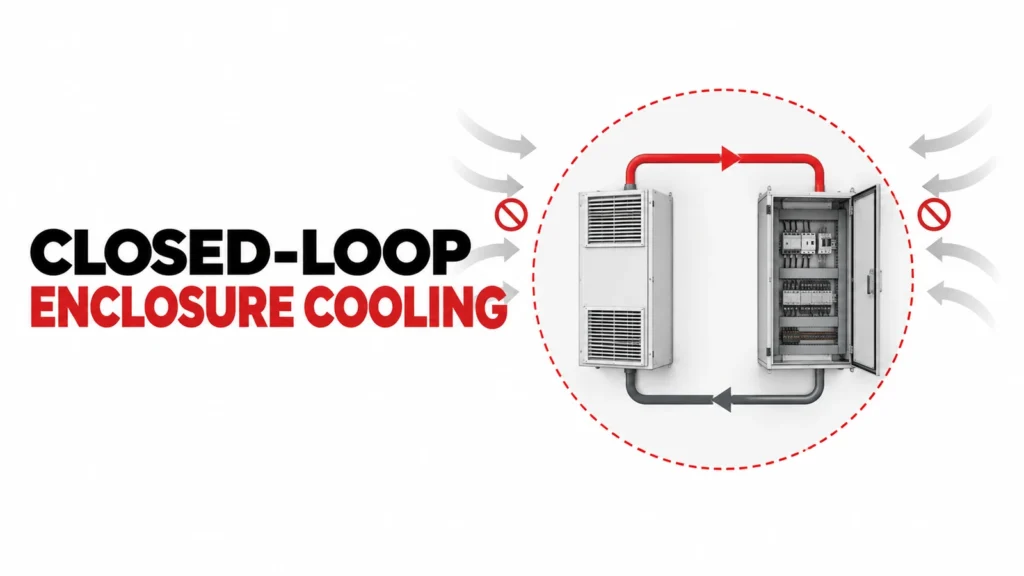
This explainer defines closed-loop enclosure cooling at an architectural level. It does not calculate cooling capacity, promise a sealing or ingress result, or claim that every enclosure air conditioner isolates internal and ambient air in the same way.
Resumen de los datos para la toma de decisiones
| Campo de revisión | El comprador debe definir | Documentación que hay que solicitar |
|---|---|---|
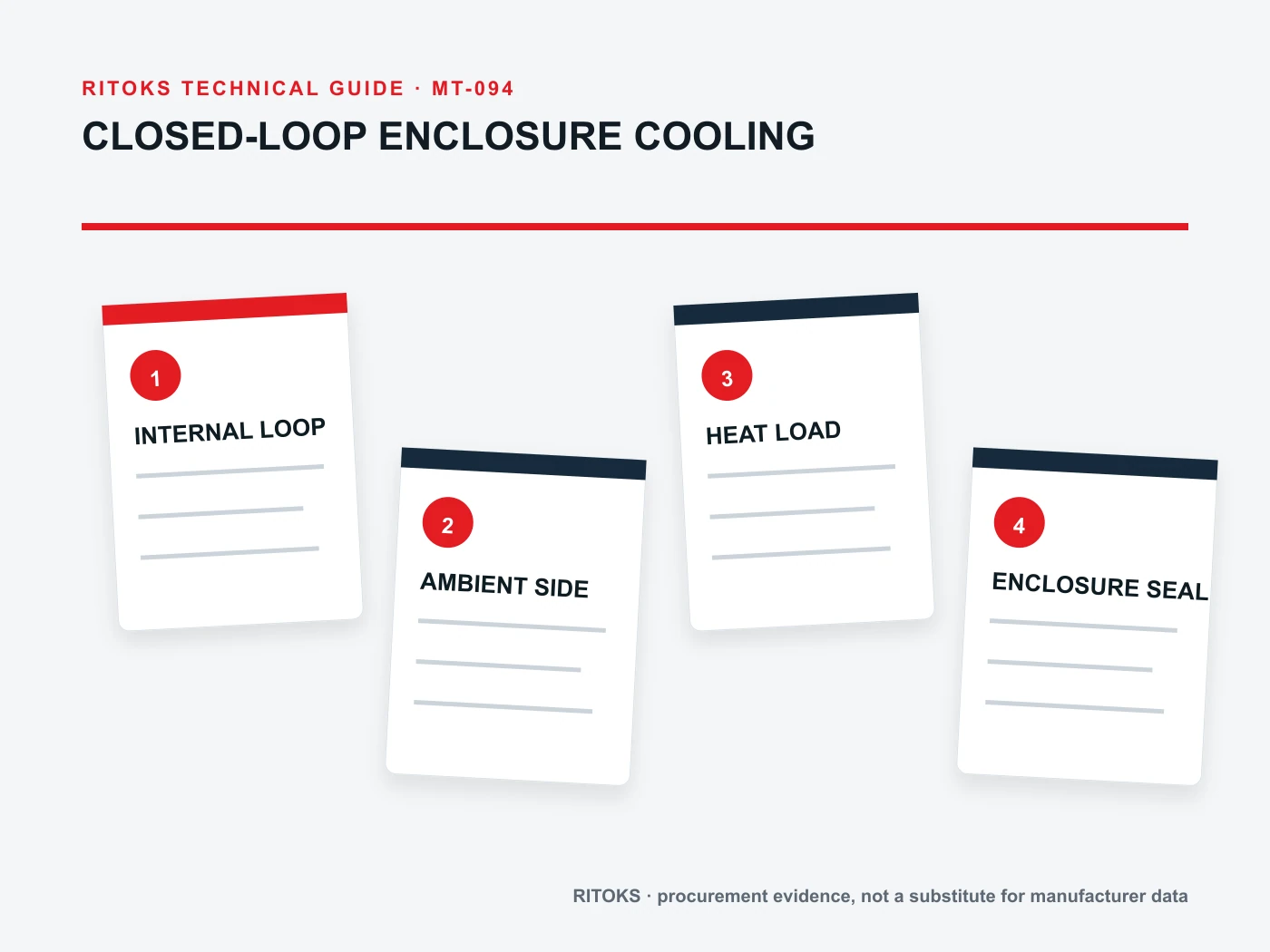
| Internal circuit | Cabinet air recirculation and component temperature objective | System design and equipment documentation |
| External circuit | Ambient-side heat rejection and installation clearance | Exact installation manual |
| Thermal load | Component losses and other heat inputs | Project heat-loss schedule |
| Límite | Openings, door condition, cable entries and enclosure construction | Enclosure inspection record |
| Medio ambiente | Ambient temperature, contamination, humidity and service access | Site conditions and maintenance plan |
The Loop Refers to Air Separation
Closed-loop enclosure cooling generally describes an architecture in which cabinet air is recirculated through a cooling device while heat is rejected through a separate ambient-side path. The intent is different from bringing outside air directly through the enclosure. The exact construction and separation still depend on the selected equipment.
The phrase does not mean that the entire cabinet is automatically sealed, contamination-proof or moisture-proof. Cable entries, doors, gaskets, drains and installation workmanship remain part of the boundary. Ask what the exact product does and what the complete enclosure achieves.
Why Ambient-Air Ventilation Is Different
A filter fan or open ventilation path exchanges cabinet air with the surrounding environment. That can be effective when ambient air is suitable and the target cabinet temperature can remain above ambient. Closed-loop cooling instead uses a heat-transfer system intended to avoid direct process-air exchange through the cooling circuit.
These architectures should not be compared from airflow and cooling-capacity headlines as if they were equivalent units. Start from the environmental boundary, allowable temperature and heat load, then evaluate the suitable method.
Map the Internal and External Thermal Paths
Inside the cabinet, heat leaves components, mixes into the internal air and reaches the cooling device. On the ambient side, the device rejects that heat to its surroundings. Obstructed internal circulation or inadequate external clearance can undermine the intended performance even when the equipment is correctly rated.
Record equipment placement, hot spots, internal obstructions and the route available for recirculated air. Separately record wall spacing, ambient-air access and rejected-heat effects. The two paths need different installation evidence.
Calculate From Heat Load and Conditions
Cooling selection begins with component losses and other heat inputs, the required internal temperature, ambient conditions and enclosure surface behavior. A cabinet size alone is not a heat-load calculation. Use a documented engineering method and exact product performance data at the relevant conditions.
Do not treat a nominal capacity in a product title as a universal delivered result. Capacity can depend on temperature conditions and installation details. The quotation should show the selection basis and keep all assumptions visible.
Protect the Enclosure Boundary During Installation
A closed-loop concept can be defeated by unmanaged openings, damaged seals or installation details that create unwanted air exchange. Review door gaskets, cable entries, mounting cutouts, drainage and service penetrations as part of the enclosure system.
The cooling-unit drawing should define its mounting interface and required clearances. Any sealing, condensate or drainage provisions must come from the exact installation instructions. Avoid generic field modifications that are not supported by those documents.
Plan Maintenance on Both Sides of the Boundary
Closed-loop equipment still needs inspection and service. Ambient-side surfaces can collect dirt, and internal circulation paths can become obstructed. The maintenance plan should define access, cleaning, alarm response and the conditions that trigger further investigation.
Keep maintenance claims precise. The absence of a direct ventilation filter does not mean maintenance-free operation. Ask the supplier for the exact schedule and preserve it with the cabinet documentation.
Crear un archivo de pruebas con un modelo exacto
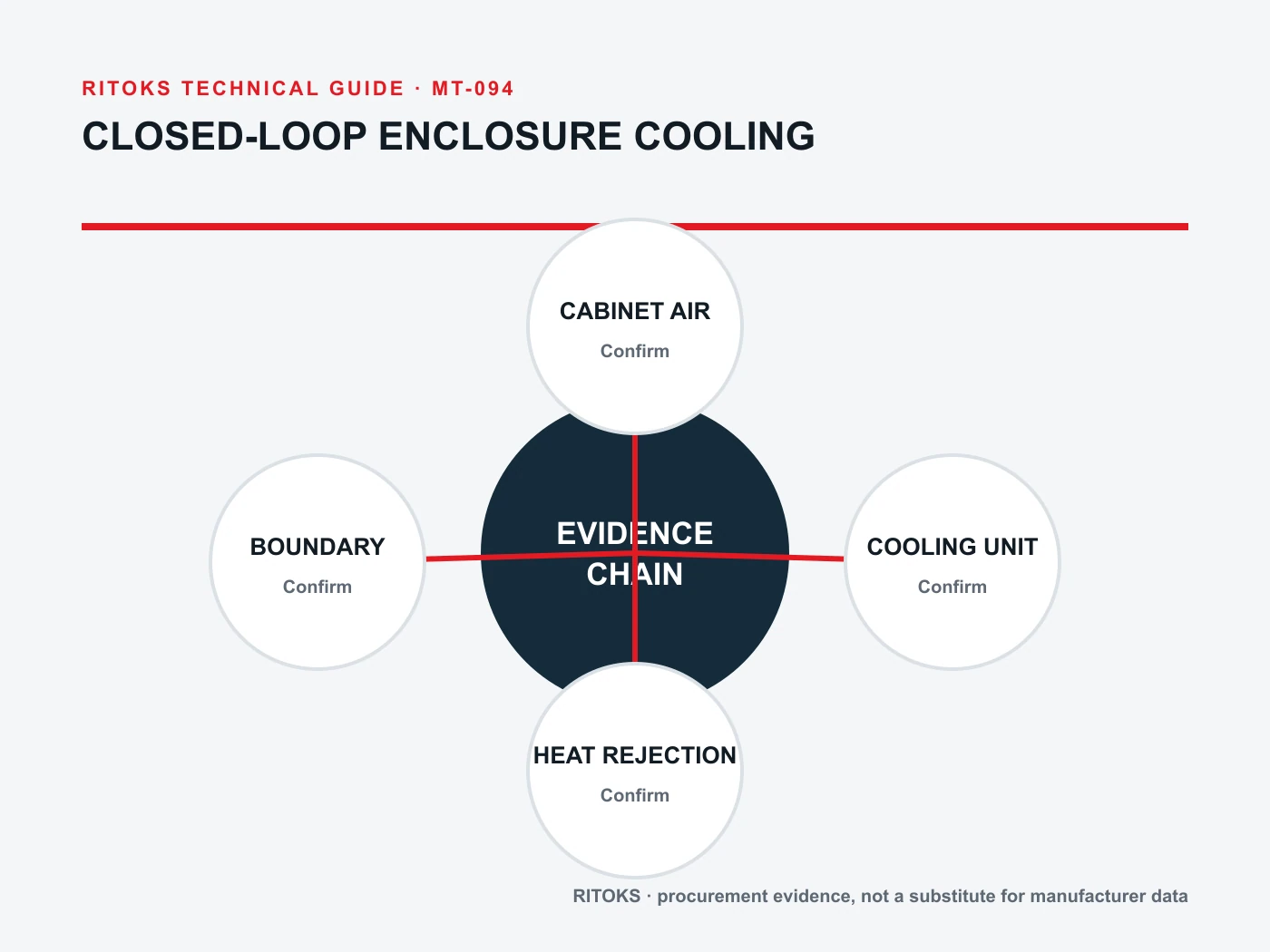
Create one approval record for the proposed Enclosure Air Conditioner order code. Put each project requirement beside the supplier document that answers it. Preserve the exact datasheet, drawing, table, instruction or selection output used, including its revision or retrieval date. A category page can establish family context, but it cannot prove an exact rating, terminal arrangement or system combination.
Comprueba que todas las especificaciones aceptadas describan el mismo artículo que se puede pedir. Las carcasas similares pueden contener diferentes circuitos, fuentes de alimentación, terminales, accesorios o funciones. No combines el número máximo por familia de una variante, un esquema de otra y una característica opcional de una tercera. Marca explícitamente los campos sin resolver para que sigan siendo visibles en la revisión comercial.
Mantén separadas las aportaciones al proyecto de las pruebas del producto
El equipo del proyecto define la aplicación: fuente, carga, régimen de funcionamiento, entorno, controles, límites mecánicos y funciones requeridas. El proveedor identifica un modelo concreto de climatizador de armario y lo respalda con la documentación correspondiente. Ninguna de las partes debe completar la información que falte basándose en deducciones derivadas de la apariencia, un nombre de familia común o un valor nominal coincidente.
Congela el expediente de la solicitud mientras se comparan los presupuestos. Si cambian la topología, la fuente, la carga, el entorno, la carcasa o la salida requerida, emite un expediente revisado y pide a cada proveedor que vuelva a confirmar la propuesta. De lo contrario, unos presupuestos aparentemente comparables podrían estar respondiendo a requisitos técnicos diferentes.
Errores habituales en las compras
Avoid selecting a Enclosure Air Conditioner from one headline value while the application context remains incomplete. Do not use a circuit, curve, terminal drawing or performance claim from a neighboring model. A product photograph and a family page can support discovery, but neither is exact technical evidence.
Evita también dar por sentado que se incluye un accesorio, una función de comunicación, una función de protección o un resultado coordinado, a menos que figure en el presupuesto y en la documentación del modelo exacto. Cualquier sustituto debe cumplir los mismos requisitos en cuanto a topología, características técnicas, montaje y revisión de la documentación que el candidato original.
Cómo comparar las ofertas de los proveedores
Normalize every Enclosure Air Conditioner offer to the same application record. Keep document revisions, stated conditions, included accessories and open questions beside each value. This makes differences in delivered scope visible and prevents a lower-cost but narrower offer from appearing equivalent to a complete solution.
Deje de realizar la comparación cuando se desconozca un dato de entrada crítico de la aplicación, el modelo citado sea ambiguo, una especificación requerida solo esté respaldada por otro fabricante o código de pedido, o la instalación no se ajuste a la información disponible. Se trata de lagunas de ingeniería, no de detalles editoriales.
Control de revisiones y sustituciones
Give the approved Enclosure Air Conditioner record a revision identifier and keep it with the project file. If the supplier changes the order code, accessory, firmware, drawing or stated operating condition, identify the change before accepting it. A substitution is a new technical proposal even when its price, housing or product-family name looks familiar.
Repite únicamente las comprobaciones afectadas, pero no las omitas. Confirma que el candidato revisado siga respondiendo a la solicitud congelada, que todos los documentos a los que se hace referencia pertenezcan a la misma y que todas las excepciones pendientes tengan un responsable. Este pequeño paso de control de cambios evita que una selección revisada técnicamente sea sustituida por un equivalente comercial no revisado.
Flujo de trabajo de toma de decisiones
- Congela el registro de la aplicación y del sistema antes de seleccionar un código de catálogo.
- Identifica la función exacta y todas las interfaces que requieran justificación.
- Solicite un código de pedido completo con su ficha técnica y planos actuales.
- Asigna cada requisito del proyecto a una declaración específica del fabricante.
- Anota las desviaciones, los accesorios, las revisiones de los documentos y las cuestiones pendientes.
- Repite la revisión cada vez que se produzcan cambios en la solicitud o en el producto propuesto.
Use this workflow as a procurement and evidence discipline. It does not replace qualified design, installation instructions or the responsible engineer's approval for the Enclosure Air Conditioner application.
Lista de comprobación para la preparación de una solicitud de presupuesto
A practical closed loop enclosure cooling should be concise enough for a supplier to answer and complete enough to prevent silent assumptions. Identify unknown values as questions rather than allowing them to become undocumented selections.
- Internal circuit: Cabinet air recirculation and component temperature objective.
- External circuit: Ambient-side heat rejection and installation clearance.
- Thermal load: Component losses and other heat inputs.
- Boundary: Openings, door condition, cable entries and enclosure construction.
- Environment: Ambient temperature, contamination, humidity and service access.
- Código exacto del producto, accesorios incluidos y versión de la documentación
- Cantidad, destino, autorizaciones necesarias y alcance comercial
Solicita el alcance exacto de cualquier especificación relativa a la clasificación, la compatibilidad, la coordinación o el rendimiento. Anota la cantidad y el destino tras los datos técnicos, para que las condiciones comerciales no oculten cuestiones de ingeniería sin resolver.
Preguntas frecuentes
Does closed-loop cooling make an enclosure airtight?
No. The complete enclosure boundary and installation details must be evaluated separately.
Can closed-loop cooling reduce temperature below ambient?
Some architectures may, but the exact capability must be verified from product data at the stated conditions.
Is a filter fan a closed-loop device?
No. A filter-fan system normally exchanges enclosure air with ambient air.
Productos y orientación relacionados de RITOKS
Estos enlaces solo ofrecen información sobre la familia de productos. Un enlace contextual no implica intercambiabilidad, compatibilidad ni una combinación de sistemas homologada.
Categoría de productos: Aire acondicionado para recintos cerrados
Aires acondicionados de interior EP-A
Referencias técnicas
Estas fuentes de los fabricantes solo respaldan los conceptos generales de ingeniería que se describen a continuación. Las especificaciones de sus productos, los esquemas eléctricos, las homologaciones y los resultados de coordinación no son aplicables a los productos de RITOKS.
Rittal, Catálogo de sistemas técnicos: Refrigeración con aire ambiente
Supports enclosure heat-load, temperature-difference and air-exchange concepts. Rittal formulas and product values apply only under their stated conditions.
Rittal, planificación de sistemas de climatización RiTherm
Supports treating enclosure climate control as a documented heat-load and environmental calculation. It does not size a RITOKS product.
Solicitar una revisión del modelo exacto
Envía los requisitos de la solicitud, las preguntas concretas sobre la documentación, la cantidad y el destino a través del formulario de contacto de RITOKS. Una solicitud de presupuesto (RFQ) requiere una revisión del modelo exacto; esta guía no aprueba ningún circuito, instalación ni sustituto automático.