
Enclosure Air Conditioners for Control Cabinets · Technical Explainer
Closed-Loop Enclosure Cooling: What It Means
Understand closed-loop enclosure cooling, its separation from ambient air exchange and the evidence needed before selection. A useful buyer review connects the project requirement to one exact orderable product and preserves the evidence used for approval.
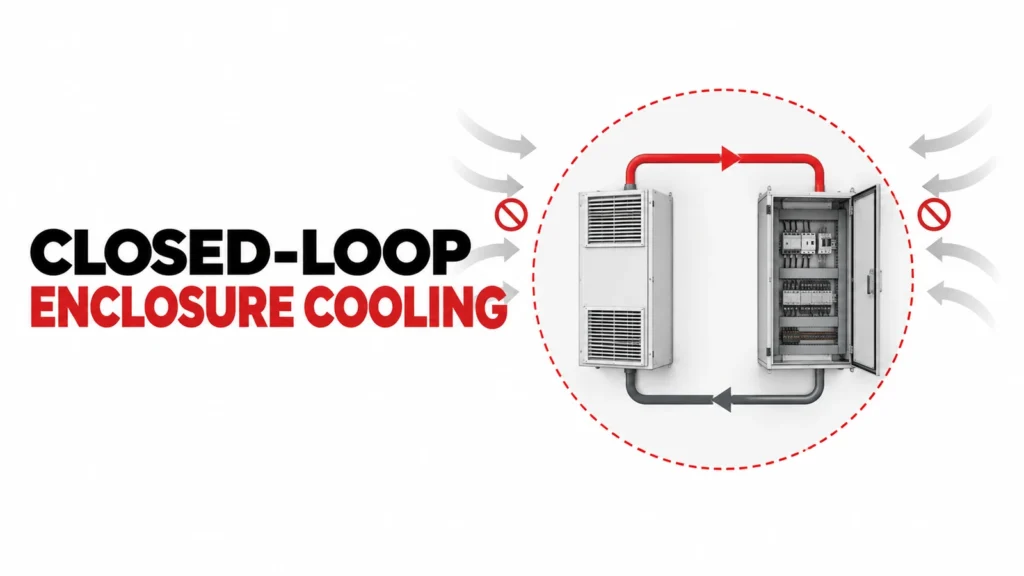
This explainer defines closed-loop enclosure cooling at an architectural level. It does not calculate cooling capacity, promise a sealing or ingress result, or claim that every enclosure air conditioner isolates internal and ambient air in the same way.
Översikt över underlag för beslut
| Granskningsfält | Köparen måste ange | Bevis som ska begäras |
|---|---|---|
| Internal circuit | Cabinet air recirculation and component temperature objective | System design and equipment documentation |
| External circuit | Ambient-side heat rejection and installation clearance | Exact installation manual |
| Thermal load | Component losses and other heat inputs | Project heat-loss schedule |
| Gräns | Openings, door condition, cable entries and enclosure construction | Enclosure inspection record |
| Miljö | Ambient temperature, contamination, humidity and service access | Site conditions and maintenance plan |
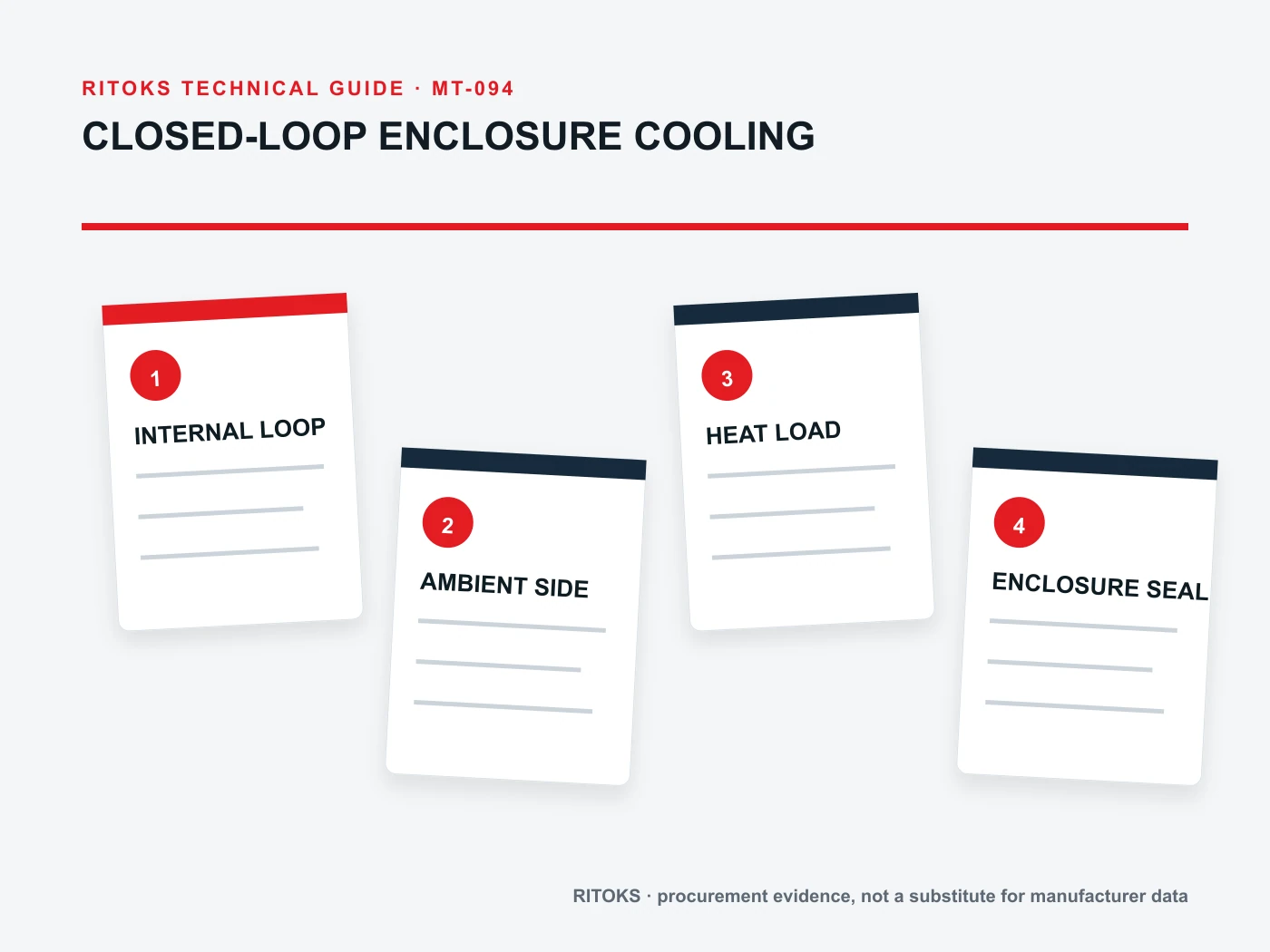
The Loop Refers to Air Separation
Closed-loop enclosure cooling generally describes an architecture in which cabinet air is recirculated through a cooling device while heat is rejected through a separate ambient-side path. The intent is different from bringing outside air directly through the enclosure. The exact construction and separation still depend on the selected equipment.
The phrase does not mean that the entire cabinet is automatically sealed, contamination-proof or moisture-proof. Cable entries, doors, gaskets, drains and installation workmanship remain part of the boundary. Ask what the exact product does and what the complete enclosure achieves.
Why Ambient-Air Ventilation Is Different
A filter fan or open ventilation path exchanges cabinet air with the surrounding environment. That can be effective when ambient air is suitable and the target cabinet temperature can remain above ambient. Closed-loop cooling instead uses a heat-transfer system intended to avoid direct process-air exchange through the cooling circuit.
These architectures should not be compared from airflow and cooling-capacity headlines as if they were equivalent units. Start from the environmental boundary, allowable temperature and heat load, then evaluate the suitable method.
Map the Internal and External Thermal Paths
Inside the cabinet, heat leaves components, mixes into the internal air and reaches the cooling device. On the ambient side, the device rejects that heat to its surroundings. Obstructed internal circulation or inadequate external clearance can undermine the intended performance even when the equipment is correctly rated.
Record equipment placement, hot spots, internal obstructions and the route available for recirculated air. Separately record wall spacing, ambient-air access and rejected-heat effects. The two paths need different installation evidence.
Calculate From Heat Load and Conditions
Cooling selection begins with component losses and other heat inputs, the required internal temperature, ambient conditions and enclosure surface behavior. A cabinet size alone is not a heat-load calculation. Use a documented engineering method and exact product performance data at the relevant conditions.
Do not treat a nominal capacity in a product title as a universal delivered result. Capacity can depend on temperature conditions and installation details. The quotation should show the selection basis and keep all assumptions visible.
Protect the Enclosure Boundary During Installation
A closed-loop concept can be defeated by unmanaged openings, damaged seals or installation details that create unwanted air exchange. Review door gaskets, cable entries, mounting cutouts, drainage and service penetrations as part of the enclosure system.
The cooling-unit drawing should define its mounting interface and required clearances. Any sealing, condensate or drainage provisions must come from the exact installation instructions. Avoid generic field modifications that are not supported by those documents.
Plan Maintenance on Both Sides of the Boundary
Closed-loop equipment still needs inspection and service. Ambient-side surfaces can collect dirt, and internal circulation paths can become obstructed. The maintenance plan should define access, cleaning, alarm response and the conditions that trigger further investigation.
Keep maintenance claims precise. The absence of a direct ventilation filter does not mean maintenance-free operation. Ask the supplier for the exact schedule and preserve it with the cabinet documentation.
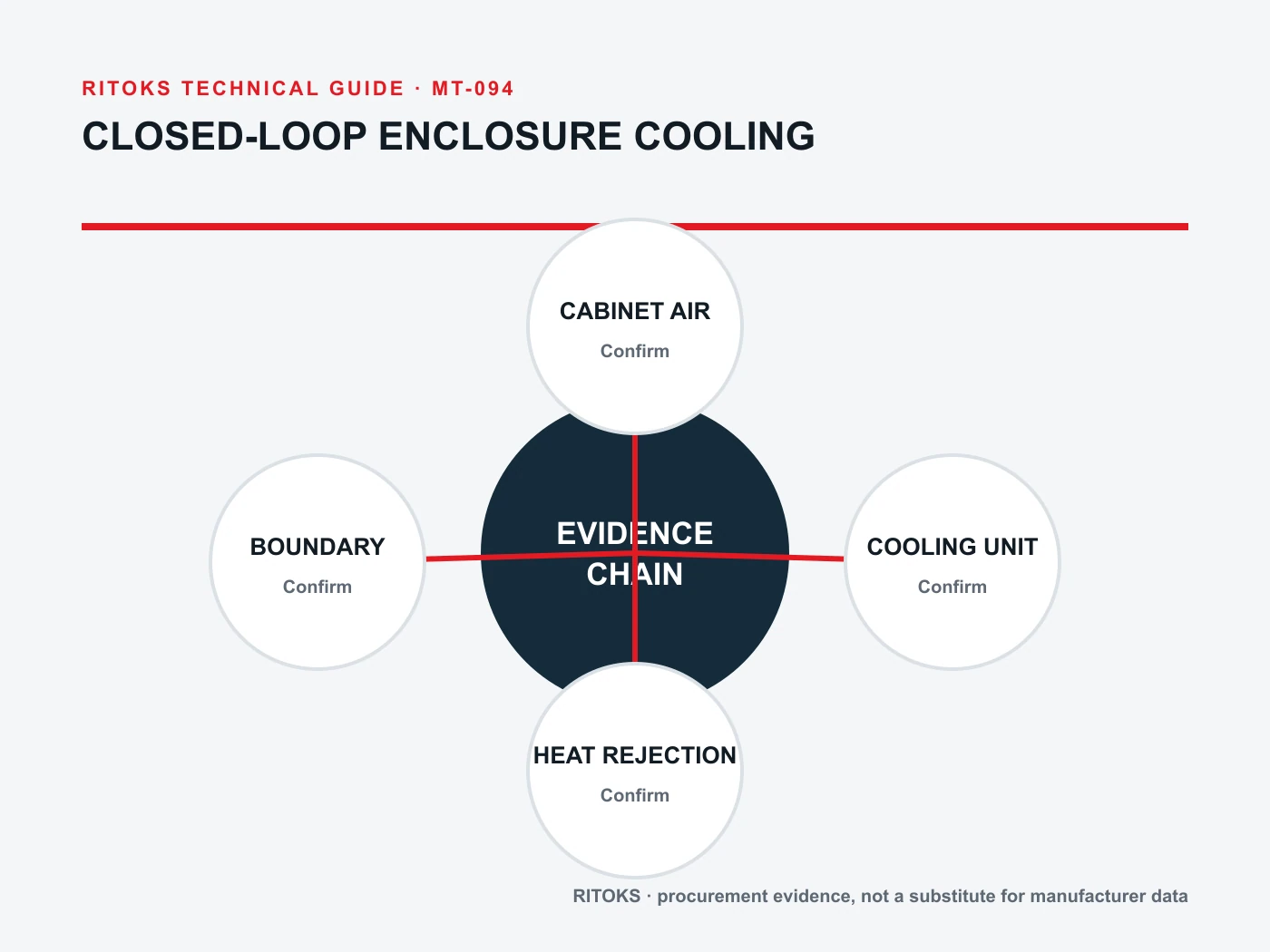
Skapa en bevisfil med en exakt modell
Create one approval record for the proposed Enclosure Air Conditioner order code. Put each project requirement beside the supplier document that answers it. Preserve the exact datasheet, drawing, table, instruction or selection output used, including its revision or retrieval date. A category page can establish family context, but it cannot prove an exact rating, terminal arrangement or system combination.
Kontrollera att varje godkänd specifikation avser samma beställningsbar artikel. Liknande höljen kan innehålla olika kretsar, strömförsörjningar, anslutningar, tillbehör eller funktioner. Kombinera inte en familjemaxvärde från en variant, ett schema från en annan och en tillvalsfunktion från en tredje. Markera ofyllta fält tydligt så att de förblir synliga vid den kommersiella granskningen.
Håll projektdata åtskilda från produktunderlag
Projektgruppen definierar tillämpningen: källa, belastning, driftsförhållanden, miljö, styrsystem, mekaniska gränsvärden och erforderliga funktioner. Leverantören identifierar en specifik kapslingsluftkonditioneringsenhet och styrker valet med exakta dokument. Ingen av parterna bör fylla i luckor genom att dra slutsatser utifrån utseende, ett gemensamt släktnamn eller ett överensstämmande nominellt värde.
Frys ansökningsunderlaget medan offerterna jämförs. Om topologin, källan, belastningen, miljön, kapslingen eller den erforderliga effekten ändras, ska ett reviderat underlag utfärdas och varje leverantör ombes att på nytt bekräfta sitt förslag. I annat fall kan offerter som till synes är jämförbara i själva verket avse olika tekniska krav.
Vanliga misstag vid upphandling
Avoid selecting a Enclosure Air Conditioner from one headline value while the application context remains incomplete. Do not use a circuit, curve, terminal drawing or performance claim from a neighboring model. A product photograph and a family page can support discovery, but neither is exact technical evidence.
Undvik också att utgå från att en tillbehörsdel, kommunikationsfunktion, skyddsfunktion eller ett samordnat resultat ingår, såvida detta inte framgår av offerten och dokumentationen för den exakta modellen. En ersättningsprodukt måste uppfylla samma krav på topologi, nominella värden, monteringssätt och granskning av dokumentation som den ursprungliga kandidaten.
Så här jämför du leverantörernas erbjudanden
Normalize every Enclosure Air Conditioner offer to the same application record. Keep document revisions, stated conditions, included accessories and open questions beside each value. This makes differences in delivered scope visible and prevents a lower-cost but narrower offer from appearing equivalent to a complete solution.
Avbryt jämförelsen om en viktig applikationsparameter är okänd, den angivna modellen är tvetydig, ett nödvändigt krav endast stöds av en annan tillverkare eller orderkod, eller om installationen ligger utanför den tillgängliga dokumentationen. Detta är tekniska brister, inte redaktionella detaljer.
Kontroll av ändringar och ersättningar
Give the approved Enclosure Air Conditioner record a revision identifier and keep it with the project file. If the supplier changes the order code, accessory, firmware, drawing or stated operating condition, identify the change before accepting it. A substitution is a new technical proposal even when its price, housing or product-family name looks familiar.
Upprepa endast de berörda kontrollerna, men avstå inte från dem. Kontrollera att den reviderade kandidaten fortfarande motsvarar den fastställda ansökan, att alla dokument som det hänvisas till hör till den och att alla öppna undantag har en ansvarig. Detta lilla steg i ändringskontrollen förhindrar att ett tekniskt granskat urval ersätts av en icke-granskad kommersiell motsvarighet.
Beslutsflöde
- Spara ansökan och systemuppgifterna innan du väljer en katalogkod.
- Identifiera den exakta funktionen och varje gränssnitt som kräver dokumentation.
- Begär en komplett beställningskod tillsammans med aktuellt datablad och ritningar.
- Koppla varje projektkrav till ett specifikt tillverkarspeciifikation.
- Notera avvikelser, tillbehör, dokumentändringar och olösta frågor.
- Upprepa granskningen varje gång applikationen eller den föreslagna produkten ändras.
Use this workflow as a procurement and evidence discipline. It does not replace qualified design, installation instructions or the responsible engineer's approval for the Enclosure Air Conditioner application.
Checklista för förberedelse av anbudsförfrågan
A practical closed loop enclosure cooling should be concise enough for a supplier to answer and complete enough to prevent silent assumptions. Identify unknown values as questions rather than allowing them to become undocumented selections.
- Internal circuit: Cabinet air recirculation and component temperature objective.
- External circuit: Ambient-side heat rejection and installation clearance.
- Thermal load: Component losses and other heat inputs.
- Boundary: Openings, door condition, cable entries and enclosure construction.
- Environment: Ambient temperature, contamination, humidity and service access.
- Exakt produktkod, medföljande tillbehör och dokumentationsversion
- Antal, bestämmelseort, nödvändiga godkännanden och affärsmässig omfattning
Begär information om den exakta omfattningen av alla påståenden rörande klassificering, kompatibilitet, samordning eller prestanda. Ange kvantitet och bestämmelseort efter de tekniska uppgifterna, så att de kommersiella villkoren inte skymmer olösta tekniska frågor.
Vanliga frågor
Does closed-loop cooling make an enclosure airtight?
No. The complete enclosure boundary and installation details must be evaluated separately.
Can closed-loop cooling reduce temperature below ambient?
Some architectures may, but the exact capability must be verified from product data at the stated conditions.
Is a filter fan a closed-loop device?
No. A filter-fan system normally exchanges enclosure air with ambient air.
Relaterade RITOKS-produkter och vägledning
Dessa länkar ger endast information om produktfamiljen. En sådan länk innebär inte att produkterna är utbytbara, kompatibla eller att det rör sig om en godkänd systemkombination.
Produktkategori: Luftkonditioneringsaggregat för inhusbruk
EP-A luftkonditioneringsaggregat för inomhusbruk
Tekniska referenser
Dessa tillverkarkällor stöder endast de allmänna tekniska principerna som beskrivs nedan. Deras produktklassificeringar, kretsscheman, godkännanden och samordningsresultat gäller inte för RITOKS-produkter.
Rittal, Katalog över tekniska system: Kylning med omgivningsluft
Supports enclosure heat-load, temperature-difference and air-exchange concepts. Rittal formulas and product values apply only under their stated conditions.
Rittal, RiTherm – Planering av klimatkontroll
Supports treating enclosure climate control as a documented heat-load and environmental calculation. It does not size a RITOKS product.
Begär en granskning av den exakta modellen
Skicka in uppgifter om tillämpningskrav, frågor om specifika dokument, antal och leveransadress via RITOKS kontaktformulär. En offertförfrågan kräver en granskning av den exakta modellen; denna guide godkänner inte någon krets, installation eller automatisk ersättning.