
Ohjauskaappien ilmastointilaitteet · Tekninen selostus
Closed-Loop Enclosure Cooling: What It Means
Understand closed-loop enclosure cooling, its separation from ambient air exchange and the evidence needed before selection. A useful buyer review connects the project requirement to one exact orderable product and preserves the evidence used for approval.
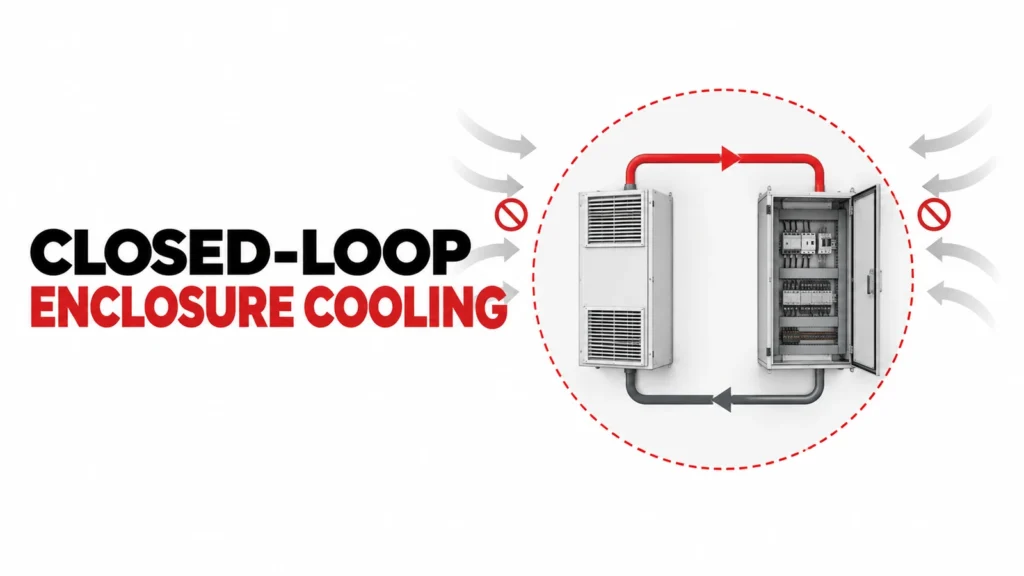
This explainer defines closed-loop enclosure cooling at an architectural level. It does not calculate cooling capacity, promise a sealing or ingress result, or claim that every enclosure air conditioner isolates internal and ambient air in the same way.
Päätöksenteon lähtökohdat lyhyesti
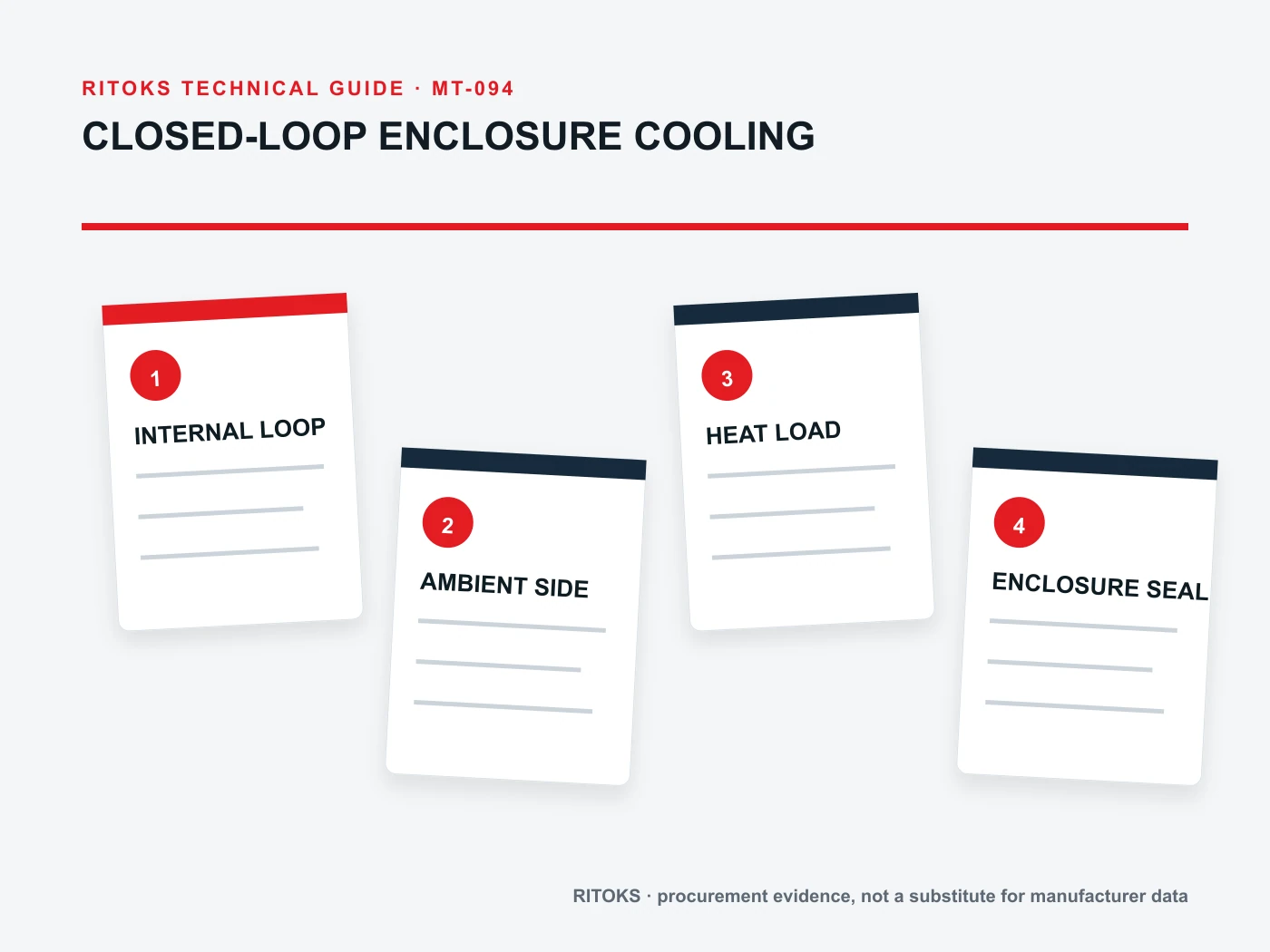
| Arvostelukenttä | Ostajan on määriteltävä | Pyydettävät todisteet |
|---|---|---|
| Internal circuit | Cabinet air recirculation and component temperature objective | System design and equipment documentation |
| External circuit | Ambient-side heat rejection and installation clearance | Exact installation manual |
| Thermal load | Component losses and other heat inputs | Project heat-loss schedule |
| Raja | Openings, door condition, cable entries and enclosure construction | Enclosure inspection record |
| Ympäristö | Ambient temperature, contamination, humidity and service access | Site conditions and maintenance plan |
The Loop Refers to Air Separation
Closed-loop enclosure cooling generally describes an architecture in which cabinet air is recirculated through a cooling device while heat is rejected through a separate ambient-side path. The intent is different from bringing outside air directly through the enclosure. The exact construction and separation still depend on the selected equipment.
The phrase does not mean that the entire cabinet is automatically sealed, contamination-proof or moisture-proof. Cable entries, doors, gaskets, drains and installation workmanship remain part of the boundary. Ask what the exact product does and what the complete enclosure achieves.
Why Ambient-Air Ventilation Is Different
A filter fan or open ventilation path exchanges cabinet air with the surrounding environment. That can be effective when ambient air is suitable and the target cabinet temperature can remain above ambient. Closed-loop cooling instead uses a heat-transfer system intended to avoid direct process-air exchange through the cooling circuit.
These architectures should not be compared from airflow and cooling-capacity headlines as if they were equivalent units. Start from the environmental boundary, allowable temperature and heat load, then evaluate the suitable method.
Map the Internal and External Thermal Paths
Inside the cabinet, heat leaves components, mixes into the internal air and reaches the cooling device. On the ambient side, the device rejects that heat to its surroundings. Obstructed internal circulation or inadequate external clearance can undermine the intended performance even when the equipment is correctly rated.
Record equipment placement, hot spots, internal obstructions and the route available for recirculated air. Separately record wall spacing, ambient-air access and rejected-heat effects. The two paths need different installation evidence.
Calculate From Heat Load and Conditions
Cooling selection begins with component losses and other heat inputs, the required internal temperature, ambient conditions and enclosure surface behavior. A cabinet size alone is not a heat-load calculation. Use a documented engineering method and exact product performance data at the relevant conditions.
Do not treat a nominal capacity in a product title as a universal delivered result. Capacity can depend on temperature conditions and installation details. The quotation should show the selection basis and keep all assumptions visible.
Protect the Enclosure Boundary During Installation
A closed-loop concept can be defeated by unmanaged openings, damaged seals or installation details that create unwanted air exchange. Review door gaskets, cable entries, mounting cutouts, drainage and service penetrations as part of the enclosure system.
The cooling-unit drawing should define its mounting interface and required clearances. Any sealing, condensate or drainage provisions must come from the exact installation instructions. Avoid generic field modifications that are not supported by those documents.
Plan Maintenance on Both Sides of the Boundary
Closed-loop equipment still needs inspection and service. Ambient-side surfaces can collect dirt, and internal circulation paths can become obstructed. The maintenance plan should define access, cleaning, alarm response and the conditions that trigger further investigation.
Keep maintenance claims precise. The absence of a direct ventilation filter does not mean maintenance-free operation. Ask the supplier for the exact schedule and preserve it with the cabinet documentation.
Laadi tarkka mallipohjainen todistusaineistotiedosto
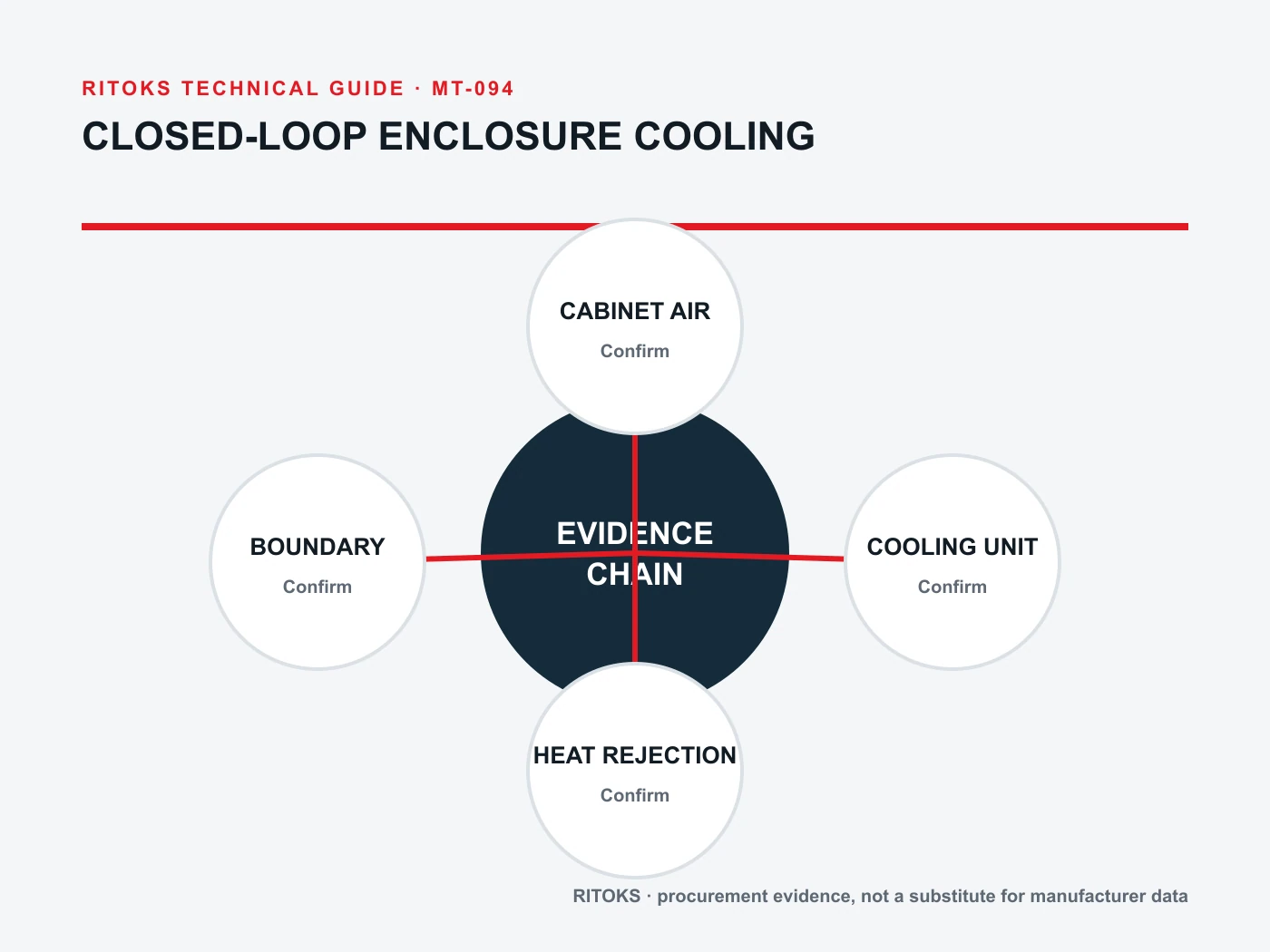
Create one approval record for the proposed Enclosure Air Conditioner order code. Put each project requirement beside the supplier document that answers it. Preserve the exact datasheet, drawing, table, instruction or selection output used, including its revision or retrieval date. A category page can establish family context, but it cannot prove an exact rating, terminal arrangement or system combination.
Tarkista, että jokainen hyväksytty kuvaus koskee samaa tilattavaa tuotetta. Samankaltaiset kotelot voivat sisältää erilaisia piirejä, virtalähteitä, liittimiä, lisävarusteita tai toimintoja. Älä yhdistä yhden variantin tuoteryhmän enimmäismäärää, toisen variantin kytkentäkaaviota ja kolmannen variantin valinnaista ominaisuutta. Merkitse täyttämättömät kentät selvästi, jotta ne pysyvät näkyvissä kaupallisessa tarkastelussa.
Pidä projektin lähtötiedot erillään tuotteen todistusaineistosta
Hanketiimi määrittelee sovelluksen: lähteen, kuormituksen, käyttötarkoituksen, ympäristön, ohjausjärjestelmät, mekaaniset rajoitukset ja vaaditut toiminnot. Toimittaja valitsee tarkalleen sopivan kotelon ilmastointilaitteen ja toimittaa siitä tarkat asiakirjat. Kumpikaan osapuoli ei saa täyttää aukkoja tekemällä johtopäätöksiä ulkonäön, yhteisen tuotemerkin tai yhden vastaavan nimellisarvon perusteella.
Jäädyttäkää tarjouspyyntötiedot tarjousten vertailun ajaksi. Jos topologia, lähde, kuormitus, ympäristö, kotelo tai vaadittu teho muuttuu, julkaiskaa päivitetyt tiedot ja pyytäkää kutakin toimittajaa vahvistamaan tarjouksensa uudelleen. Muutoin näennäisesti vertailukelpoiset tarjoukset saattavat perustua erilaisiin teknisiin vaatimuksiin.
Yleisiä hankintavirheitä
Avoid selecting a Enclosure Air Conditioner from one headline value while the application context remains incomplete. Do not use a circuit, curve, terminal drawing or performance claim from a neighboring model. A product photograph and a family page can support discovery, but neither is exact technical evidence.
Älä myöskään oleta, että lisävaruste, viestintätoiminto, suojaustehtävä tai sovittu tulos sisältyy tarjoukseen, ellei sitä mainita tarjouksessa ja tarkkojen mallitietojen sisältävissä asiakirjoissa. Korvaava tuote edellyttää samaa topologiaa, nimellistehoa, asennustapaa ja todisteiden tarkastelua kuin alkuperäinen ehdokas.
Kuinka vertailla toimittajien tarjouksia
Normalize every Enclosure Air Conditioner offer to the same application record. Keep document revisions, stated conditions, included accessories and open questions beside each value. This makes differences in delivered scope visible and prevents a lower-cost but narrower offer from appearing equivalent to a complete solution.
Lopeta vertailu, jos sovelluksen kannalta kriittistä syöttötietoa ei tunneta, mainittu malli on epäselvä, vaadittua vaatimusta tukee ainoastaan toinen valmistaja tai tilauskoodi tai asennus ei kuulu saatavilla olevan aineiston piiriin. Nämä ovat teknisiä puutteita, eivät toimituksellisia yksityiskohtia.
Muutosten ja korvausten hallinta
Give the approved Enclosure Air Conditioner record a revision identifier and keep it with the project file. If the supplier changes the order code, accessory, firmware, drawing or stated operating condition, identify the change before accepting it. A substitution is a new technical proposal even when its price, housing or product-family name looks familiar.
Toista vain ne tarkastukset, joihin ongelma liittyy, mutta älä jätä niitä väliin. Varmista, että päivitetty ehdokas vastaa edelleen jäädytettyä hakemusta, että kaikki viitatut asiakirjat kuuluvat siihen ja että kaikilla avoimilla poikkeuksilla on vastuuhenkilö. Tämä pieni muutoksenhallintatoimenpide estää sen, että teknisesti tarkistettu valinta korvataan tarkistamattomalla kaupallisella vastineella.
Päätöksentekoprosessi
- Jäädytä sovellus ja järjestelmätallenne ennen luettelokoodin valitsemista.
- Määritä tarkka toiminto ja kaikki rajapinnat, joiden osalta tarvitaan todisteita.
- Pyydä yksi täydellinen tilauskoodi sekä siihen liittyvä ajantasainen tuotetiedote ja piirustukset.
- Liitä kukin projektivaatimus tiettyyn valmistajan ilmoitukseen.
- Kirjaa poikkeamat, lisävarusteet, asiakirjojen muutokset ja ratkaisemattomat kysymykset.
- Tarkastus on toistettava aina, kun sovellus tai ehdotettu tuote muuttuu.
Use this workflow as a procurement and evidence discipline. It does not replace qualified design, installation instructions or the responsible engineer's approval for the Enclosure Air Conditioner application.
Tarjouspyynnön laatimisen tarkistuslista
A practical closed loop enclosure cooling should be concise enough for a supplier to answer and complete enough to prevent silent assumptions. Identify unknown values as questions rather than allowing them to become undocumented selections.
- Internal circuit: Cabinet air recirculation and component temperature objective.
- External circuit: Ambient-side heat rejection and installation clearance.
- Thermal load: Component losses and other heat inputs.
- Boundary: Openings, door condition, cable entries and enclosure construction.
- Environment: Ambient temperature, contamination, humidity and service access.
- Tuotteen tarkka koodi, mukana toimitettavat lisävarusteet ja ohjeiden versio
- Määrä, määräpaikka, vaadittavat luvat ja kaupallinen laajuus
Pyydä tarkat tiedot luokitteluun, yhteensopivuuteen, koordinointiin tai suorituskykyyn liittyvien väitteiden laajuudesta. Kirjaa määrä ja toimituskohde teknisten tietojen jälkeen, jotta kaupalliset ehdot eivät peitä ratkaisemattomia teknisiä kysymyksiä.
Usein kysytyt kysymykset
Does closed-loop cooling make an enclosure airtight?
No. The complete enclosure boundary and installation details must be evaluated separately.
Can closed-loop cooling reduce temperature below ambient?
Some architectures may, but the exact capability must be verified from product data at the stated conditions.
Is a filter fan a closed-loop device?
No. A filter-fan system normally exchanges enclosure air with ambient air.
Aiheeseen liittyvät RITOKS-tuotteet ja ohjeet
Nämä linkit antavat ainoastaan tietoa tuoteperheestä. Kontekstuaalinen linkki ei tarkoita, että tuotteet olisivat keskenään vaihdettavissa, yhteensopivia tai että kyseessä olisi hyväksytty järjestelmäyhdistelmä.
Ilmastointilaitteet -tuoteryhmä
EP-A-sisäyksikölliset ilmastointilaitteet
Tekniset viitteet
Nämä valmistajien lähteet tukevat ainoastaan jäljempänä kuvattuja yleisiä teknisiä periaatteita. Niiden tuotteiden nimellisarvot, kytkentäkaaviot, hyväksynnät ja sovitustulokset eivät koske RITOKS-tuotteita.
Rittal, Teknisten järjestelmien tuoteluettelo: Jäähdytys ympäröivällä ilmalla
Supports enclosure heat-load, temperature-difference and air-exchange concepts. Rittal formulas and product values apply only under their stated conditions.
Rittal, RiTherm-ilmastointisuunnittelu
Supports treating enclosure climate control as a documented heat-load and environmental calculation. It does not size a RITOKS product.
Pyydä tarkka malliarviointi
Lähetä hakemusvaatimukset, tarkat asiakirjoja koskevat kysymykset, määrä ja toimituskohde RITOKS-yhteydenottolomakkeen kautta. Tarjouspyyntö edellyttää tarkan mallin tarkastelua; tässä ohjeessa ei hyväksytä piirijärjestelmiä, asennuksia tai automaattisia korvaavia tuotteita.