
Enclosure Air Conditioners for Control Cabinets · Technical Explainer
Closed-Loop Enclosure Cooling: What It Means
Understand closed-loop enclosure cooling, its separation from ambient air exchange and the evidence needed before selection. A useful buyer review connects the project requirement to one exact orderable product and preserves the evidence used for approval.
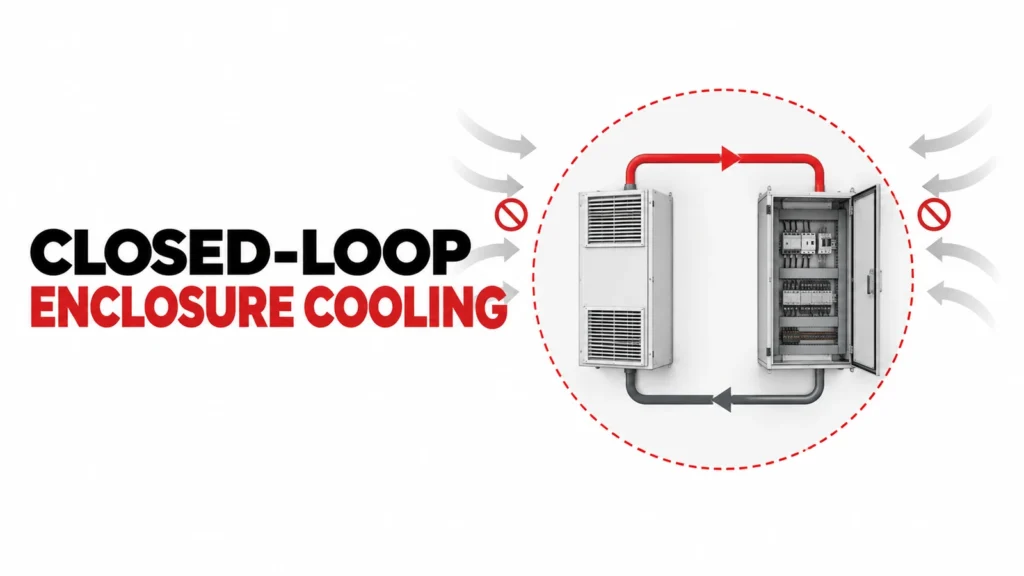
This explainer defines closed-loop enclosure cooling at an architectural level. It does not calculate cooling capacity, promise a sealing or ingress result, or claim that every enclosure air conditioner isolates internal and ambient air in the same way.
意思決定の入力要素の概要
| レビュー欄 | 購入者は以下を定義しなければならない | 提出を求める証拠 |
|---|---|---|
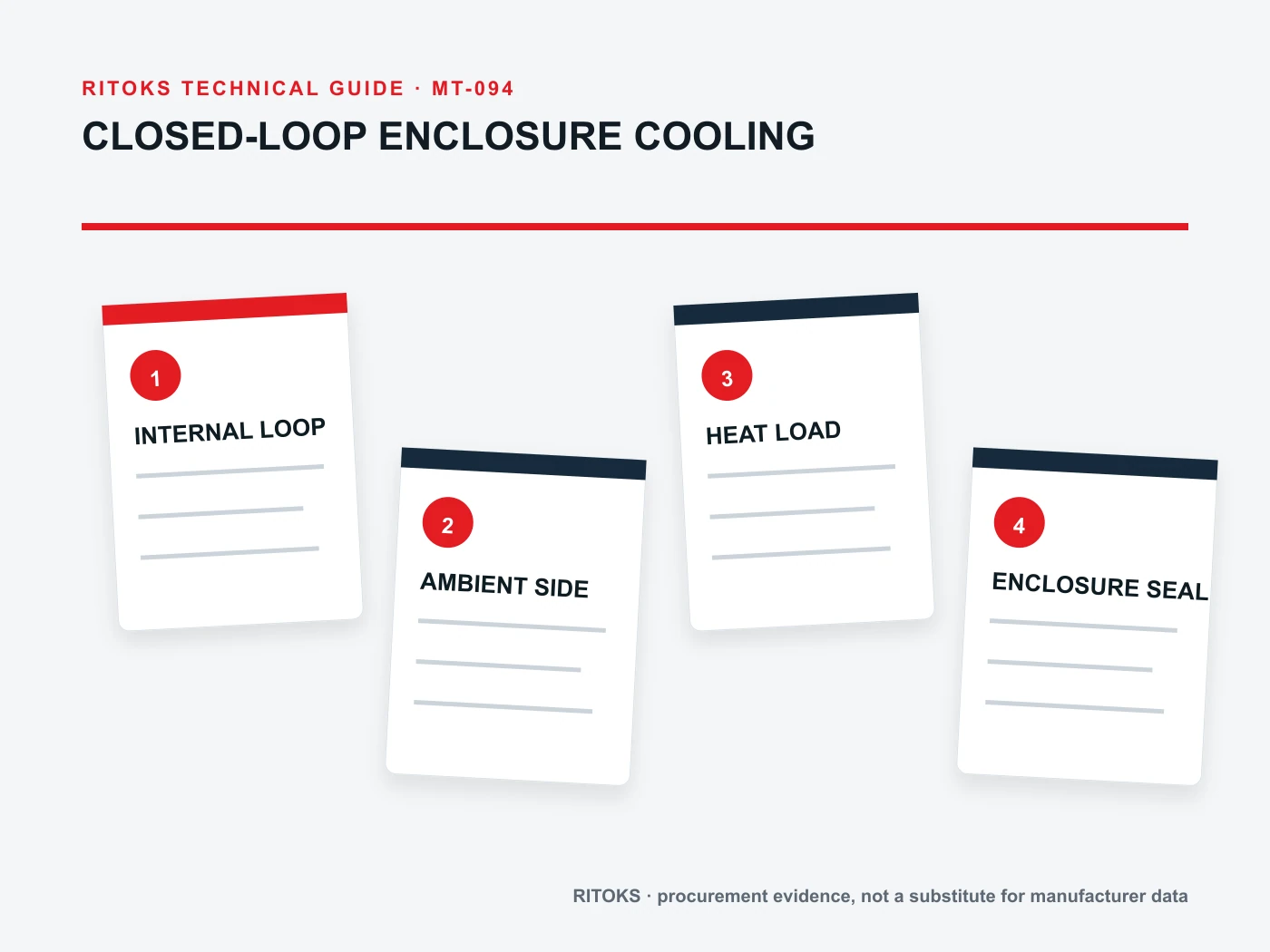
| Internal circuit | Cabinet air recirculation and component temperature objective | System design and equipment documentation |
| External circuit | Ambient-side heat rejection and installation clearance | Exact installation manual |
| Thermal load | Component losses and other heat inputs | Project heat-loss schedule |
| 境界 | Openings, door condition, cable entries and enclosure construction | Enclosure inspection record |
| 環境 | Ambient temperature, contamination, humidity and service access | Site conditions and maintenance plan |
The Loop Refers to Air Separation
Closed-loop enclosure cooling generally describes an architecture in which cabinet air is recirculated through a cooling device while heat is rejected through a separate ambient-side path. The intent is different from bringing outside air directly through the enclosure. The exact construction and separation still depend on the selected equipment.
The phrase does not mean that the entire cabinet is automatically sealed, contamination-proof or moisture-proof. Cable entries, doors, gaskets, drains and installation workmanship remain part of the boundary. Ask what the exact product does and what the complete enclosure achieves.
Why Ambient-Air Ventilation Is Different
A filter fan or open ventilation path exchanges cabinet air with the surrounding environment. That can be effective when ambient air is suitable and the target cabinet temperature can remain above ambient. Closed-loop cooling instead uses a heat-transfer system intended to avoid direct process-air exchange through the cooling circuit.
These architectures should not be compared from airflow and cooling-capacity headlines as if they were equivalent units. Start from the environmental boundary, allowable temperature and heat load, then evaluate the suitable method.
Map the Internal and External Thermal Paths
Inside the cabinet, heat leaves components, mixes into the internal air and reaches the cooling device. On the ambient side, the device rejects that heat to its surroundings. Obstructed internal circulation or inadequate external clearance can undermine the intended performance even when the equipment is correctly rated.
Record equipment placement, hot spots, internal obstructions and the route available for recirculated air. Separately record wall spacing, ambient-air access and rejected-heat effects. The two paths need different installation evidence.
Calculate From Heat Load and Conditions
Cooling selection begins with component losses and other heat inputs, the required internal temperature, ambient conditions and enclosure surface behavior. A cabinet size alone is not a heat-load calculation. Use a documented engineering method and exact product performance data at the relevant conditions.
Do not treat a nominal capacity in a product title as a universal delivered result. Capacity can depend on temperature conditions and installation details. The quotation should show the selection basis and keep all assumptions visible.
Protect the Enclosure Boundary During Installation
A closed-loop concept can be defeated by unmanaged openings, damaged seals or installation details that create unwanted air exchange. Review door gaskets, cable entries, mounting cutouts, drainage and service penetrations as part of the enclosure system.
The cooling-unit drawing should define its mounting interface and required clearances. Any sealing, condensate or drainage provisions must come from the exact installation instructions. Avoid generic field modifications that are not supported by those documents.
Plan Maintenance on Both Sides of the Boundary
Closed-loop equipment still needs inspection and service. Ambient-side surfaces can collect dirt, and internal circulation paths can become obstructed. The maintenance plan should define access, cleaning, alarm response and the conditions that trigger further investigation.
Keep maintenance claims precise. The absence of a direct ventilation filter does not mean maintenance-free operation. Ask the supplier for the exact schedule and preserve it with the cabinet documentation.
正確なモデルの証拠ファイルを作成する
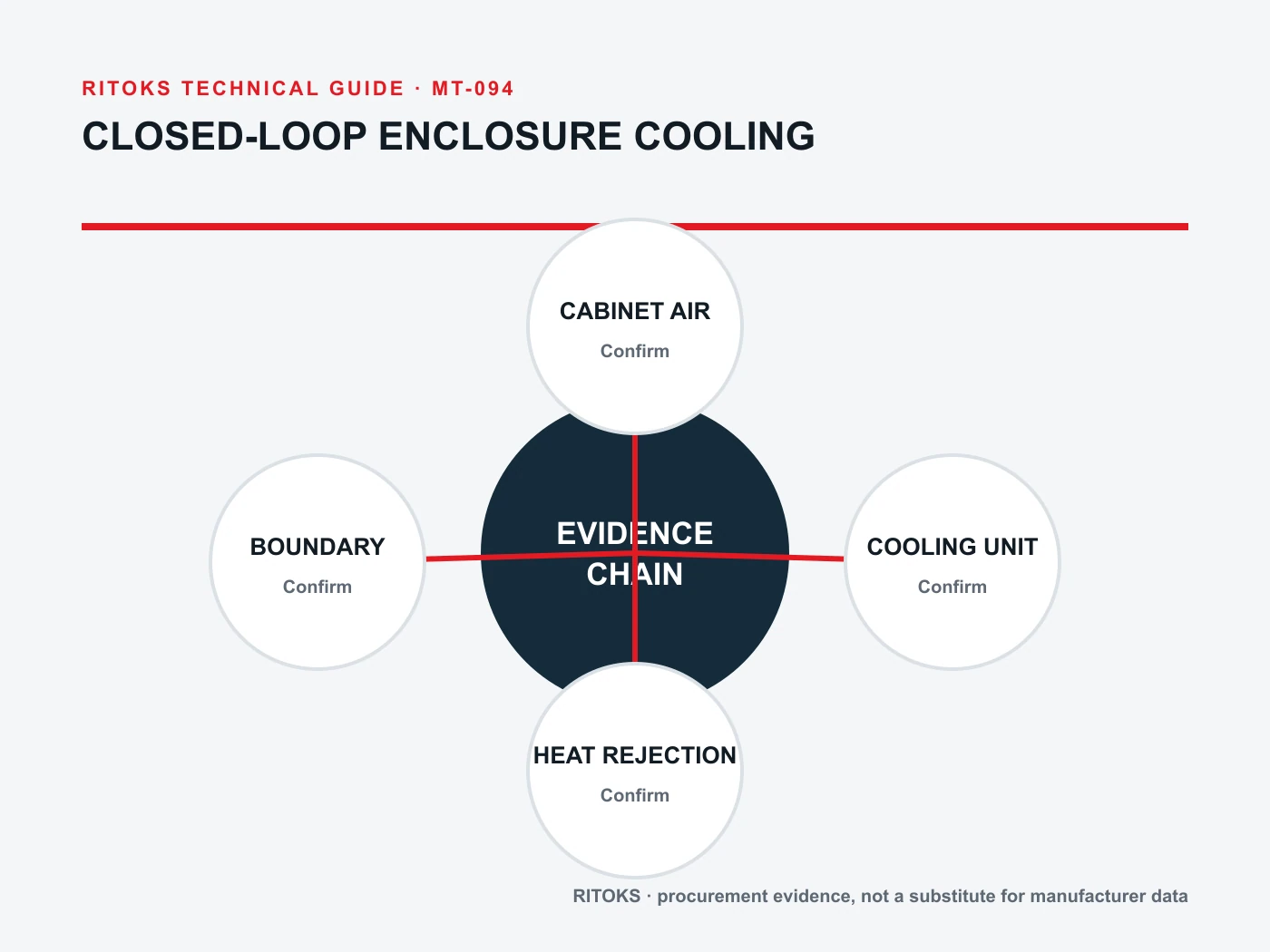
Create one approval record for the proposed Enclosure Air Conditioner order code. Put each project requirement beside the supplier document that answers it. Preserve the exact datasheet, drawing, table, instruction or selection output used, including its revision or retrieval date. A category page can establish family context, but it cannot prove an exact rating, terminal arrangement or system combination.
承認されたすべての明細が、同一の注文可能品目を記述していることを確認してください。外観が類似している製品であっても、回路、電源、端子、付属品、または機能が異なる場合があります。あるバリエーションの「ファミリー最大値」、別のバリエーションの「図面」、さらに別のバリエーションの「オプション機能」を組み合わせて使用しないでください。未解決の項目については、商業レビューでも確認できるよう、明確にマークを付けておいてください。.
プロジェクトのインプットと成果物の根拠は区別しておく
プロジェクトチームは、アプリケーション(供給源、負荷、稼働条件、環境、制御、機械的制限、および必要な機能)を定義します。サプライヤーは、具体的なエンクロージャー用空調機を特定し、正確な資料をもってそれを裏付けます。いずれの側も、外観や共通する製品ファミリー名、あるいは一致する主要な性能値のみに基づいて推測を行い、不足部分を補完してはなりません。.
見積書の比較中は、申請記録を凍結してください。トポロジー、電源、負荷、環境、筐体、または必要な出力が変更された場合は、改訂版記録を発行し、各サプライヤーに候補品の再確認を依頼してください。そうしないと、一見比較可能な見積書であっても、実際には異なる技術要件に対応している可能性があるからです。.
調達におけるよくあるミス
Avoid selecting a Enclosure Air Conditioner from one headline value while the application context remains incomplete. Do not use a circuit, curve, terminal drawing or performance claim from a neighboring model. A product photograph and a family page can support discovery, but neither is exact technical evidence.
また、見積書や正確なモデル仕様書に記載されていない限り、付属品、通信機能、保護機能、または連携による成果が含まれていると想定しないようにしてください。代替品については、当初の候補品と同様に、トポロジー、定格、取り付け方法、および証拠資料の審査が必要です。.
サプライヤーの提案を比較する方法
Normalize every Enclosure Air Conditioner offer to the same application record. Keep document revisions, stated conditions, included accessories and open questions beside each value. This makes differences in delivered scope visible and prevents a lower-cost but narrower offer from appearing equivalent to a complete solution.
重要なアプリケーションの入力値が不明な場合、引用されたモデルが曖昧な場合、必要な主張が他のメーカーや注文コードによってのみ裏付けられている場合、あるいは設置条件が利用可能な証拠の範囲外である場合は、比較を中止してください。これらは編集上の細部ではなく、技術的な不備です。.
改訂および置換の管理
Give the approved Enclosure Air Conditioner record a revision identifier and keep it with the project file. If the supplier changes the order code, accessory, firmware, drawing or stated operating condition, identify the change before accepting it. A substitution is a new technical proposal even when its price, housing or product-family name looks familiar.
影響を受けたチェック項目のみ再実施し、それらを免除してはならない。改訂後の候補が依然として「凍結済み」の申請に対応していること、参照されているすべての文書がその申請に属していること、および未解決の例外事項すべてに担当者が割り当てられていることを確認すること。この小さな変更管理の手順により、技術的な審査を経た選定が、審査を受けていない商業的な代替品に置き換えられることを防ぐことができる。.
意思決定ワークフロー
- カタログコードを選択する前に、アプリケーションとシステムの記録を凍結してください。.
- 証拠を必要とする正確な関数と、すべてのインターフェースを特定する。.
- 1件の完全な注文コードと、それに付随する最新のデータシートおよび図面を1セットご提供ください。.
- 各プロジェクト要件を、特定のメーカーの声明と対応付けます。.
- 逸脱事項、付属品、文書の改訂、および未解決の疑問点を記録してください。.
- アプリケーションや提案された製品に変更があった場合は、その都度、見直しを行ってください。.
Use this workflow as a procurement and evidence discipline. It does not replace qualified design, installation instructions or the responsible engineer's approval for the Enclosure Air Conditioner application.
見積依頼書(RFQ)作成チェックリスト
A practical closed loop enclosure cooling should be concise enough for a supplier to answer and complete enough to prevent silent assumptions. Identify unknown values as questions rather than allowing them to become undocumented selections.
- Internal circuit: Cabinet air recirculation and component temperature objective.
- External circuit: Ambient-side heat rejection and installation clearance.
- Thermal load: Component losses and other heat inputs.
- Boundary: Openings, door condition, cable entries and enclosure construction.
- Environment: Ambient temperature, contamination, humidity and service access.
- 正確な製品コード、同梱付属品、およびドキュメントの改訂版
- 数量、仕向地、必要な承認、および商業的範囲
分類、互換性、調整、または性能に関する主張については、その正確な範囲を明示するよう求めてください。技術的な仕様の後に数量と仕向地を明記し、商取引上の条件によって未解決の技術的な問題が覆い隠されないようにしてください。.
よくある質問
Does closed-loop cooling make an enclosure airtight?
No. The complete enclosure boundary and installation details must be evaluated separately.
Can closed-loop cooling reduce temperature below ambient?
Some architectures may, but the exact capability must be verified from product data at the stated conditions.
Is a filter fan a closed-loop device?
No. A filter-fan system normally exchanges enclosure air with ambient air.
関連するRITOKS製品およびガイダンス
これらのリンクは、製品ファミリーに関する背景情報を提供するのみです。こうしたリンクは、互換性や適合性、あるいは承認されたシステムの組み合わせを保証するものではありません。.
技術資料
これらのメーカーの情報は、以下に説明する一般的な技術概念のみを裏付けるものです。それらの製品の定格、回路図、認証、および調整結果は、RITOKS製品には適用されません。.
Supports enclosure heat-load, temperature-difference and air-exchange concepts. Rittal formulas and product values apply only under their stated conditions.
Supports treating enclosure climate control as a documented heat-load and environmental calculation. It does not size a RITOKS product.
正確なモデルに関するレビューを依頼する
申請要件、書類に関する具体的な質問、数量、および配送先を、RITOKSのお問い合わせフォームから送信してください。RFQ(見積依頼)では、正確なモデルの確認が求められます。本ガイドでは、回路、設置、または自動的な代替品の承認は行いません。.