
Kastkoelventilatoren · Technische uitleg
Cabinet Airflow Calculation Inputs: Heat Load, Temperature Rise and Restrictions
Cabinet airflow calculation inputs are often reduced to one fan capacity number. That misses the first engineering task: establish how much heat is produced, which ambient air is available and where that air can travel. A fan moves air through a real enclosure with filters, grilles and obstructions, so the useful result differs from an open-bench rating.
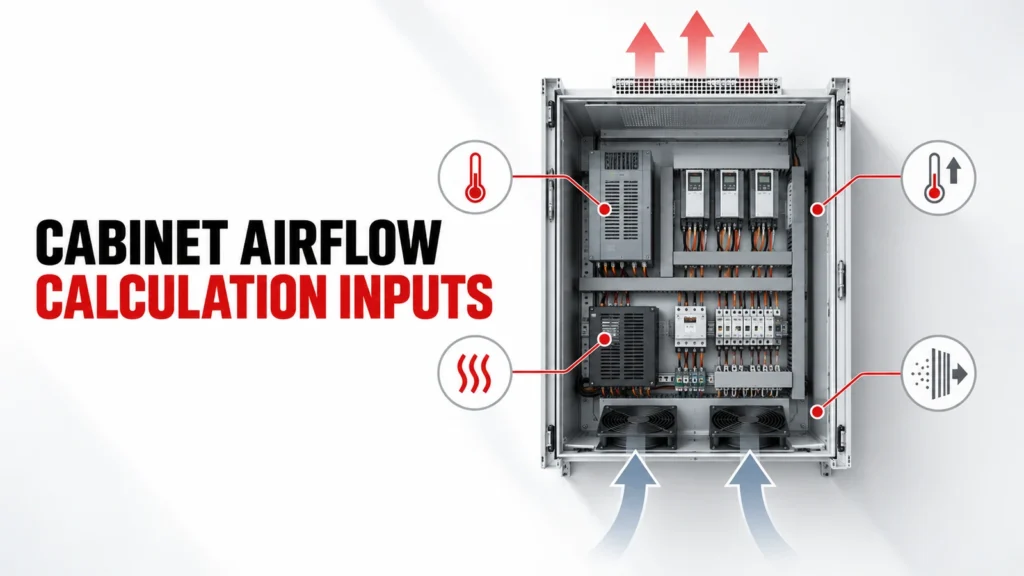
This guide identifies the evidence needed before estimating airflow and comparing fan candidates. It also shows when ventilation is the wrong cooling architecture, such as when ambient air or contamination conditions prevent the intended heat removal.
De beslissingsfactoren in één oogopslag
| Beoordelingsgebied | Wat de koper vastlegt | Te vragen bewijsstukken |
|---|---|---|
| Warmtebelasting | Losses by component and operating state | Equipment loss data and duty record |
| Milieu | Ambient range and contamination | Site conditions and enclosure objective |
| Luchtpad | Inlet, outlet, filters, obstructions | Layout and cutout drawings |
| Fan operating point | Flow at actual pressure resistance | Exact-model fan curve and system estimate |
Inventory real heat sources
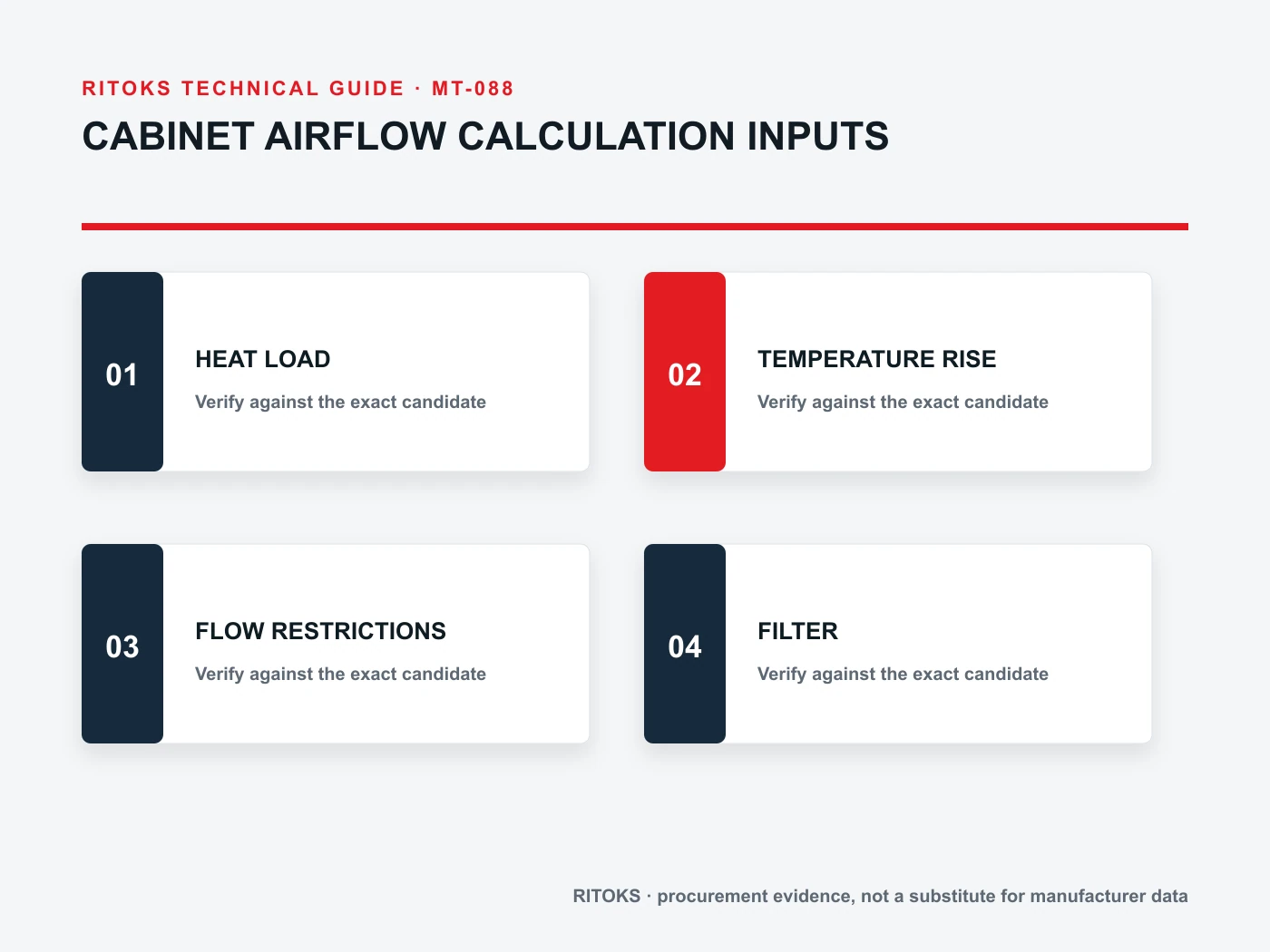
List the components that dissipate heat inside the enclosure: power devices, supplies, drives, transformers, control electronics and wiring where relevant. Use credible operating states, not only installed nameplate capacity. Some sources do not peak together, while others have short but significant duty periods.
Record the basis for every loss estimate and the load combinations the cabinet will actually see. Unknown heat inputs should remain open assumptions rather than disappearing into an arbitrary fan margin.
Define ambient and internal limits
Ventilation exchanges cabinet air with surrounding air. Document the ambient range at the actual installation, including solar exposure or nearby hot equipment where relevant, and define the acceptable internal condition for the most sensitive installed component.
The air entering the enclosure cannot be cooler than the surrounding source without an active cooling method. If ambient approaches or exceeds the required internal limit, adding fan capacity alone may not solve the problem.
Draw the path from inlet to outlet
Show where air enters, how it crosses the heat sources and where it leaves. Separate a clear path from a short circuit in which fresh air exits before reaching the critical equipment. Wiring ducts, shelves and component placement can redirect flow.
A useful drawing marks inlet and outlet height, guards, filters, internal barriers and service doors. It lets the design team discuss hot spots and maintenance access before choosing a frame size.
Account for restriction, not only free air
Filters, louvers, grilles and narrow passages impose pressure resistance. A fan curve describes how available flow changes with pressure. Therefore a free-air figure is not the delivered airflow through a finished cabinet.
Ask for an exact-model performance curve and estimate the resistance of the assembled path. Revisit the estimate when filter media, outlet geometry or cabinet layout changes; otherwise the selected operating point may shift.
Consider filter condition over time
A clean filter is not the only operating condition. Dust loading changes resistance and service needs. Define the contamination expected at the site, an inspection method and the replacement element.
Do not invent a fixed maintenance interval from a product category name. The first inspection schedule should reflect actual exposure and be refined from recorded condition and temperature behavior.
Choose fan direction and control deliberately
Whether the fan supplies or extracts air influences pressure direction and leakage paths. The choice also affects where filtered air enters and how it reaches heat sources. Specify any thermostat, alarm or speed control requirement as a separate feature to verify.
Review the supply voltage, wiring and control sequence with the electrical designer. Avoid assuming that a fan family includes monitoring outputs or variable-speed control unless the exact order code confirms them.
Validate the finished cabinet
The estimate narrows candidates; the built cabinet provides the final evidence. Check representative duty states, ambient conditions when possible, internal temperature locations, flow obstructions and alarm behavior.
Document the installed fan, filter, cutouts, control settings and test conditions. If a hot spot remains, trace the airflow path and heat input before simply increasing nominal fan size.
Een bewijsmap op basis van een exact model samenstellen
A category or product-family page helps locate relevant options; it does not by itself approve one variant. For cabinet ventilation, keep the full proposed order code, current datasheet, terminal or mounting drawing, operating instructions and any project calculation together. Read the conditions attached to each rating or function. If the evidence belongs to a neighboring model, request the correct document instead of carrying the claim across.
Het projectteam is verantwoordelijk voor de systeeminput en de acceptatiecriteria. De leverancier is verantwoordelijk voor het bewijsmateriaal met betrekking tot het aangeboden product. Geef bij de technische beoordeling bij elke verplichte eis aan welk document en welke revisie hier precies aan voldoen. Markeer een ontbrekend veld als ‘open’, ‘voorwaardelijk’ of ‘niet ondersteund’. Zo ontstaat een traceerbare beslissing en wordt voorkomen dat een gunstige nominale waarde een incompatibele aansluiting of installatievoorwaarde verhult.
Vergelijk alle aanbiedingen
| Artikel | Vermelding in de vergelijking | Reden |
|---|---|---|
| Bestelbaar artikel | Volledige code, variant en meegeleverde accessoires | Voorkomt aannames op gezinsniveau |
| Overeenkomst tussen sollicitaties | Schriftelijke reactie op elke bijdrage aan het project | Houdt uitzonderingen zichtbaar |
| Documentatie | Gegevensblad, tekening, instructies en herzieningen | Aanspraken op het aangeboden artikel |
| Openstaande punten | Eigenaar en uiterste datum voor verduidelijking | Voorkomt stilzwijgende instemming |
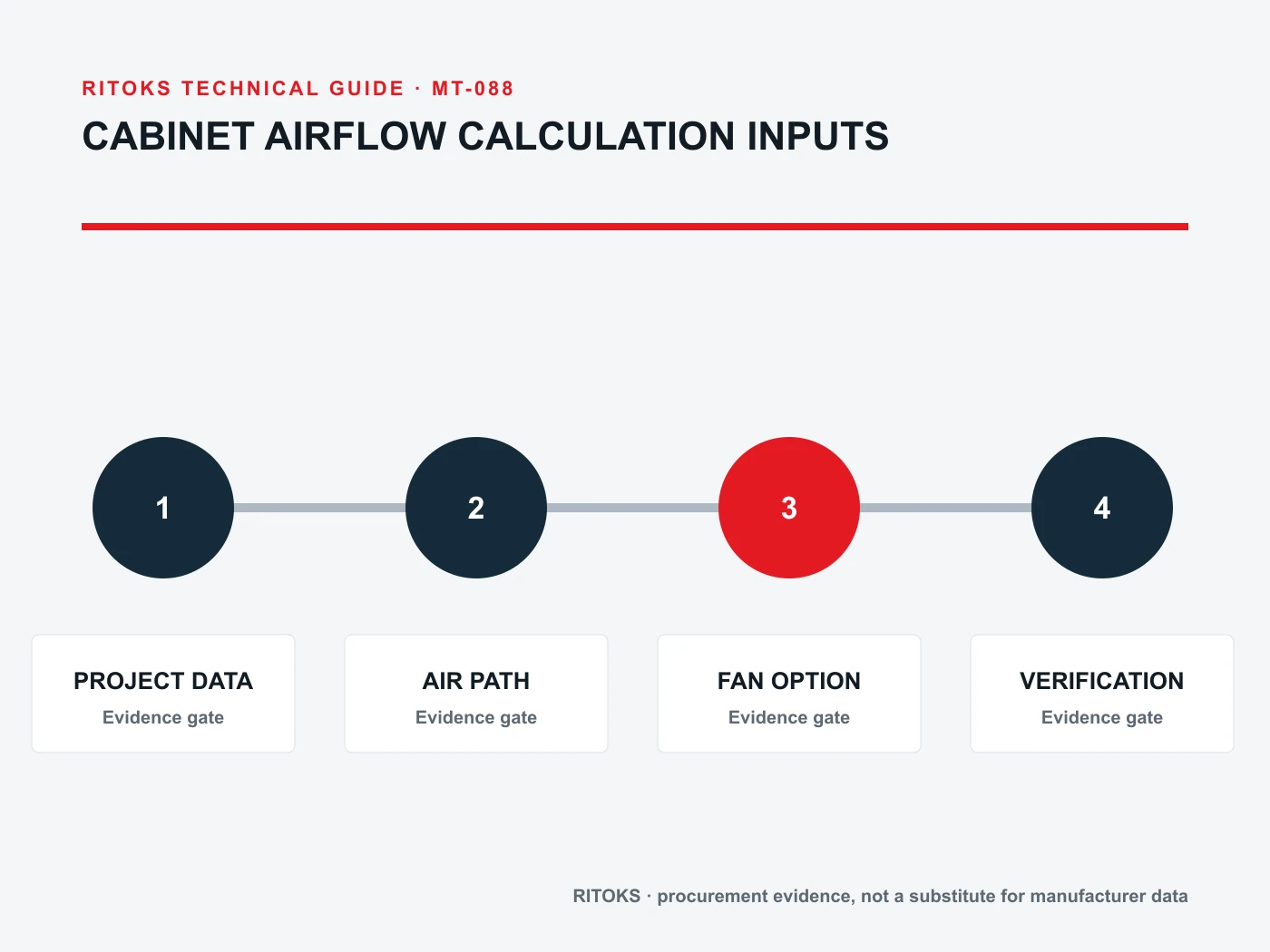
Gebruik voor elke offerte dezelfde projectopdracht. Commerciële voorwaarden, zoals prijs en levertijd, kunnen worden vergeleken zodra de technische omvang is gestandaardiseerd. Beschouw weggelaten accessoires, niet-ondersteunde specificaties of een onopgeloste aanname inzake de bedrading niet als gelijkwaardig aan een gedocumenteerde offerte. Als er een alternatief wordt voorgesteld, vraag dan welke gegevens veranderen en herhaal de betreffende beoordeling.
Controle van de installatie en oplevering
Controleer vóór de installatie of het meegeleverde etiket, de volledige code en de accessoires overeenkomen met het goedgekeurde dossier. Vergelijk de aansluitingen, de montage, de toegang tot de geleiders en de eventuele aangegeven oriëntatie met de exacte instructies. Een product dat er uiterlijk op de goedgekeurde versie lijkt, kan toch een andere elektrische configuratie, bedieningsoptie of testbasis hebben.
Plan een opleveringscontrole die is afgestemd op de daadwerkelijke risico’s van het project. Dit kan onder meer bestaan uit het controleren van de bedrading aan de hand van het goedgekeurde schema, het testen van de werking, het uitvoeren van metingen onder representatieve bedrijfsomstandigheden en het verifiëren van eventuele communicatie- of alarmfuncties. Leg de omstandigheden en resultaten vast. Het opleveringsplan moet worden opgesteld op basis van de toepassing en de door de leverancier verstrekte documentatie, en niet op basis van een algemene checklist.
Checklist voor offerteaanvragen
- Identify the circuit, equipment and location that cabinet ventilation must serve.
- Voeg de systeemtekening en de bedrijfstoestanden toe die de toepassing omschrijven.
- Record heat sources and its source document.
- Record ambient range and its source document.
- Record target condition and its source document.
- Record duty cycle and its source document.
- Confirm the exact-model evidence for inlet filter.
- Confirm the exact-model evidence for flow path.
- Confirm the exact-model evidence for system resistance.
- Confirm the exact-model evidence for hot spots.
- Vraag de volledige bestelcode, accessoires, tekeningen en de versie van het gegevensblad op.
- Vraag naar uitsluitingen, aannames, vervangende oplossingen en onopgeloste technische kwesties.
De offerteaanvraag moet zo concreet zijn dat een leverancier deze kan beantwoorden zonder ontbrekende projectgegevens zelf te moeten invullen. Als een essentieel gegeven nog niet bekend is, geef dit dan aan als een vraag en vermeld wie dit zal vaststellen. Maak van een aanname geen beoordelingscriterium, geen conformiteitsverklaring of een goedgekeurde installatiemethode.
Wat beïnvloedt de beslissing?
A decision can change when the source arrangement, load behavior, environment, installation geometry or required function changes. Revisit the selected cabinet ventilation whenever one of those inputs moves outside the approved brief. Recheck the order code and the exact evidence affected by the change; do not rely on a previous approval for a circuit that now asks the component to do different work.
Houd een beknopte revisiegeschiedenis bij van de projectopdracht, het antwoord van de leverancier en de lijst met goedgekeurde uitzonderingen. Dit overzicht zorgt ervoor dat de afdelingen engineering, inkoop en inbedrijfstelling op basis van dezelfde versie kunnen werken. Dit is met name nuttig wanneer een offerte wordt aangepast, een alternatief wordt aangeboden of het paneelontwerp na de eerste vergelijking verandert.
Vragen die vóór goedkeuring moeten worden opgehelderd
Ask who owns each remaining technical question for the proposed cabinet ventilation. The buyer should confirm the system inputs and installation constraints; the supplier should confirm the exact item, included options and applicable documentation. Put the answer and document revision beside the question. An unanswered point should remain visible in the comparison rather than being converted into an assumed feature.
Wanneer een offerte een alternatief biedt, vraag dan om een schriftelijke toelichting op de gewijzigde schakeling, montage of prestatiebasis. Bekijk eventuele nieuwe tekeningen samen met de projectingenieur en leg vast of de voorgestelde wijziging aanvaardbaar is. Een vervanging is een nieuwe technische beslissing, zelfs als deze commercieel gezien gelijkwaardig lijkt. Dit is met name van belang wanneer meerdere leveranciers vergelijkbare productnamen gebruiken voor verschillende configuraties.
Veelgestelde vragen
Can a free-air rating be used as cabinet airflow?
No. The installed filter and cabinet path create resistance, so review the exact fan curve and system operating point.
Will a larger fan always lower cabinet temperature?
Not necessarily. Ambient conditions, heat load and whether air reaches hot components determine the result.
When should I consider closed-loop cooling?
Review another method when outdoor air cannot meet the target condition or must be kept out of the enclosure.
Relevante RITOKS-pagina’s
Zie voor meer informatie over de productfamilie Behuizing en warmtebeheer. De bijbehorende gepubliceerde productpagina's zijn onder meer Fd Cabinet Filter Fan Electrical Enclosures, Industrial Ac Axial Cooling Fan 60 250mm, 12038 Ac Axial Cooling Fan 110v 220v 380v. Gebruik bij het vergelijken van een voorgesteld artikel hun huidige documenten met de exacte modelgegevens.
Voor een offerte op maat, stuur de projectbeschrijving naar RITOKS aan de hand van de bovenstaande diagrammen en open vragen.