
Enclosure Air Conditioners for Control Cabinets · Technical Explainer
Closed-Loop Enclosure Cooling: What It Means
Understand closed-loop enclosure cooling, its separation from ambient air exchange and the evidence needed before selection. A useful buyer review connects the project requirement to one exact orderable product and preserves the evidence used for approval.
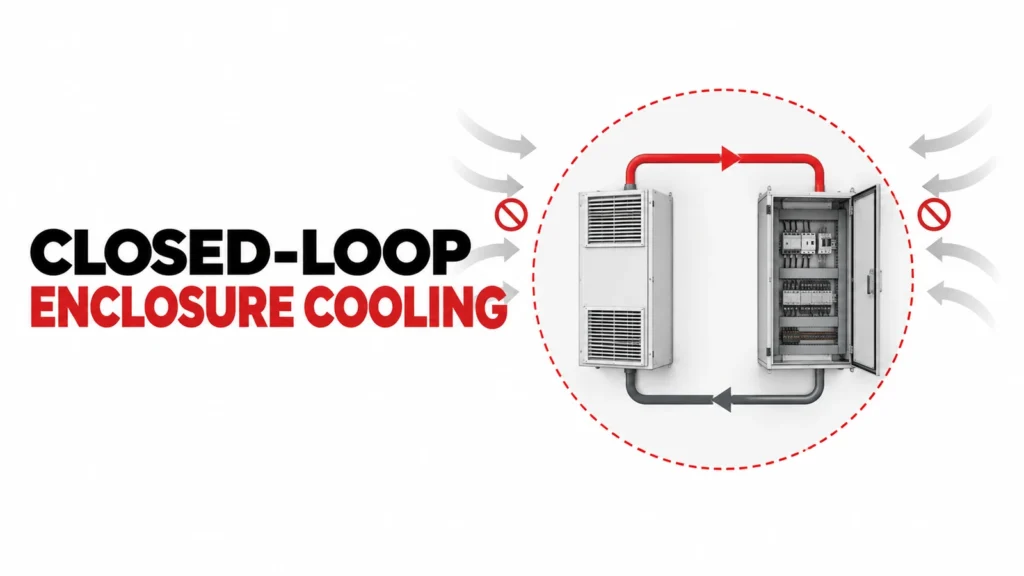
This explainer defines closed-loop enclosure cooling at an architectural level. It does not calculate cooling capacity, promise a sealing or ingress result, or claim that every enclosure air conditioner isolates internal and ambient air in the same way.
Přehled podkladů pro rozhodnutí
| Pole pro recenzi | Kupující musí určit | Důkazy, o které je třeba požádat |
|---|---|---|
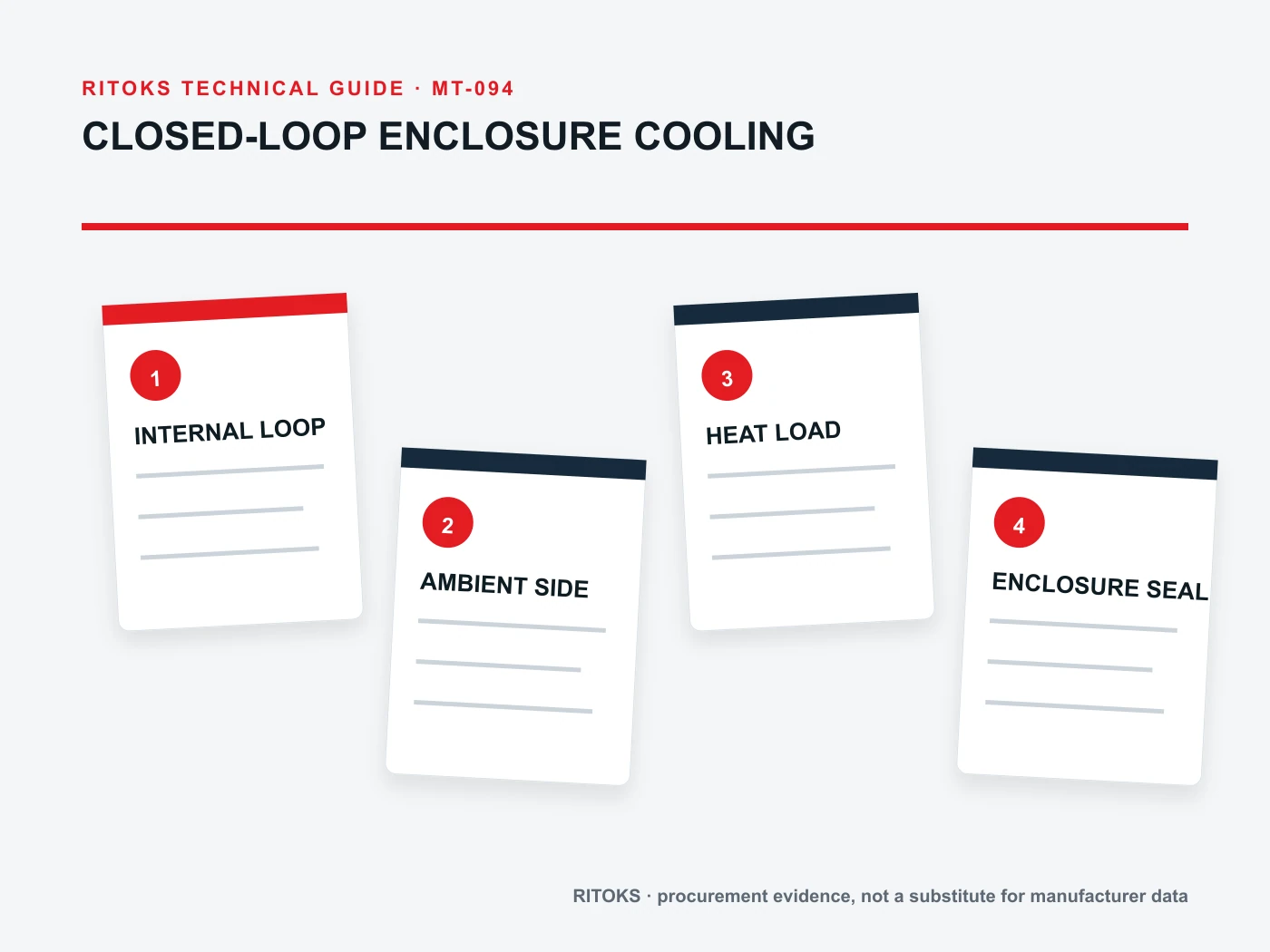
| Internal circuit | Cabinet air recirculation and component temperature objective | System design and equipment documentation |
| External circuit | Ambient-side heat rejection and installation clearance | Exact installation manual |
| Thermal load | Component losses and other heat inputs | Project heat-loss schedule |
| Hranice | Openings, door condition, cable entries and enclosure construction | Enclosure inspection record |
| Životní prostředí | Ambient temperature, contamination, humidity and service access | Site conditions and maintenance plan |
The Loop Refers to Air Separation
Closed-loop enclosure cooling generally describes an architecture in which cabinet air is recirculated through a cooling device while heat is rejected through a separate ambient-side path. The intent is different from bringing outside air directly through the enclosure. The exact construction and separation still depend on the selected equipment.
The phrase does not mean that the entire cabinet is automatically sealed, contamination-proof or moisture-proof. Cable entries, doors, gaskets, drains and installation workmanship remain part of the boundary. Ask what the exact product does and what the complete enclosure achieves.
Why Ambient-Air Ventilation Is Different
A filter fan or open ventilation path exchanges cabinet air with the surrounding environment. That can be effective when ambient air is suitable and the target cabinet temperature can remain above ambient. Closed-loop cooling instead uses a heat-transfer system intended to avoid direct process-air exchange through the cooling circuit.
These architectures should not be compared from airflow and cooling-capacity headlines as if they were equivalent units. Start from the environmental boundary, allowable temperature and heat load, then evaluate the suitable method.
Map the Internal and External Thermal Paths
Inside the cabinet, heat leaves components, mixes into the internal air and reaches the cooling device. On the ambient side, the device rejects that heat to its surroundings. Obstructed internal circulation or inadequate external clearance can undermine the intended performance even when the equipment is correctly rated.
Record equipment placement, hot spots, internal obstructions and the route available for recirculated air. Separately record wall spacing, ambient-air access and rejected-heat effects. The two paths need different installation evidence.
Calculate From Heat Load and Conditions
Cooling selection begins with component losses and other heat inputs, the required internal temperature, ambient conditions and enclosure surface behavior. A cabinet size alone is not a heat-load calculation. Use a documented engineering method and exact product performance data at the relevant conditions.
Do not treat a nominal capacity in a product title as a universal delivered result. Capacity can depend on temperature conditions and installation details. The quotation should show the selection basis and keep all assumptions visible.
Protect the Enclosure Boundary During Installation
A closed-loop concept can be defeated by unmanaged openings, damaged seals or installation details that create unwanted air exchange. Review door gaskets, cable entries, mounting cutouts, drainage and service penetrations as part of the enclosure system.
The cooling-unit drawing should define its mounting interface and required clearances. Any sealing, condensate or drainage provisions must come from the exact installation instructions. Avoid generic field modifications that are not supported by those documents.
Plan Maintenance on Both Sides of the Boundary
Closed-loop equipment still needs inspection and service. Ambient-side surfaces can collect dirt, and internal circulation paths can become obstructed. The maintenance plan should define access, cleaning, alarm response and the conditions that trigger further investigation.
Keep maintenance claims precise. The absence of a direct ventilation filter does not mean maintenance-free operation. Ask the supplier for the exact schedule and preserve it with the cabinet documentation.
Vytvořte soubor důkazů pro přesný model
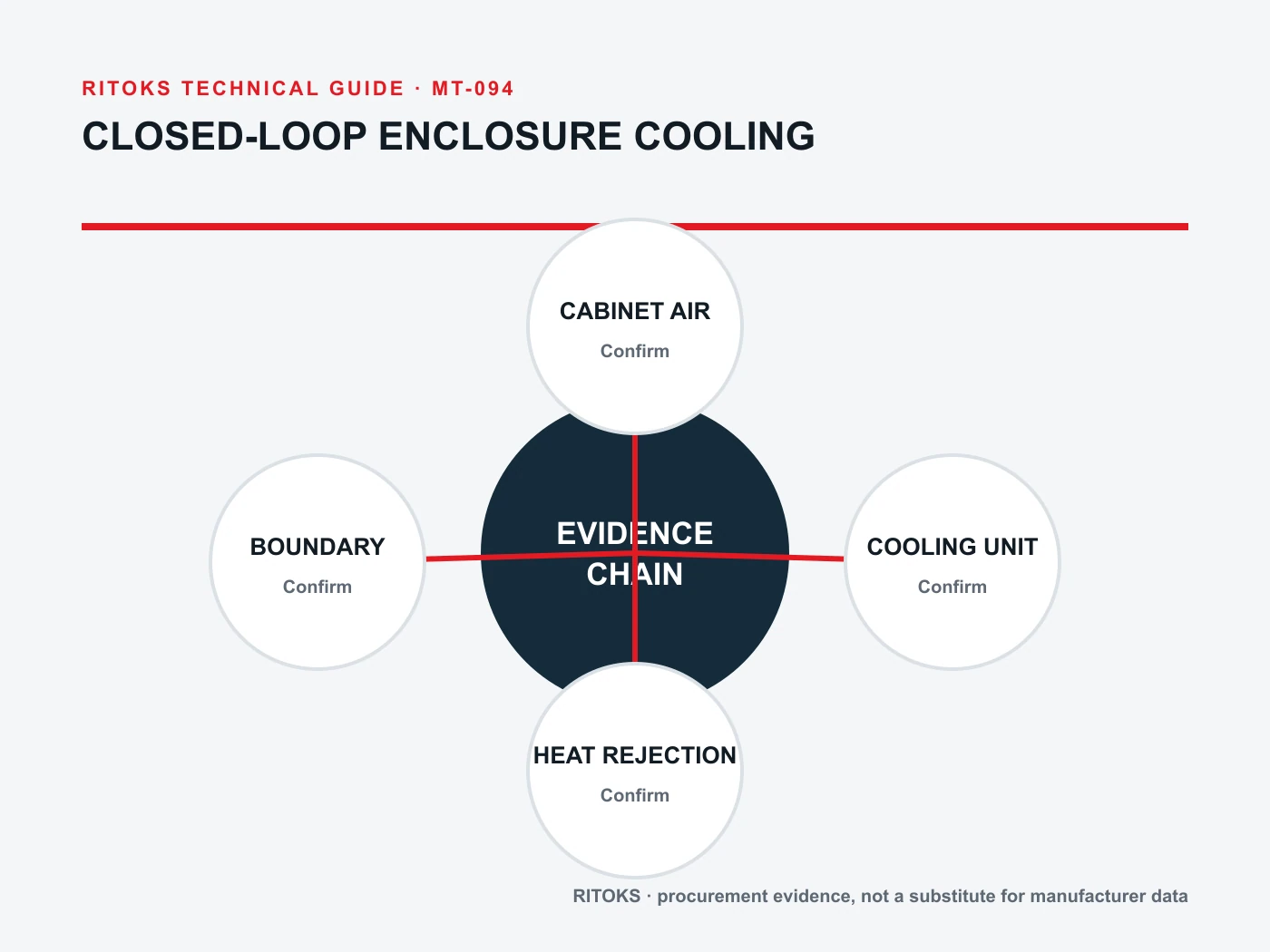
Create one approval record for the proposed Enclosure Air Conditioner order code. Put each project requirement beside the supplier document that answers it. Preserve the exact datasheet, drawing, table, instruction or selection output used, including its revision or retrieval date. A category page can establish family context, but it cannot prove an exact rating, terminal arrangement or system combination.
Zkontrolujte, zda každý schválený popis odpovídá stejné objednávatelné položce. Podobná pouzdra mohou obsahovat odlišné obvody, napájecí zdroje, svorky, příslušenství nebo funkce. Nekombinujte maximální počet kusů z jedné varianty, schéma z jiné a volitelnou funkci z třetí. Nevyplněná pole výslovně označte, aby zůstala viditelná při obchodní kontrole.
Udržujte vstupy projektu oddělené od důkazů o produktu
Projektový tým definuje požadavky na zařízení: zdroj, zatížení, provozní režim, prostředí, ovládací prvky, mechanické limity a požadované funkce. Dodavatel určí konkrétní model klimatizační jednotky pro rozvaděč a doloží jej přesnou dokumentací. Žádná ze stran by neměla vyplňovat mezery v informacích na základě domněnek vycházejících z vnějšího vzhledu, společného názvu produktové řady nebo shodné jmenovité hodnoty.
Během porovnávání nabídek pozastavte platnost záznamu o žádosti. Dojde-li ke změnám v topologii, zdroji, zatížení, prostředí, skříni nebo požadovaném výkonu, vystavte revidovaný záznam a požádejte každého dodavatele o opětovné potvrzení vybraného produktu. V opačném případě by se mohlo stát, že zdánlivě srovnatelné nabídky budou odpovídat odlišným technickým požadavkům.
Časté chyby při zadávání veřejných zakázek
Avoid selecting a Enclosure Air Conditioner from one headline value while the application context remains incomplete. Do not use a circuit, curve, terminal drawing or performance claim from a neighboring model. A product photograph and a family page can support discovery, but neither is exact technical evidence.
Také se vyhněte předpokladu, že je součástí dodávky příslušenství, komunikační funkce, ochranná funkce nebo koordinovaný výsledek, pokud to není uvedeno v nabídce a v dokumentaci k přesnému modelu. Náhradní díl musí splňovat stejné požadavky na topologii, jmenovité hodnoty, způsob montáže a posouzení důkazů jako původní kandidát.
Jak porovnat nabídky dodavatelů
Normalize every Enclosure Air Conditioner offer to the same application record. Keep document revisions, stated conditions, included accessories and open questions beside each value. This makes differences in delivered scope visible and prevents a lower-cost but narrower offer from appearing equivalent to a complete solution.
Přestaňte s porovnáváním, pokud není známý klíčový vstupní údaj aplikace, pokud je uvedený model nejednoznačný, pokud je požadovaná specifikace podložena pouze údajem jiného výrobce nebo objednacím kódem, nebo pokud instalace nespadá do rámce dostupných podkladů. Jedná se o technické mezery, nikoli o redakční detaily.
Kontrola revizí a nahrazení
Give the approved Enclosure Air Conditioner record a revision identifier and keep it with the project file. If the supplier changes the order code, accessory, firmware, drawing or stated operating condition, identify the change before accepting it. A substitution is a new technical proposal even when its price, housing or product-family name looks familiar.
Zopakujte pouze dotčené kontroly, ale nevynechávejte je. Ověřte, zda revidovaný kandidát stále odpovídá zmrazené žádosti, zda k ní patří všechny uvedené dokumenty a zda mají všechny otevřené výjimky svého odpovědného pracovníka. Tento malý krok v rámci řízení změn zabraňuje tomu, aby byl technicky prověřený výběr nahrazen neprověřeným komerčním ekvivalentem.
Pracovní postup při rozhodování
- Před výběrem katalogového kódu pozastavte aplikaci a systémový záznam.
- Určete přesnou funkci a každé rozhraní, u kterého je třeba předložit důkaz.
- Žádáme o zaslání jednoho kompletního objednacího kódu spolu s aktuálním technickým listem a výkresy.
- Každý požadavek projektu přiřaďte ke konkrétnímu prohlášení výrobce.
- Zaznamenávejte odchylky, příslušenství, revize dokumentů a nevyřešené otázky.
- Přezkum je třeba opakovat pokaždé, když dojde ke změně žádosti nebo navrhovaného výrobku.
Use this workflow as a procurement and evidence discipline. It does not replace qualified design, installation instructions or the responsible engineer's approval for the Enclosure Air Conditioner application.
Kontrolní seznam pro přípravu žádosti o nabídku
A practical closed loop enclosure cooling should be concise enough for a supplier to answer and complete enough to prevent silent assumptions. Identify unknown values as questions rather than allowing them to become undocumented selections.
- Internal circuit: Cabinet air recirculation and component temperature objective.
- External circuit: Ambient-side heat rejection and installation clearance.
- Thermal load: Component losses and other heat inputs.
- Boundary: Openings, door condition, cable entries and enclosure construction.
- Environment: Ambient temperature, contamination, humidity and service access.
- Přesný kód výrobku, dodávané příslušenství a revize dokumentace
- Množství, místo určení, požadovaná povolení a obchodní rozsah
Vyžádejte si přesný rozsah jakýchkoli tvrzení týkajících se klasifikace, kompatibility, koordinace nebo výkonu. Uveďte množství a místo určení až za technickými údaji, aby obchodní podmínky nezastíraly nevyřešené technické otázky.
Často kladené otázky
Does closed-loop cooling make an enclosure airtight?
No. The complete enclosure boundary and installation details must be evaluated separately.
Can closed-loop cooling reduce temperature below ambient?
Some architectures may, but the exact capability must be verified from product data at the stated conditions.
Is a filter fan a closed-loop device?
No. A filter-fan system normally exchanges enclosure air with ambient air.
Související produkty a pokyny společnosti RITOKS
Tyto odkazy slouží pouze k uvedení do kontextu produktové řady. Kontextový odkaz neznamená zaměnitelnost, kompatibilitu ani schválenou systémovou kombinaci.
Produktová kategorie: Klimatizační jednotky do uzavřených prostorů
Klimatizační jednotky EP-A pro vnitřní použití
Technické odkazy
Tyto zdroje od výrobců slouží pouze k podpoře obecných technických principů popsaných níže. Technické parametry jejich výrobků, schémata zapojení, certifikace a výsledky koordinace se nevztahují na výrobky společnosti RITOKS.
Rittal, Katalog technických systémů: Chlazení okolním vzduchem
Supports enclosure heat-load, temperature-difference and air-exchange concepts. Rittal formulas and product values apply only under their stated conditions.
Rittal, projektování klimatizačních systémů RiTherm
Supports treating enclosure climate control as a documented heat-load and environmental calculation. It does not size a RITOKS product.
Požádat o posouzení konkrétního modelu
Požadavky na objednávku, konkrétní dotazy k dokumentaci, množství a místo určení zašlete prostřednictvím kontaktního formuláře společnosti RITOKS. Žádost o cenovou nabídku vyžaduje posouzení konkrétního modelu; tento průvodce neschvaluje žádné obvody, instalace ani automatické náhrady.