
Power Module Heatsinks · Comparison
Natural-Convection vs Forced-Air Heatsinks for Power Modules
Natural-Convection vs Forced-Air Heatsinks for Power Modules starts with the system question: When does the thermal design require airflow rather than passive cooling? A useful selection brief connects the equipment duty, installation and receiving system to a specific orderable product. The article below separates project inputs from product evidence so that a familiar product name does not quietly become a technical approval.
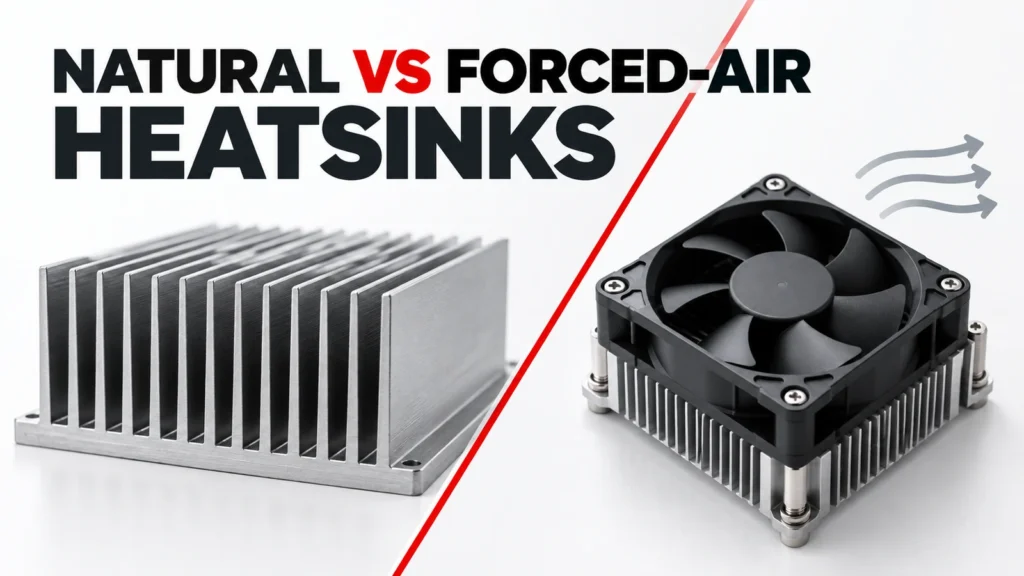
This comparison explains the thermal design evidence required to choose passive or forced-air heatsinking. It gives no universal heat dissipation rating, airflow value, thermal resistance or fan lifetime for a product without exact test conditions.
Entscheidungsgrundlagen auf einen Blick
| Bewertungsbereich | Projektbeitrag | Anzufordernde Nachweise |
|---|---|---|
| DEVICE LOSS | Den tatsächlichen Betriebszustand und die Systemgrenzen definieren | Genehmigte Systemzeichnung oder Betriebsprotokoll |
| INTERFACE | Bezeichnung der Schnittstelle, Geometrie oder erwartete Funktionsweise | Genaue Geräte- oder Produktdokumentation |
| HEATSINK | Zustand der Umgebung und der Aufstellungsbedingungen | Lage- oder Plattenzeichnung |
| AMBIENT | Beschreiben Sie die Service- und Abnahmeanforderungen | Genaue Anweisungen und Testplan |
Two cooling methods, one thermal obligation
A natural-convection heatsink transfers heat to surrounding air without a dedicated fan moving air through its fins. A forced-air heatsink uses directed airflow to change that transfer condition. The practical choice is not determined by appearance or the word “power” in a module description. It depends on verified semiconductor loss, allowable temperatures, ambient conditions, mounting and the entire thermal path.
Both approaches can be appropriate in industrial equipment. Passive cooling avoids dependence on a fan, but often requires a compatible installation orientation, space and ambient. Forced air can support a different heat-transfer condition, but introduces airflow, power, acoustic, filtration, service and failure-state questions. The exact device data decides whether either approach has sufficient margin.
Calculate losses before comparing fin shapes
The starting input is the power module’s heat dissipation under representative operating states. Obtain loss information for the exact semiconductor order code and the intended electrical duty. A nameplate current or visually large package does not equal the heat that must leave the assembly. Include continuous and relevant transient conditions in the project brief.
Document whether the module is an SCR, rectifier, diode or another device, because conduction and switching behavior may differ. If the loss model is uncertain, do not backfill a generic wattage. Identify the missing curve or supplier calculation and treat the heatsink selection as provisional until it is supplied.
Trace the complete thermal path
Heat moves from junction through the device package, mounting interface and heatsink into the surrounding air. Each boundary needs evidence. The mechanical contact, approved interface material, mounting pressure and surface condition affect the result, as does the airflow or convection environment at the fins. A quoted heatsink value without its test conditions is not transferable to every assembly.
Ask for the exact thermal data, mounting instructions and a drawing that shows contact area and clearances. Compare the semiconductor’s allowable temperature with the proposed operating states using the supplier’s method. Reserve a prototype temperature check for conditions that are difficult to model, such as a densely populated enclosure or uncertain local air recirculation.
Natural convection needs a real installation context
Passive performance depends on how air can enter, warm and leave the fin channels. Orientation, vertical clearance, adjacent equipment and enclosure temperature may change the result materially. A bench test in open air may not describe a crowded cabinet with nearby heat sources. Define the actual mounting plane and free space before accepting a catalog thermal curve.
The system should also account for warm-start and high-ambient conditions. The passive option may be attractive where fan maintenance is difficult, but simplicity does not waive a thermal check. If the only available data describes a different orientation or ambient, request an applicable test or engineering review.
Forced air is an operating system, not an accessory
A fan rating quoted in free air does not reveal the flow through a heatsink inside a cabinet. Filters, grilles, duct turns, neighboring components and air recirculation can restrict the actual path. Request the fan curve and heatsink performance under documented airflow conditions, then evaluate the assembled path rather than adding nominal component values.
Decide who monitors fan operation and what the equipment does when airflow is lost. A forced-air design can be valid only if its power supply, wiring, maintenance access, replacement plan and alarm behavior are accepted by the project. Include these controls in the quotation and assembly test plan.
Compare reliability and service honestly
A passive design can reduce moving parts but may use more volume and still require clean air passages. A forced-air design can fit a different thermal envelope but needs fan and filter inspection. Dust accumulation affects both fin exposure and the airflow system. State the intended service interval as a project decision, not as an invented universal product property.
Procurement should compare delivered scope: heatsink extrusion, machining, mounting hardware, interface material, fan, guard, filter and cables. Two quotes for “the same heatsink” may include different work. Normalize those inclusions before comparing lead time or price.
Confirm with an assembly-level temperature test
A calculation screens candidates; a representative assembly test closes uncertainty. Measure the relevant points under the operating states and ambient conditions specified by the project engineer, and record how the result maps to the exact device limit. Do not substitute an enclosure air reading for a junction calculation without a supported method.
The test record should identify the exact semiconductor, heatsink, fan configuration if used, mounting material, orientation and enclosure state. A later change to any of these inputs can invalidate the result. Keep the approved thermal configuration with the product build documentation.
Erstellen Sie eine Beweisdatei nach dem Exaktmodell
For the proposed Power Module Heatsink, create one approval record with the complete order code, the exact datasheet, the relevant drawing, installation instructions and any curve or test report used for the decision. Date each file or record its revision. A product-family page is useful for discovery, but it does not prove that a particular configuration includes an optional feature or meets a system condition.
Vergleichen Sie jede Anforderung mit den Nachweisen für denselben bestellbaren Artikel. Kombinieren Sie nicht den maximalen Wert einer Variante mit einem Schaltplan, einer Zubehörliste oder einer Temperaturkurve einer anderen Variante. Tragen Sie ungeklärte Felder in eine gut sichtbare Klärungsspalte ein. Wenn ein Lieferant einen Ersatz vorschlägt, wiederholen Sie die betreffende Überprüfung, bevor Sie dessen technische Gleichwertigkeit bestätigen.
Projekt-Eingaben von Lieferantenabrechnungen trennen
Das Projektteam ist für die Anwendungsdaten verantwortlich: Quelle und Last, Betriebszustände, Umgebung, Einbau, Steuerungen, Wartung und Abnahmekriterien. Der Lieferant ist für den vorgeschlagenen Bestellcode und die dazugehörigen Gerätedokumente verantwortlich. Keine der beiden Seiten sollte Lücken durch Schlussfolgerungen aufgrund des Aussehens oder eines bekannten Familiennamens füllen. Eine sinnvolle Antwort kann lauten: “Daten noch nicht verfügbar”, vorausgesetzt, für den fehlenden Punkt gibt es einen Verantwortlichen und einen Termin für die Fertigstellung.
Halten Sie diese Daten fest, während die Angebote verglichen werden. Sollten sich der Betriebszweck, der Schaltschrank, die Stromquelle, der Zähler, der Motor oder die Schutzarchitektur ändern, erstellen Sie ein überarbeitetes Eingabeblatt und bitten Sie jeden Lieferanten, seinen Vorschlag erneut zu bestätigen. Dadurch wird verhindert, dass ein frühes Angebot als Genehmigung für eine spätere Auslegung gewertet wird.
So vergleichen Sie Angebote von Lieferanten
| Angebotsartikel | Was soll verglichen werden? | Nachweis der Genehmigung |
|---|---|---|
| Bestellbarer Umfang | Kompletter Code und mitgeliefertes Zubehör | Genaues Angebot und Stückliste |
| Elektrische Passform | Alle relevanten Betriebszustände | Dokument mit genauen Nennwerten, Schaltplänen oder Kennlinien |
| Formschluss | Montage, Anschlüsse und Zugang | Zeichnungs- und Montageanleitung |
| Serviceplan | Verfahren zur Überprüfung und zum Austausch | Pflegehinweise |
| Offene Posten | Annahmen, Ausschlüsse und Ausnahmen | Register für schriftliche Klarstellungen |
Normalize each Power Module Heatsink offer to the same application record. A shorter lead time or lower price is meaningful only after the technical scope is comparable. Record whether each supplier included the required accessories, documents and support for commissioning. Keep exceptions explicit, especially when the candidate needs a change to the panel or control design.
Kontrollpunkte bei der Beschaffung und Inbetriebnahme
- Bestätigen Sie die Systemgrenzen, Betriebszustände und Abnahmekriterien.
- Einen vollständigen Bestellcode anhand der Dokumente zum genauen Modell überprüfen.
- Behebung von Ausnahmen in den Bereichen Elektrik, Mechanik, Umwelt und Service.
- Vergleichen Sie den gelieferten Umfang und die Dokumentenänderungen zwischen den verschiedenen Angeboten.
- Prüfen Sie die gelieferte Ware anhand des genehmigten Datensatzes.
- Testen Sie die fertige Baugruppe gemäß dem für das Projekt genehmigten Verfahren.
Bei der Wareneingangskontrolle sind das gelieferte Etikett, die Anschlüsse, das mitgelieferte Zubehör und die Unterlagen mit der genehmigten Bestellung abzugleichen. Ein Ersatz durch ein Produkt derselben Produktfamilie ist nicht automatisch zulässig. Bei der Inbetriebnahme sind die anwendungsabhängigen Funktionen zu überprüfen, die sich nicht allein aus der Produktdokumentation ableiten lassen. Der Prüfplan sollte repräsentative Zustände und Abnahmekriterien benennen, ohne allgemeingültige Grenzwerte festzulegen.
Checkliste zur Vorbereitung einer Angebotsanfrage
A useful request for quotation on natural convection vs forced air heatsink is concise but complete. Ask for the exact orderable configuration and list unknown values as questions. Do not let the sales description silently answer a technical question that belongs to a calculation, a drawing or a test.
- DEVICE LOSS
- INTERFACE
- HEATSINK
- AMBIENT
- FAN CURVE
- RESTRICTION
- FAILURE MODE
- TEST
- Gültige Dokumentversionen
- Menge, Bestimmungsort und Lieferumfang
Fordern Sie den Lieferanten auf, Ausschlüsse, Annahmen und optionale Posten gesondert aufzuführen. Bewahren Sie das Protokoll zur technischen Klärung zusammen mit dem Angebot auf, damit die Beschaffung und die Technik denselben Umfang prüfen können. Falls eine entscheidende Angabe weiterhin fehlt, kann der Anbieter zwar wirtschaftlich interessant bleiben, seine technische Zulassung bleibt jedoch offen.
Häufig gestellte Fragen
Can a Power Module Heatsink be chosen from one headline rating?
Nein. Die Anwendung, die genaue Konfiguration sowie die relevanten elektrischen, mechanischen, thermischen und umgebungsbezogenen Bedingungen müssen gemeinsam geprüft werden. Ein Katalogtitel ist ein Ausgangspunkt für die Recherche, jedoch kein vollständiger Zulassungsnachweis.
Beweist eine Familienseite eine direkte Verbindung oder eine Nebenverbindung?
Nein. Verwenden Sie die vorgeschlagene Bestellnummer sowie die aktuelle Zeichnung, das Datenblatt und die Montageanleitung. Optionale Ausstattungsmerkmale oder alternative Anschlussanordnungen können innerhalb einer Produktfamilie variieren.
Was passiert, wenn der Lieferant einen der erforderlichen Werte nicht angeben kann?
Kennzeichnen Sie den Wert als ungeklärt, legen Sie fest, wer ihn ermitteln soll, und setzen Sie die betreffende Entscheidung vorübergehend aus. Wandeln Sie eine Annahme nicht einfach deshalb in eine verifizierte Aussage um, weil ein Kauftermin näher rückt.
Wo soll die Rezension fortgesetzt werden?
Durchsuchen Sie die Power Module Heatsink category für die verfügbare Produktfamilie, dann überprüfen Sie die Seite mit ähnlichen Produkten als möglichen Ausgangspunkt. Auf diesen Seiten wird der Einsatzzweck genannt; die genauen Musterdokumente entscheiden über die Eignung der Anwendung. Für einen projektspezifischen Vergleich senden Sie bitte die Systemdaten und offenen Fragen über das RITOKS-Anfrageseite.
Sollte sich nach Prüfung der Fakten herausstellen, dass ein anderes Gerät oder Verfahren besser geeignet ist, überarbeiten Sie das Lastenheft, bevor Sie einen Austausch beantragen. Verweisen Sie in den Unterlagen stets auf die endgültige Schaltung und Installation und nicht nur auf die Produktfamilie, die ursprünglich Ihre Aufmerksamkeit erregt hat.