
Power Module Heatsinks · Comparison
Natural-Convection vs Forced-Air Heatsinks for Power Modules
Natural-Convection vs Forced-Air Heatsinks for Power Modules starts with the system question: When does the thermal design require airflow rather than passive cooling? A useful selection brief connects the equipment duty, installation and receiving system to a specific orderable product. The article below separates project inputs from product evidence so that a familiar product name does not quietly become a technical approval.
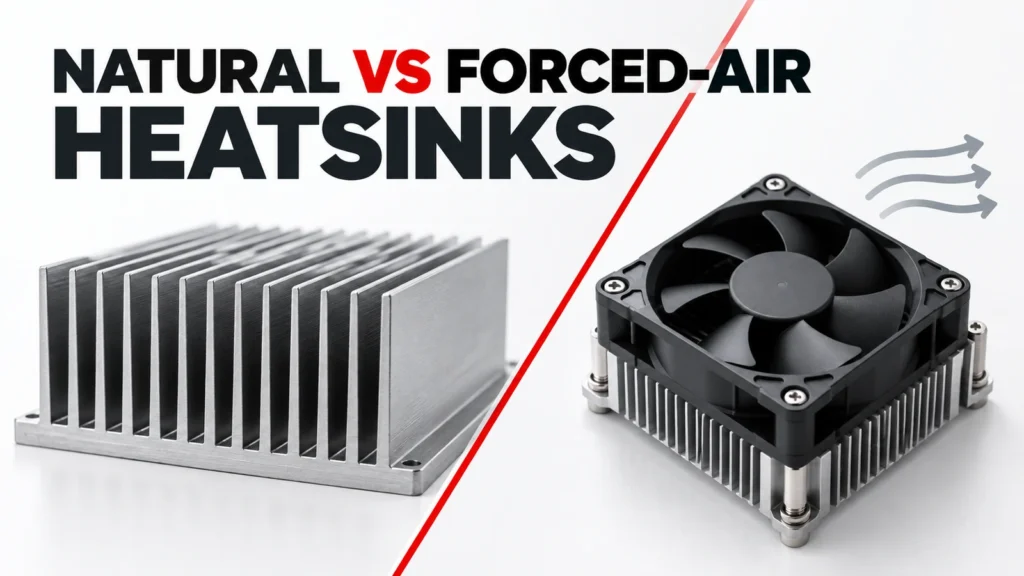
This comparison explains the thermal design evidence required to choose passive or forced-air heatsinking. It gives no universal heat dissipation rating, airflow value, thermal resistance or fan lifetime for a product without exact test conditions.
Краткий обзор исходных данных для принятия решений
| Обзор области | Входные данные проекта | Доказательства, которые необходимо запросить |
|---|---|---|
| DEVICE LOSS | Определить фактическое рабочее состояние и границы системы | Утвержденный системный чертеж или технологическая карта |
| INTERFACE | Назовите интерфейс, геометрию или ожидания в отношении элементов управления | Точная документация по оборудованию или продукции |
| HEATSINK | Состояние окружающей среды и условия установки | Чертеж объекта или панели |
| AMBIENT | Опишите требования к обслуживанию и приемке | Подробные инструкции и план тестирования |
Two cooling methods, one thermal obligation
A natural-convection heatsink transfers heat to surrounding air without a dedicated fan moving air through its fins. A forced-air heatsink uses directed airflow to change that transfer condition. The practical choice is not determined by appearance or the word “power” in a module description. It depends on verified semiconductor loss, allowable temperatures, ambient conditions, mounting and the entire thermal path.
Both approaches can be appropriate in industrial equipment. Passive cooling avoids dependence on a fan, but often requires a compatible installation orientation, space and ambient. Forced air can support a different heat-transfer condition, but introduces airflow, power, acoustic, filtration, service and failure-state questions. The exact device data decides whether either approach has sufficient margin.
Calculate losses before comparing fin shapes
The starting input is the power module’s heat dissipation under representative operating states. Obtain loss information for the exact semiconductor order code and the intended electrical duty. A nameplate current or visually large package does not equal the heat that must leave the assembly. Include continuous and relevant transient conditions in the project brief.
Document whether the module is an SCR, rectifier, diode or another device, because conduction and switching behavior may differ. If the loss model is uncertain, do not backfill a generic wattage. Identify the missing curve or supplier calculation and treat the heatsink selection as provisional until it is supplied.
Trace the complete thermal path
Heat moves from junction through the device package, mounting interface and heatsink into the surrounding air. Each boundary needs evidence. The mechanical contact, approved interface material, mounting pressure and surface condition affect the result, as does the airflow or convection environment at the fins. A quoted heatsink value without its test conditions is not transferable to every assembly.
Ask for the exact thermal data, mounting instructions and a drawing that shows contact area and clearances. Compare the semiconductor’s allowable temperature with the proposed operating states using the supplier’s method. Reserve a prototype temperature check for conditions that are difficult to model, such as a densely populated enclosure or uncertain local air recirculation.
Natural convection needs a real installation context
Passive performance depends on how air can enter, warm and leave the fin channels. Orientation, vertical clearance, adjacent equipment and enclosure temperature may change the result materially. A bench test in open air may not describe a crowded cabinet with nearby heat sources. Define the actual mounting plane and free space before accepting a catalog thermal curve.
The system should also account for warm-start and high-ambient conditions. The passive option may be attractive where fan maintenance is difficult, but simplicity does not waive a thermal check. If the only available data describes a different orientation or ambient, request an applicable test or engineering review.
Forced air is an operating system, not an accessory
A fan rating quoted in free air does not reveal the flow through a heatsink inside a cabinet. Filters, grilles, duct turns, neighboring components and air recirculation can restrict the actual path. Request the fan curve and heatsink performance under documented airflow conditions, then evaluate the assembled path rather than adding nominal component values.
Decide who monitors fan operation and what the equipment does when airflow is lost. A forced-air design can be valid only if its power supply, wiring, maintenance access, replacement plan and alarm behavior are accepted by the project. Include these controls in the quotation and assembly test plan.
Compare reliability and service honestly
A passive design can reduce moving parts but may use more volume and still require clean air passages. A forced-air design can fit a different thermal envelope but needs fan and filter inspection. Dust accumulation affects both fin exposure and the airflow system. State the intended service interval as a project decision, not as an invented universal product property.
Procurement should compare delivered scope: heatsink extrusion, machining, mounting hardware, interface material, fan, guard, filter and cables. Two quotes for “the same heatsink” may include different work. Normalize those inclusions before comparing lead time or price.
Confirm with an assembly-level temperature test
A calculation screens candidates; a representative assembly test closes uncertainty. Measure the relevant points under the operating states and ambient conditions specified by the project engineer, and record how the result maps to the exact device limit. Do not substitute an enclosure air reading for a junction calculation without a supported method.
The test record should identify the exact semiconductor, heatsink, fan configuration if used, mounting material, orientation and enclosure state. A later change to any of these inputs can invalidate the result. Keep the approved thermal configuration with the product build documentation.
Создать файл доказательств на основе точной модели
For the proposed Power Module Heatsink, create one approval record with the complete order code, the exact datasheet, the relevant drawing, installation instructions and any curve or test report used for the decision. Date each file or record its revision. A product-family page is useful for discovery, but it does not prove that a particular configuration includes an optional feature or meets a system condition.
Сравните каждое требование с подтверждающими данными по тому же заказываемому изделию. Не сочетайте максимальное значение для данной серии, указанное для одного варианта, со схемой соединений, перечнем принадлежностей или тепловой кривой другого варианта. Незаполненные поля поместите в заметную колонку для уточнений. Если поставщик предлагает замену, повторите соответствующую проверку перед утверждением её технической эквивалентности.
Раздельно вести учет входящих данных по проекту и счетов-фактур поставщиков
Команда проекта несет ответственность за документацию по приложению: данные о источнике и нагрузке, рабочие состояния, среду эксплуатации, монтаж, средства управления, а также критерии обслуживания и приемки. Поставщик несет ответственность за предлагаемый код заказа и сопутствующую документацию по устройству. Ни одна из сторон не должна восполнять пробелы, делая выводы на основании внешнего вида или знакомого названия семейства. Допустимым ответом может быть “данные пока отсутствуют”, при условии, что у отсутствующего элемента есть ответственное лицо и установлен срок завершения.
Приостановите действие этой записи на время сравнения предложений. В случае изменения режима эксплуатации, шкафа, источника питания, измерительного прибора, двигателя или схемы защиты выпустите пересмотренный лист технических требований и попросите каждого поставщика вновь подтвердить свой вариант. Это позволит избежать ситуации, при которой раннее ценовое предложение будет рассматриваться как одобрение более позднего проекта.
Как сравнивать предложения поставщиков
| Предложение | Что сравнивать | Доказательства утверждения |
|---|---|---|
| Область видимости оператора «order» | Полный комплект и входящие в него аксессуары | Точная смета и спецификация материалов |
| Электромонтаж | Все возможные рабочие режимы | Документ с точными рейтингами, схемами или кривыми |
| Механическая посадка | Крепление, клеммы и доступ | Инструкции по сборке и установке |
| План обслуживания | Метод проверки и замены | Инструкции по техническому обслуживанию |
| Незавершенные вопросы | Допущения, исключения и отступления | Реестр письменных разъяснений |
Normalize each Power Module Heatsink offer to the same application record. A shorter lead time or lower price is meaningful only after the technical scope is comparable. Record whether each supplier included the required accessories, documents and support for commissioning. Keep exceptions explicit, especially when the candidate needs a change to the panel or control design.
Контрольные точки при закупке и вводе в эксплуатацию
- Подтвердите границы системы, рабочие состояния и критерии приемки.
- Сверьте один полный код заказа с документацией по конкретной модели.
- Устранять неисправности электрического, механического и экологического характера, а также неисправности, связанные с обслуживанием.
- Сравните объем поставки и изменения в документации по различным предложениям.
- Сравните полученный товар с утвержденной спецификацией.
- Проведите испытания готовой сборки в соответствии с утвержденной процедурой проекта.
При входном контроле необходимо проверить соответствие поставленной этикетки, клемм, прилагаемых принадлежностей и документов утвержденному заказу. Замена на изделие того же семейства не допускается автоматически. При вводе в эксплуатацию следует проверить функции, зависящие от конкретного применения, которые невозможно установить, опираясь исключительно на техническую документацию по компонентам. В плане испытаний должны быть указаны типичные рабочие режимы и критерии приемки без установления универсальных предельных значений.
Контрольный список по подготовке запроса предложений
A useful request for quotation on natural convection vs forced air heatsink is concise but complete. Ask for the exact orderable configuration and list unknown values as questions. Do not let the sales description silently answer a technical question that belongs to a calculation, a drawing or a test.
- DEVICE LOSS
- INTERFACE
- HEATSINK
- AMBIENT
- FAN CURVE
- RESTRICTION
- FAILURE MODE
- TEST
- Применимые версии документа
- Количество, пункт назначения и объем поставки
Попросите поставщика отдельно указать исключения, допущения и опциональные позиции. Сохраняйте протокол технических разъяснений вместе с коммерческим предложением, чтобы специалисты по закупкам и инженеры рассматривали один и тот же объем работ. Если по-прежнему отсутствует какой-либо важный элемент, кандидат может оставаться коммерчески привлекательным, но вопрос о его техническом одобрении останется открытым.
Часто задаваемые вопросы
Can a Power Module Heatsink be chosen from one headline rating?
Нет. Необходимо комплексно рассмотреть заявку, конкретную конфигурацию, а также соответствующие электрические, механические, тепловые и экологические условия. Название каталога является отправной точкой для изучения, а не полным документом об утверждении.
Доказывает ли семейная страница наличие точной связи или соучастия?
Нет. Используйте предложенный код заказа, а также актуальный чертеж, техническое описание и инструкции по монтажу. Дополнительные функции или альтернативные варианты расположения клемм могут различаться в пределах одной серии.
Что делать, если поставщик не может предоставить одно из требуемых значений?
Пометьте данное значение как «неустановленное», определите, кто его получит, и приостановите принятие соответствующего решения. Не следует превращать предположение в подтвержденное утверждение только потому, что приближается дата покупки.
Где продолжить обзор
Просмотреть Power Module Heatsink category для имеющегося семейства продуктов, после чего ознакомьтесь с страница со связанными товарами в качестве ориентировочной отправной точки. На этих страницах указан коммерческий направление применения; о применимости решения решают конкретные типовые документы. Для сравнения с учетом особенностей конкретного проекта отправьте исходные данные системы и открытые вопросы через Страница запросов RITOKS.
Если после анализа имеющихся данных станет очевидно, что другое устройство или метод подходит лучше, внесите изменения в техническое задание, прежде чем запрашивать замену. Убедитесь, что документация соответствует окончательной схеме и установке, а не только семейству продуктов, которое первоначально привлекло внимание.